Click on image to open full size.


Patrick Swift (1927-1983)
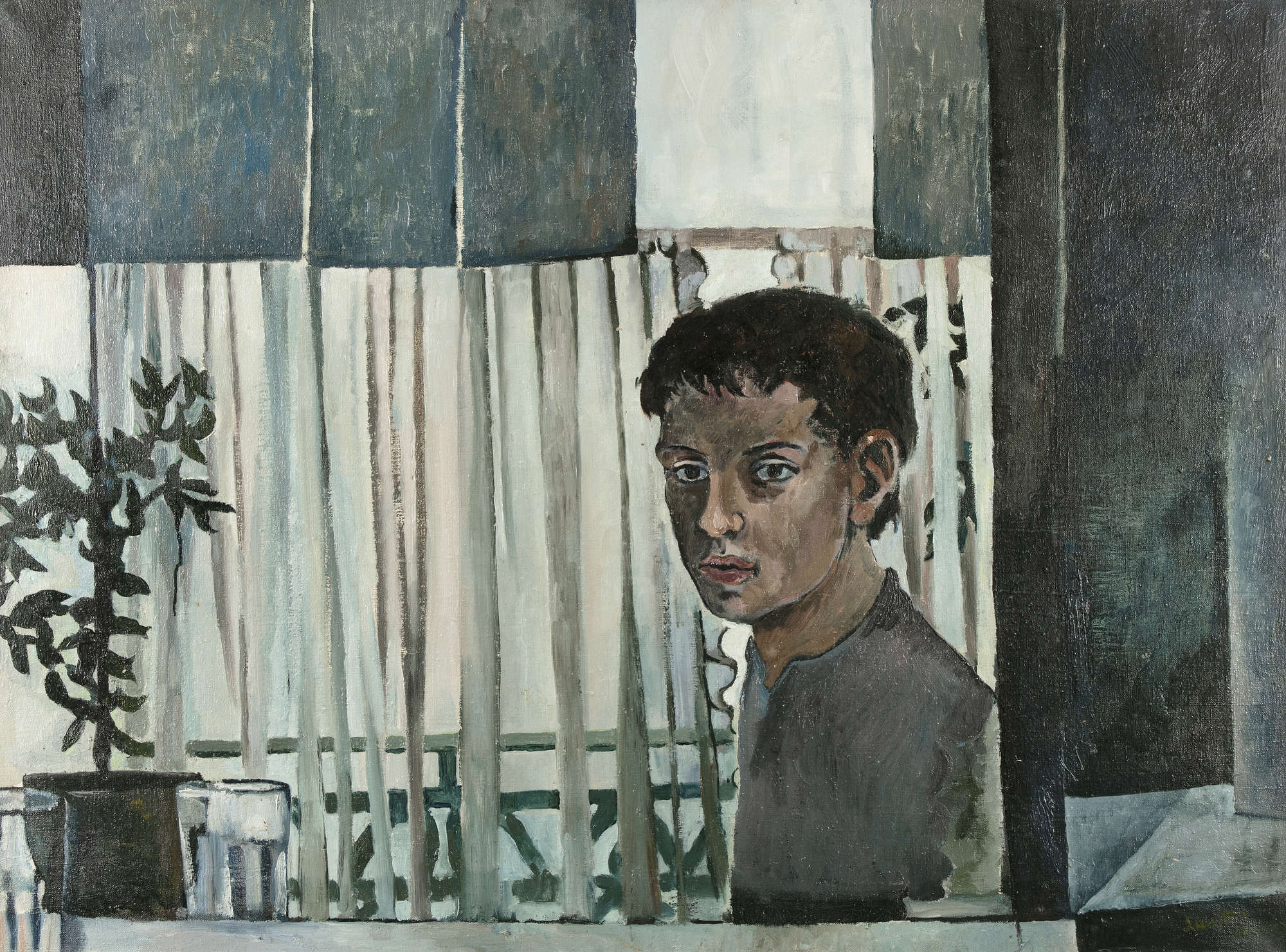
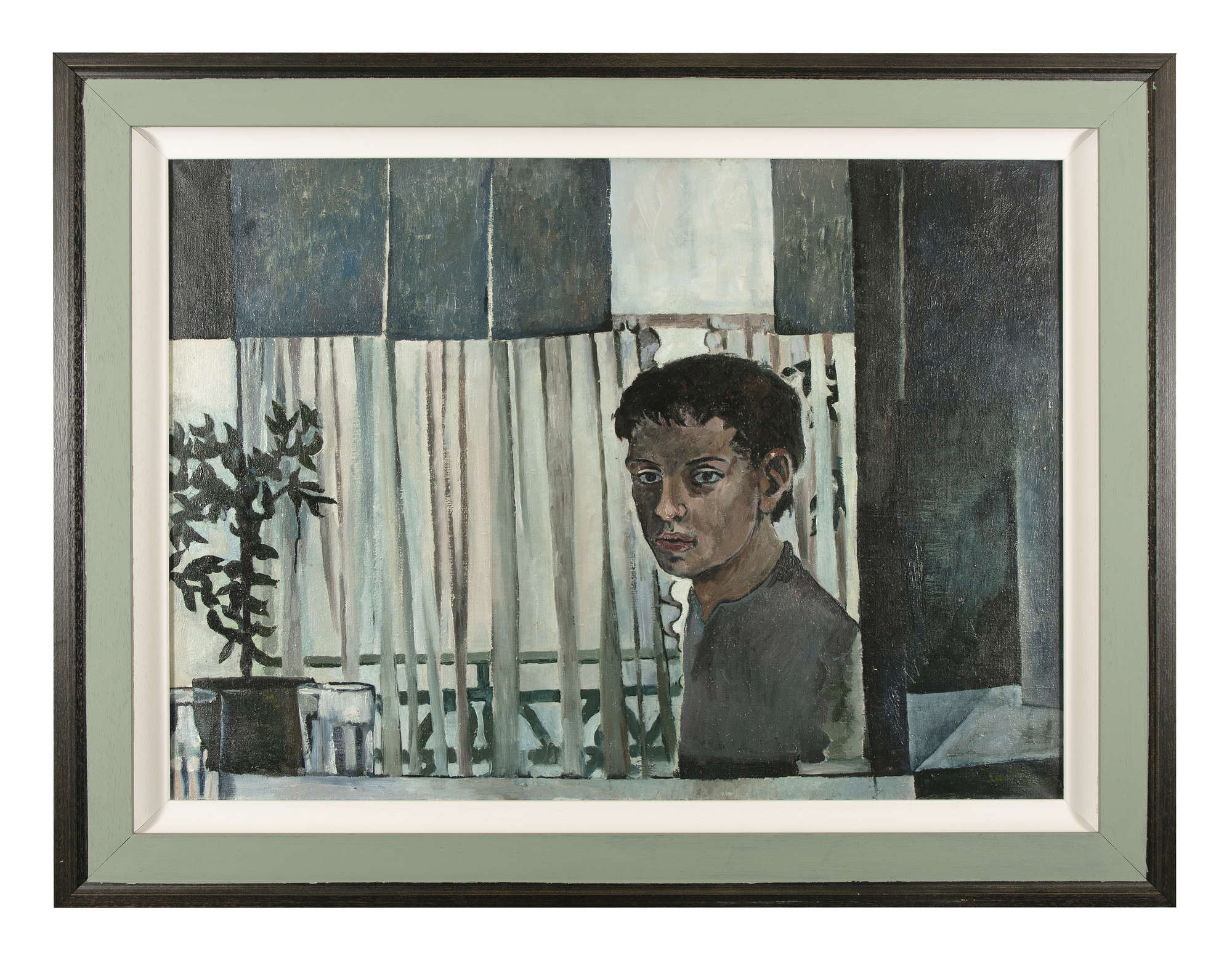
Portrait of Lucian Freud in Patrick Swift's Hatch Street Studio
Oil on canvas, 69 x 94cm (27¼ x 37'')
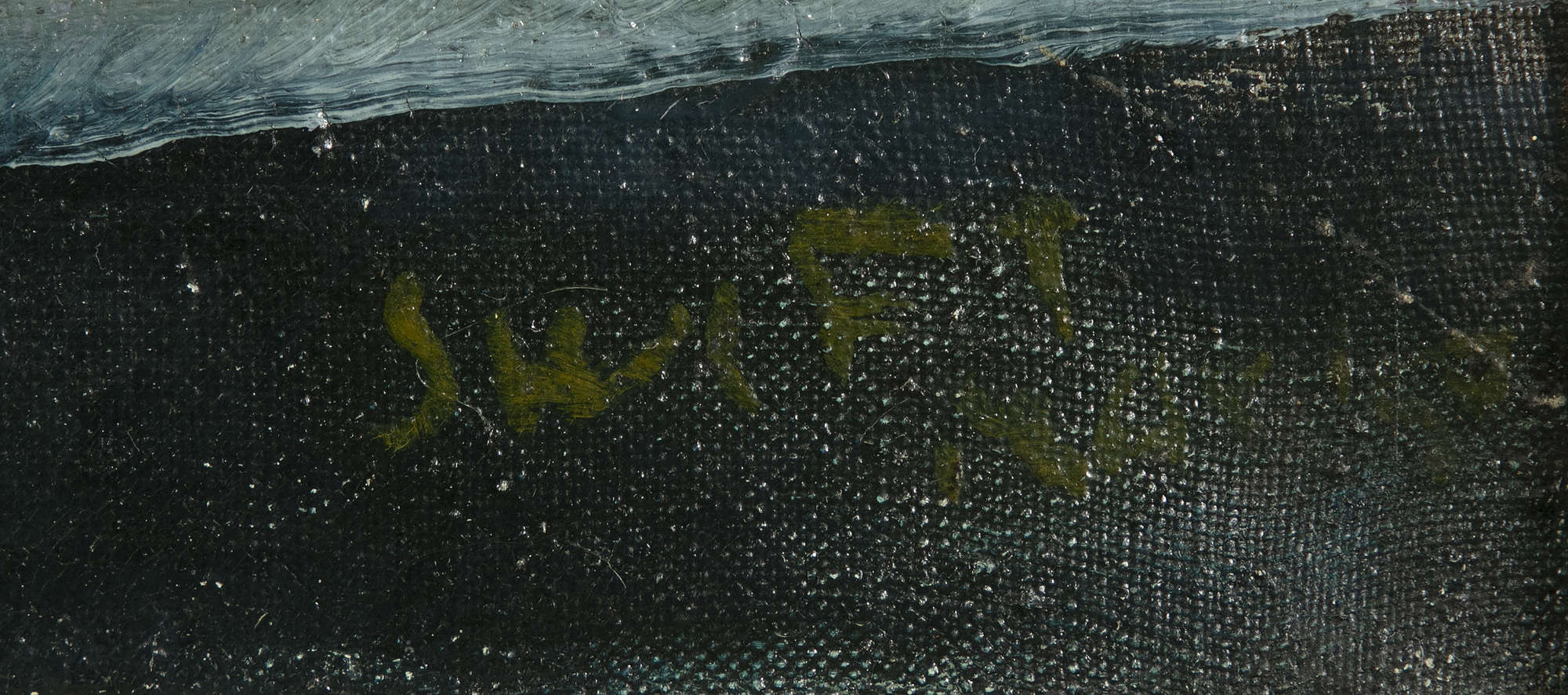
Signed
Provenance: The Artist's Family
Between 1948 and 1956, when he...
Patrick Swift (1927-1983)
Portrait of Lucian Freud in Patrick Swift's Hatch Street Studio
Oil on canvas, 69 x 94cm (27¼ x 37'')
Signed
Provenance: The Artist's Family
Between 1948 and 1956, when he was a frequent visitor to Ireland, Lucian Freud developed a friendship with Patrick Swift, whose studio on Hatch Street he regularly shared during his visits. During this time, the two artists observed one another’s work closely; both were interested, at this time, in portraiture and, to a lesser extent, still lifes. Swift was still in the early stages of his career at this point, while Freud had been critically lauded and celebrated in London, with a string of acclaimed solo exhibitions and the support of numerous influential patrons; his work was already being added to public collections in England and the US before he was selected to represent Britain (with Francis Bacon and Ben Nicholson) in 1954.
Swift had trained as an artist at the National College of Art in the late 1940s, while working for the Dublin Gas Company, and his work was included in the Exhibition of Living Art in 1950 and periodically thereafter through the 1950s. Up until 1952, he was both living and working in the house on Hatch Street, where he shared a large flat with American poet and Trinity student Claire McAllister. That year, their relationship came to an end, Swift having met Oonagh Ryan, who he would go on to marry.
Also in 1952, he had his first solo exhibition at the Victor Waddington Galleries in Dublin, which was met with critical acclaim. Swift was, by now, part of a more-or-less bohemian set of artists and writers that included Brendan Behan, Patrick Kavanagh, Nano Reid, and John Ryan; he was also connected to the art dealer Deirdre McDonagh. Freud was introduced to this cultural network through the artist Anne Dunn on his first visit to the city in the late 1940s. On his regular visits to Dublin thereafter, Freud participated in this artistic milieu.
Swift’s previously unexhibited portrait of Freud was painted at the Hatch Street studio in the early 1950s, when the two artists were in closest dialogue. It is part of a body of Swift’s work deriving from this period, when he painted a number of significant portraits, including portraits of many of the aforementioned friends and cultural figures (Cronin, Behan, McAllister). The influence of Freud on these early works was noted from the outset. At a technical level, both artists were at this point painting with a precise, severe linearity, working with a restrained, quite cold palette. Swift also approached his work with the same sense of analytical objectivity as Freud, seeking to reveal something of his sitter’s interior life
Maybe most notably, both artists’ work from this period sought to capture and convey some of the tensions – psychological and otherwise – that animated their subjects. Tony Gray, reviewing Swift’s 1952 solo exhibition, noted the parallels with Freud’s work, noting how ‘a brooding oppressive atmosphere’ pervaded Swift’s work, with ‘[d]etails … picked out in sharp relief, as they might be under the relentless floodlight of a prison interrogation’; according to Gray, Swift’s ‘merciless scrutiny … unearths from [his subjects] not a story, nor a decorative pattern, nor even a mood, but some sort of tension which is a property of their existence.’ (1)
Yet there are also clear differences between the two painters. For instance, Swift was uninterested in the kind of meticulous draughtsmanship that characterised Freud’s work at this time, his obsessive attention to detail, the texture of fabric and hair in particular. On the contrary, Swift’s portraits from this period often include elements and flourishes that suggest more abstract interests. In the portrait of Freud, the background – a grid of windowpanes and hard and soft window blinds – becomes an arrangement of repeated rectilinear forms. This treatment of the background is reminiscent of his portrait of Anthony Cronin, except here the sitter is off-centre, allowing for a more extensive and striking formal arrangement. The right-hand panel of the canvas in particular is clearly demarcated from the representational frame of the portrait, with a number of apparently abstract forms intersecting, at various angles, giving the effect of a contained exercise in Cubism – a mode Swift occasionally employed as a sort of foil within his predominantly realist compositions.
That said, great care has been taken to realistically render the filtering of light through the blinds behind the sitter, and the two tumblers on the table before him. The distinctive wrought-iron railings of the Hatch Street studio window also feature, as does a tall house-plant – a botanical motif that recurs across both Freud’s and Swift’s work. Swift’s interest in foliage would eventually lead him away from the dark psychological atmosphere that suffuses his early work (and arguably away from Freud’s strong initial influence) toward a looser, more profuse, even expressionistic style, painting landscapes and outdoor subjects as well as the portraits and still lifes that predominated in the early 1950s.
Swift’s portrait of Freud thus represents a singular record of the encounter between these two artists. They did maintain contact beyond their initial Hatch Street exchange, and Swift would include reproductions of some of Freud’s work in the final issue of X, A Quarterly Review, the periodical he founded and ran (with David Wright) from 1959–62. Swift was an artist who also wrote, and he published several important pieces of his own commentary on painting and literature in the magazine, as well as work by a range of Irish, British, and European writers – including Samuel Beckett, John McGahern, and Malcolm Lowry – alongside reproductions of mostly figurative painters, including Freud, Francis Bacon, Frank Auerbach, and David Bomberg.
In 1962, following a visit, Swift and his wife decided to move to the Algarve, where they set up Porches Pottery. He rarely exhibited his work thereafter. It was not until 1993, ten years after his death, that a major retrospective at the Irish Museum of Modern Art revived critical and popular interest in his work. In his contribution to the catalogue for that exhibition, Anthony Cronin attested that Swift ‘was never in any doubt that painting was a re-creation of what the painter saw … what he was actually looking at during the act of painting. A faithfulness of this sort was part of the bargain, part of his contract with his art. In conversation he – we – associated this faithfulness, this “truth” which might be possible in painting with an equivalent truth or honesty to experience which might be possible in literature.’ This conviction perhaps goes some way to explaining the editorial logic of X, with its curious configuration of artists and writers, practitioners of an art that was, in Cronin’s words, ‘frugal, ascetic, puritanical’. (2)
Nathan O’Donnell, October 2021
(1) G.H.G. [Tony Gray], ‘Young Artist of Promise’, Irish Times, 3 October 1952, 5.
(2) Anthony Cronin, ‘Patrick Swift in His Time’, Patrick Swift, exh. cat., Irish Museum of Modern Art, 1993.
All bids are placed in Euros (€)
Please note that by submitting a bid you are agreeing to our Terms & Conditions


 Have a similar item to sell?
Make Enquiry
Have a similar item to sell?
Make Enquiry