Click on image to open full size.


James Arthur O'Connor (1792-1841)
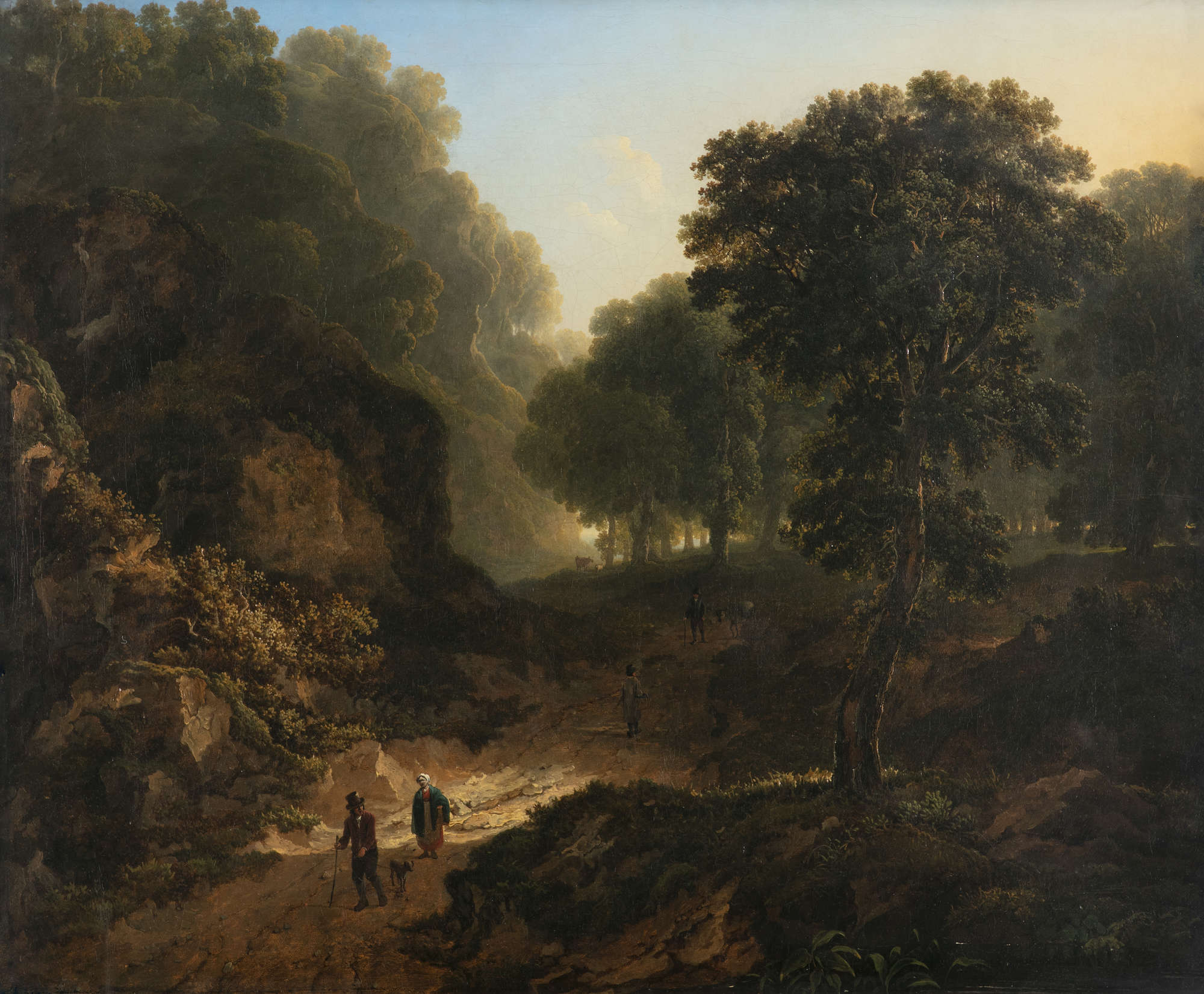
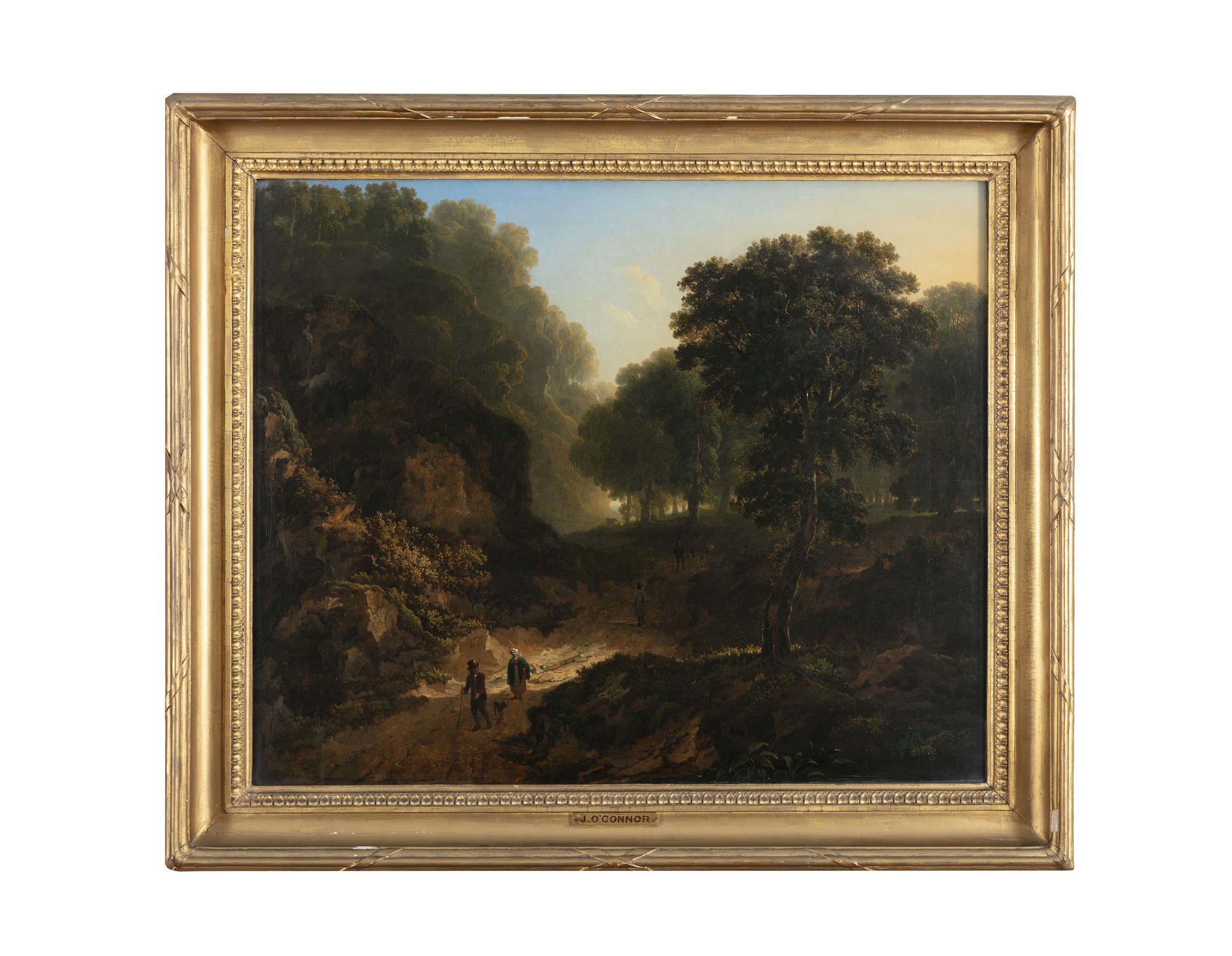
Wooded Defile with Figures and Distant Cattle
Oil on canvas, 63 x 75cm (24¾ x 29½'')
Signed and dated 1827
Provenance: Collection of Dr. R.R Woods, Merrion Square,...
James Arthur O'Connor (1792-1841)
Wooded Defile with Figures and Distant Cattle
Oil on canvas, 63 x 75cm (24¾ x 29½'')
Signed and dated 1827
Provenance: Collection of Dr. R.R Woods, Merrion Square, Dublin
Exhibited: Dublin, Municipal Gallery of Modern Art, O'Connor Centenary Exhibition, 1941, Catalogue No. 35
When, in Pride and Prejudice [1813] Jane Austen has Elizabeth Bennett exclaim ‘What are men to rocks and mountains?’ Austen, though offering us a humorous view of Romanticism, is nonetheless highlighting the beauty and power of landscape and its effect on us. For T.E. Hulme, the root of all Romanticism is when the individual feels within ‘an infinite reservoir of possibility’ and especially when the open, untamed landscape, the great outdoors, works wonders on both mind and imagination.
James Arthur O’Connor belongs to the great Romantic movement, a movement that celebrates - in literature, music and especially in painting - creativity and a deep involvement with what Wordsworth calls ‘the goings on of earth and sky’.
O’Connor was born, at 9 Exchequer St Dublin, in 1792. Shelley was born that same year. In 1792 Constable was sixteen, Turner was seventeen. Wordsworth and Beethoven were both twenty-two, and though not all of them knew each other, being contemporaries, their work reflected and expressed the spirit of the age in which they lived.
O’Connor’s father, an engraver and printmaker, died when O’Connor was sixteen, his mother died before O’Connor’s twenty-first birthday. By 1809, O’Connor, then twenty-seven, began to exhibit with success at the Dublin Society. He most likely had been taught by his father but was also self-taught and his early work featured frequently commissioned landscapes of the west of Ireland including View of Lough Derg with Portumna Castle in the Background, The Grounds, Ballinrobe House, View of Westport with Croagh Patrick, Mangerton Killarney.
In 1822, O’Connor, experiencing financial difficulties and hoping to improve his lot and help his orphaned sisters, moved to London with his wife Anastasia. He lived at Upper Marylebone Road, travelled widely in Britain and France, exhibited regularly at the Royal Academy, the British Institute and the Royal Society of British Artists. Exiled future French King Louis Philippe bought several of O’Connor’s work but O’Connor beset by conmen and dealers, who behaved dishonourably, deprived him of earnings that were rightly his.
When he moved to Hampstead he lived close to where John Constable, an important influence, lived. In 1826 O’Connor spent a year in Brussels. In 1832 he lived in Paris for nine months and then spent six months in Southern Germany where the Saar and Moselle valleys inspired some of his best work.
When O’Connor was forty-three, one of his Irish landscapes was acquired by the Musée des Beaux-Arts Thomas-Henry, Normandy, on its foundation in 1835, but during the 1830s O’Connor’s eyesight deteriorated and his career went into decline.
O’Connor died poor in London aged forty-nine and was buried at St Luke’s Church, Chelsea. Prince Albert and the RA initiated a subscription to assist his widow. His obituary in the Dublin Monthly Magazine spoke of O’Connor as ‘a spirit of exceeding mildness; manly, ardent, unobtrusive and sincere; generous in proclaiming contemporary merit, and unskilled and reluctant to put forth his own’.
His skill, imagination and brilliant compositional talents are evident in this exceptional work painted when he was thirty-five years old, Wooded Defile, Figures and Distant Cattle [1827]. Defile, here, means ‘a steep-sided narrow gorge or passage (originally one requiring troops to march in single file)’ and the dramatic, steep, rocky cliff-like landscape to the left and the rising ground to the right create a pathway along which four figures are travelling.
These four figures, three men and a woman, carry with them and contain their own stories. In the foreground the two figures, a man and a woman, lit from behind, are given prominence. The tall-hatted man in rust-coloured jacket with walking stick and a dog on a lead, seems to have paused to look back at his companion. The woman in red dress, blue-green shawl and carrying a receptacle - a small cage perhaps? - as if in response to the man before her, stands her ground. Farther along the path, the man with his back to us carrying a basket and stick walks on slowly; the blue cloth in his basket a little bright detail, the side of his face brightly lit. A fourth figure in dark clothes and white shirt walks towards us leading a young cow. Each one prompts in the viewer a narrative of our own making. In this painting from 1827 we are invited to ask, who are they? where are they going? what are they like? And against the distant trees the ‘distant cattle’ of the title – important enough to get a mention.
There are beautiful details here: in O’Connor’s handling of trees, rocks, shrubs but the triumph is in his capturing the way light falls through the defile and that beautifully bright golden-blue sky. Light, shade, perspective all make this a radiant and stunning work.
Constable who died in 1837, just three years before O’Connor, said that ‘A gentleman’s park is my aversion. It is not beauty because it is not nature.’ Here, O’Connor celebrates the untamed, natural beautiful landscape, a landscape imbued with a Romantic sensibility where rocks and mountains dominate in every sense.
Niall MacMonagle, February 2022
All bids are placed in Euros (€)
Please note that by submitting a bid you are agreeing to our Terms & Conditions


 Have a similar item to sell?
Make Enquiry
Have a similar item to sell?
Make Enquiry