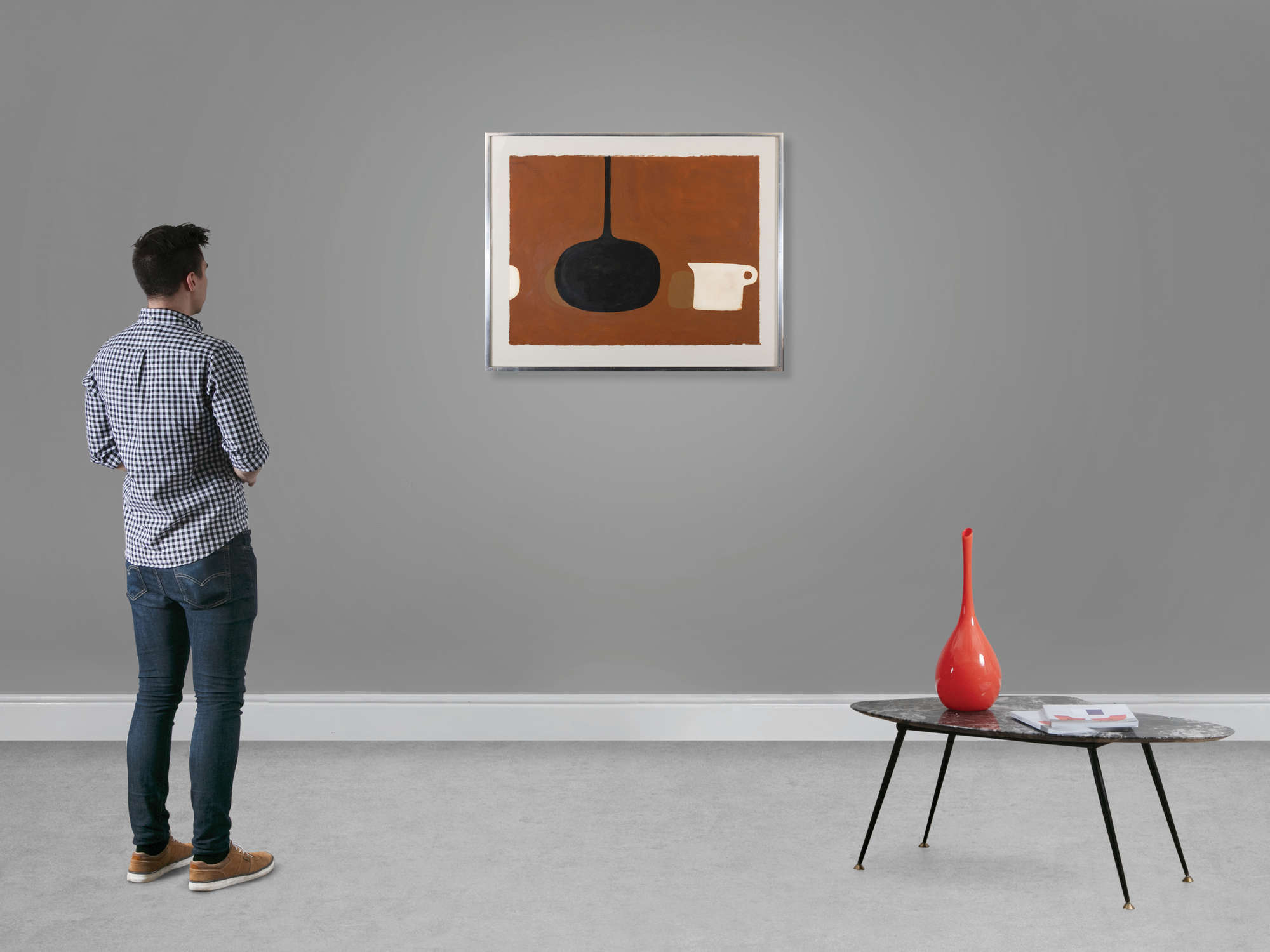
Click on image to open full size.


William Scott RA (1913 - 1989)
Still Life No.2 (1970)
Gouache on paper, 59 x 78cm (23¼ x 30¾")
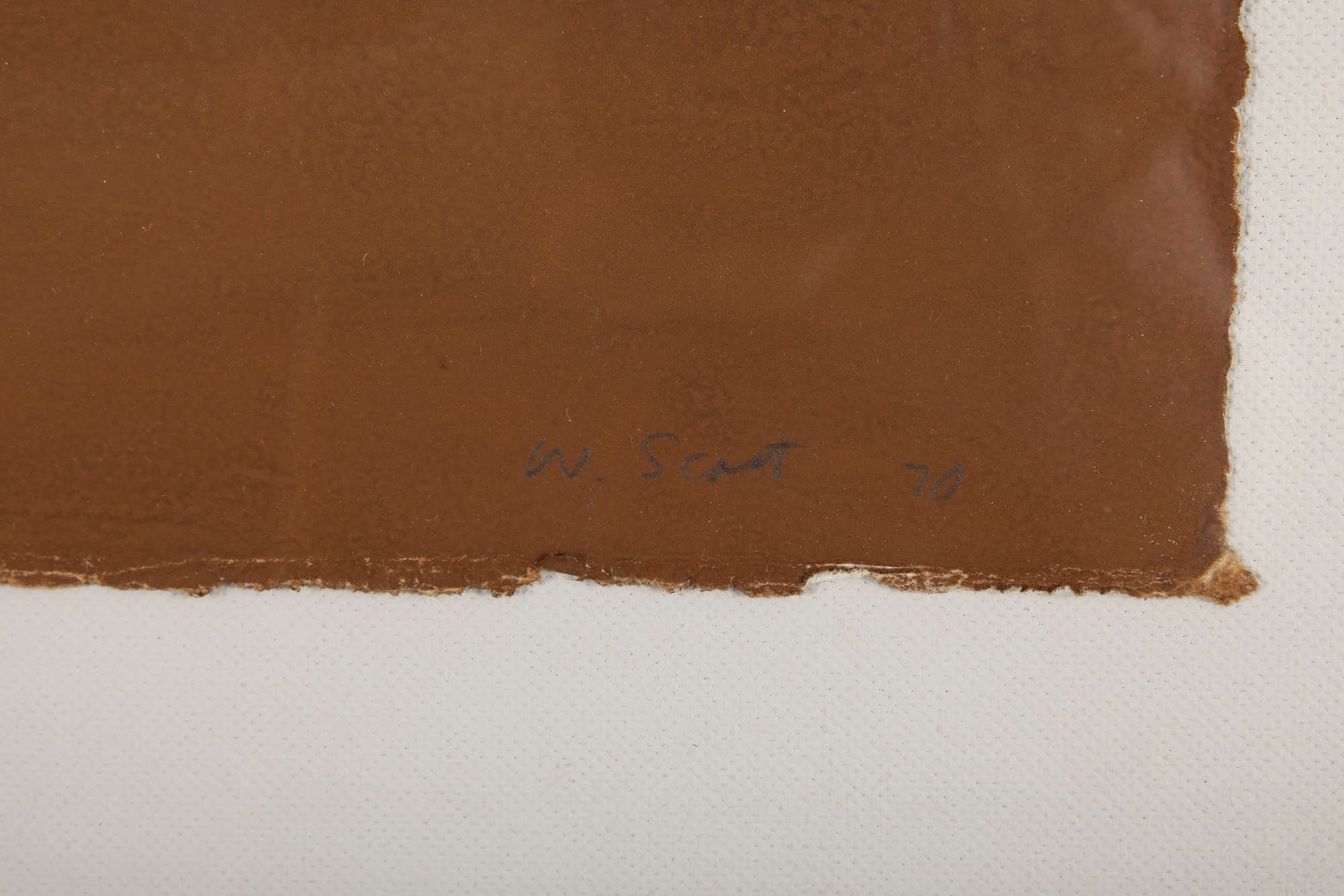
Signed and dated 1970
Provenance: Collection of R.W. Wilson, Dublin
Still Life No.2 (1970) is...
William Scott RA (1913 - 1989)
Still Life No.2 (1970)
Gouache on paper, 59 x 78cm (23¼ x 30¾")
Signed and dated 1970
Provenance: Collection of R.W. Wilson, Dublin
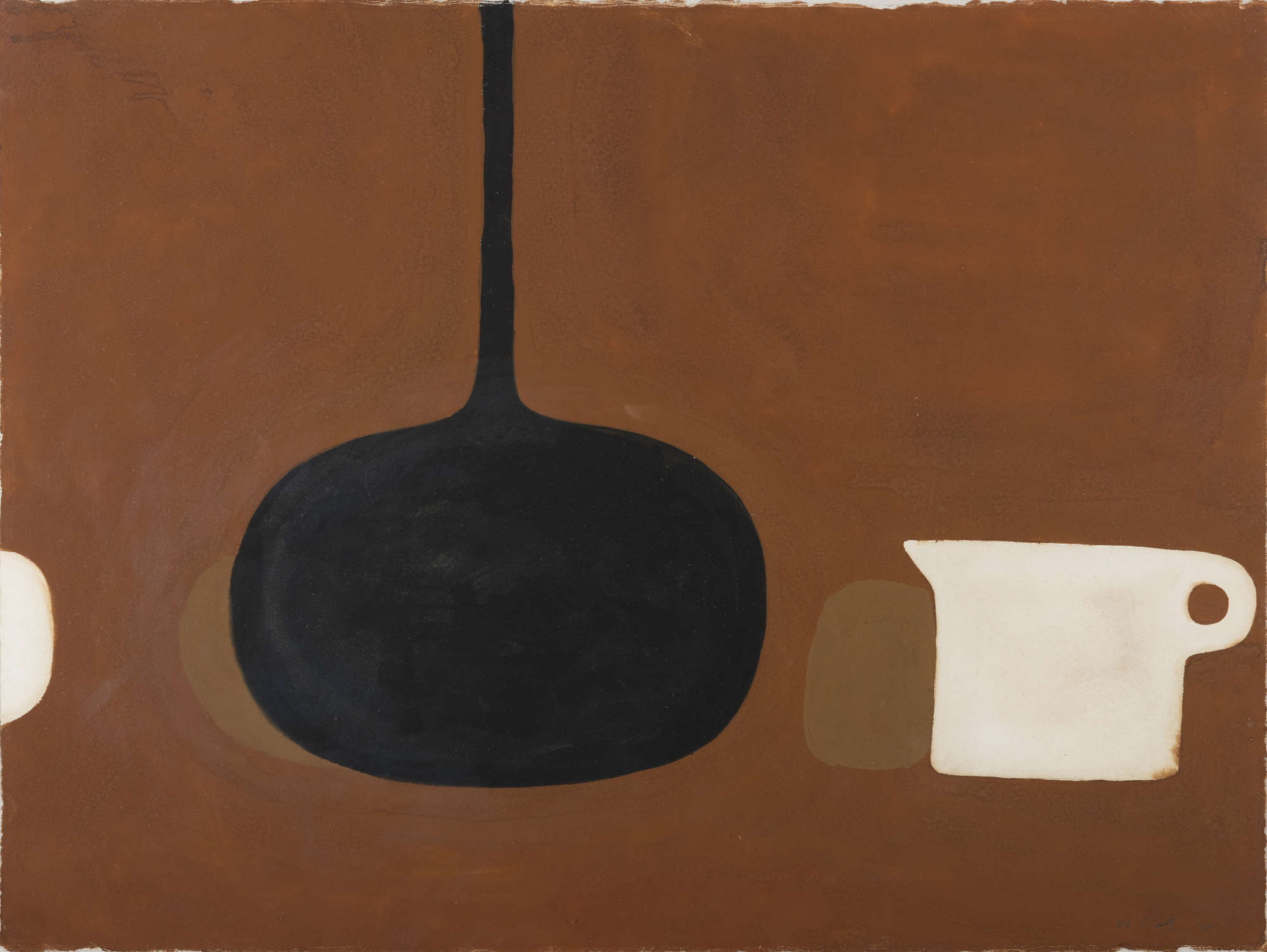
Still Life No.2 (1970) is representative of the approach to such themes painted by William Scott at this time. Over the years, Scott had explored a range of thematic subjects, from the early biblical narratives and genre scenes, to the landscapes and nudes that featured repeatedly throughout his oeuvre. However, Scott consistently reverted to still life as the primary theme of interest across his life as an artist.
William Scott's earliest still life images are relatively naturalistic, though always stylised rather than strictly mimetic. Following a series of phases of exploration, the forms in Scott's paintings became increasingly distilled, typically based on the familiar domestic objects typical of his childhood in Greenock, Scotland, where he was born. He later moved with his family to his father's native Enniskillen, and remained in Northern Ireland where he began his education as an artist. He continued his education at the Royal Academy Schools in London, eventually settling in Somerset. Scott was ground-breaking in creating art that combined the familiar and mundane useful object with his perspective on Modernism abstracted form.
Still life has attracted artists for centuries, providing an opportunity to represent a host of significant objects. The earliest examples in western art present still life elements in religious altarpieces, particularly in Northern Europe, prioritising the potential of objects, some ordinary, others precious, to carry symbolic meaning: thus this genre provided a readable array of distinctive 'attributes', by which the character of religious characters could be defined - a vital visual language in an era of low literacy. Over time, still life emerged as a subject in its own right, though it continued to embody a host of readable symbols for purposes of morality, intended as reminders of the perceived wisdom at the time.
In time, still life became a celebration of the ordinary, as artists began to focus on mundane objects for their own sake, to signify the familiar and to evoke nostalgia. From the late nineteenth century, towards the emergence of Modernism, the possibilities of forms of expression that challenged academic principles, provided an impetus for alternative methods of seeing: from the colours and shapes of the objects themselves, to how they could be located in space.
William Scott had the opportunity to observe methods of expression through the work of artists encountered in exhibitions and art galleries, ranging from the Renaissance to the present, from Piero della Francesca to Henri Matisse, via Jean Siméon Chardin and Paul Cézanne. His visits to the United States from 1953, for his own exhibitions there, provided unique opportunities to observe the most contemporary developments and to meet some of the leading exponents as an equal - artists like Jackson Pollock, Barnett Newman - and Mark Rothko, who visited him in Somerset some years later.
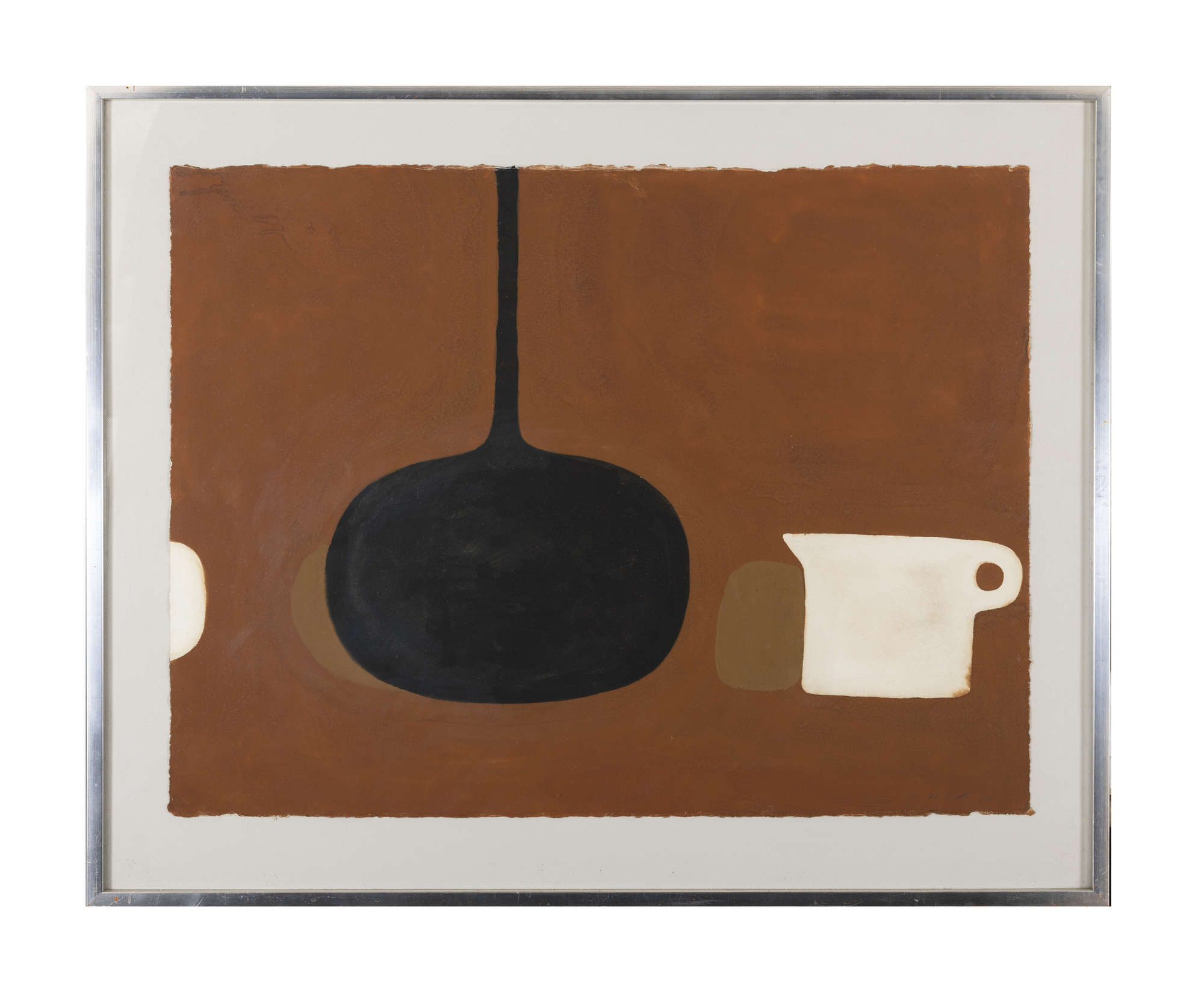
Still Life No.2 (1970) demonstrates characteristics that can be observed in iconic works by William Scott, such as Still Life Brown with Black Note (1969)(1). Still Life No.2 comprises colours and forms typified by the artist at the time: a flat black profile appears suspended, suggestive of the profile of a skillet, familiar in Scott's work. A white circular object to the left is cut off by the edge of the painting, while on the right a white jug, another form that appears in Scott's work, is presented like a stencil against the red-brown ground. The background shows the marks of the brush, and there is a suggestion of shadows thrown by some of the objects. The slight 'bleeding' of paint at the edges of objects, softens their otherwise austere profiles, and indicates the hand-crafted dimension of the artwork, and introduces a human dimension to the austerity of the arrangement. The composition is spare and spacious, a marked distinction from Scott's still life paintings of the 1950s, which featured crowded, almost chaotic, 'table top' images connecting the artist and viewer more closely with the domestic realities of a busy kitchen environment. The present painting reflects the more abstract and symbolic nature associated with the later works of the painter. Once he divested his repertoire of the food items (fish, eggs, vegetables) evident in his earliest work, Scott's particular selection of items reflects his stated preference for man-made over 'natural' things, perhaps identifying with durability despite repeated use, over organic fragility.
William Scott is recorded as commenting on his practice in a lecture delivered at the British Council in 1961 that sheds light on his approach to still life:
"My pictures now contained not only recognisable imagery but textures and a freedom to distort. I again painted a profusion of objects that spread themselves across the canvas, often clinging to the edges leaving the centre open ...'.(2)
All bids are placed in Euros (€)
Please note that by submitting a bid you are agreeing to our Terms & Conditions


 Have a similar item to sell?
Make Enquiry
Have a similar item to sell?
Make Enquiry