Click on image to open full size.


Joseph Tudor (c.1695 - 1759)
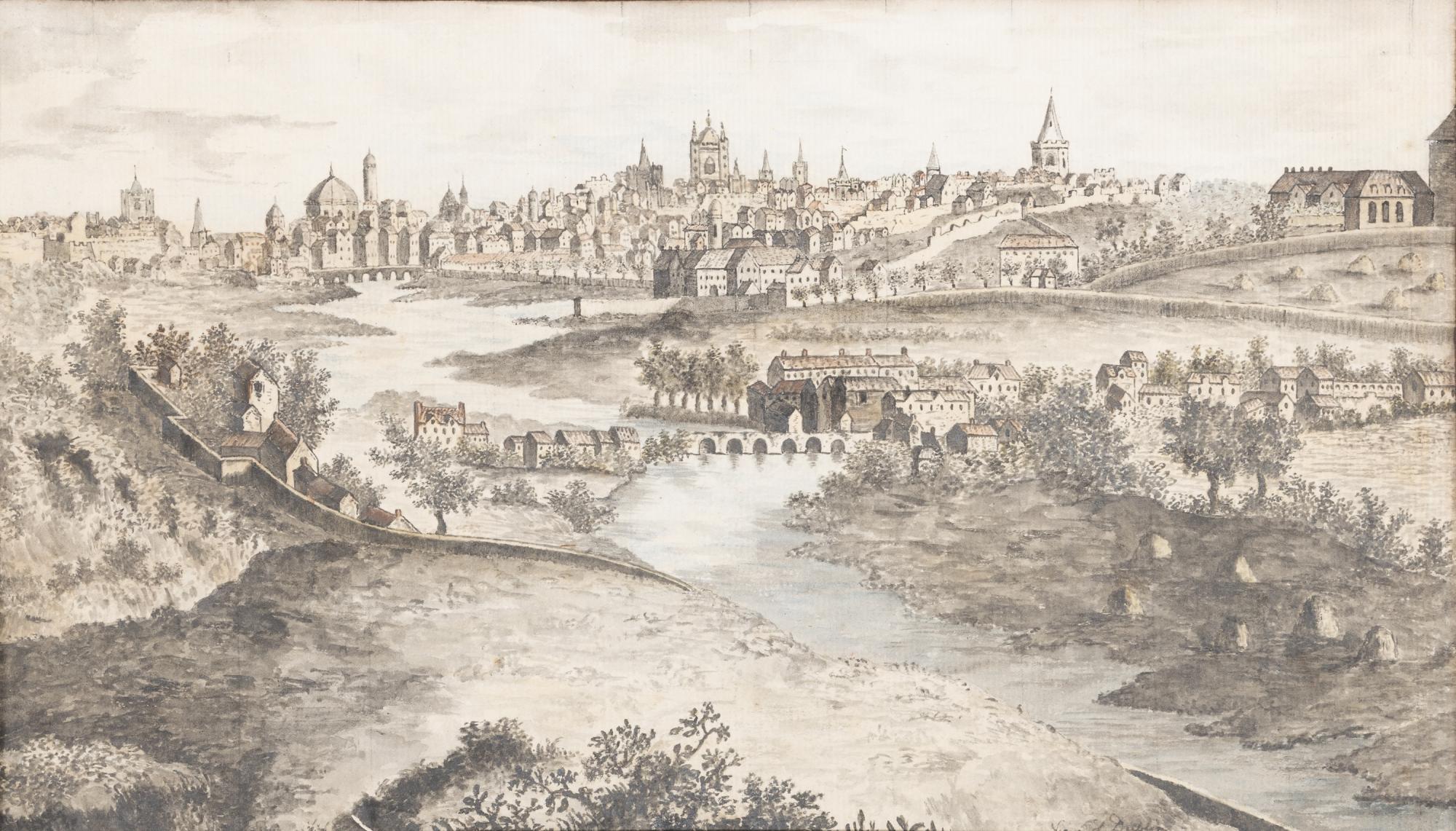
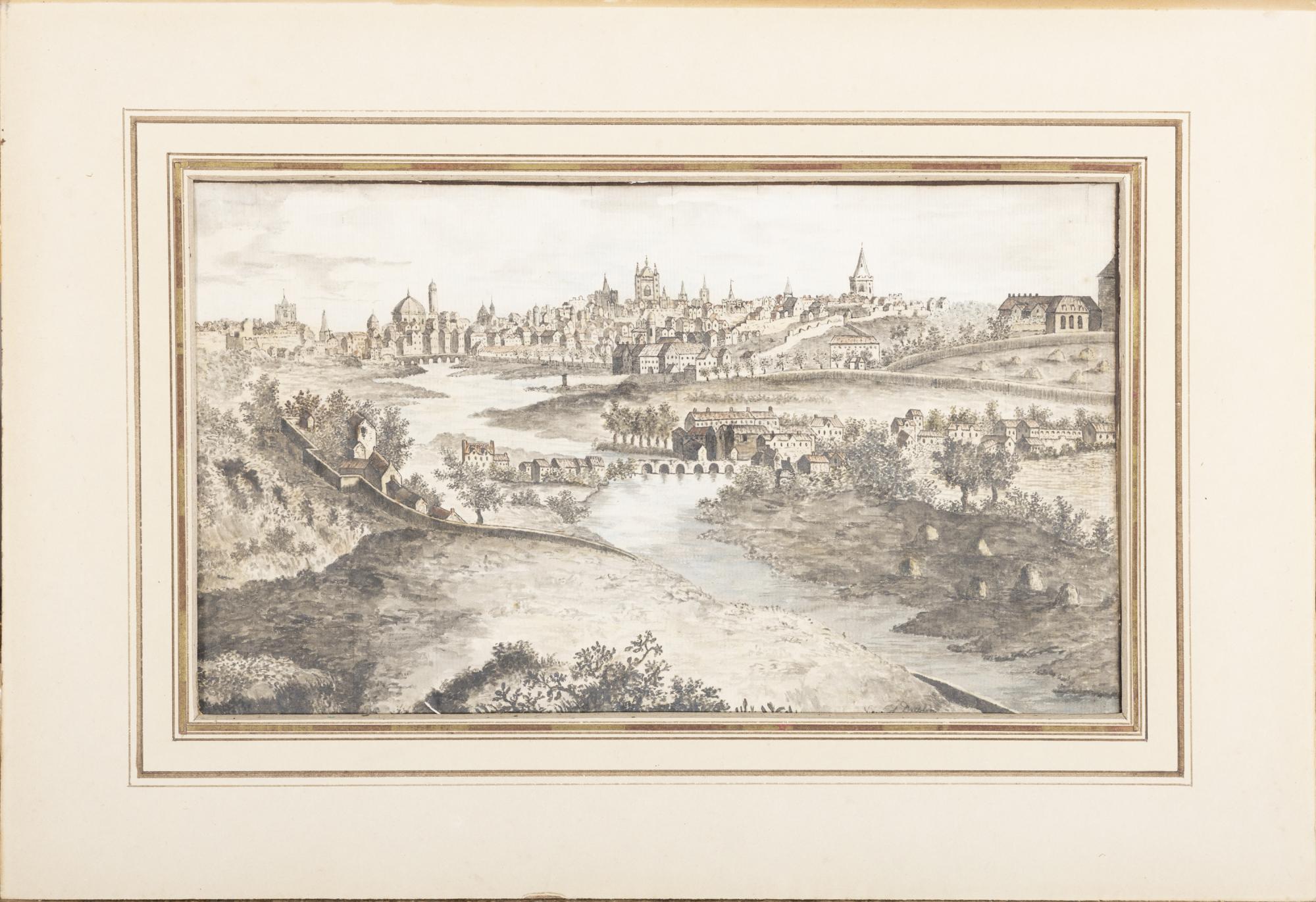
View of Dublin from the Phoenix Park
Watercolour, 16.5 x 28.5cm (6½ x 11¼")
Inscribed: View of Dublin
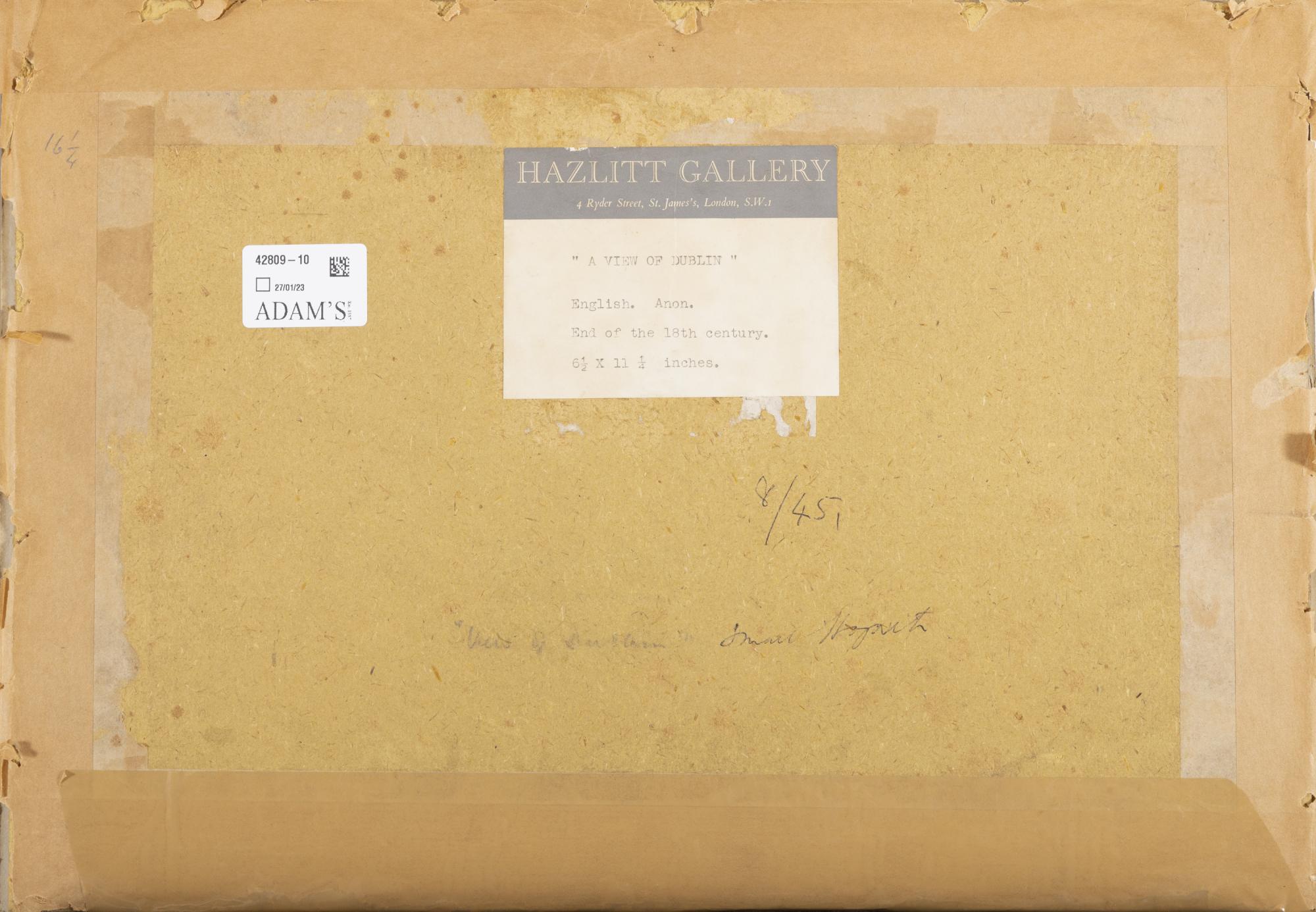
Provenance: With Hazlitt, Gooden & Fox, London from who...
Joseph Tudor (c.1695 - 1759)
View of Dublin from the Phoenix Park
Watercolour, 16.5 x 28.5cm (6½ x 11¼")
Inscribed: View of Dublin
Provenance: With Hazlitt, Gooden & Fox, London from who acquired Sir Jack Baer (1924 - 2016) and from whose estate acquired by the present owner.
A rare example of Joseph Tudor’s art dating from 1753 or a little earlier, this sheet is the preparatory drawing for his known well-known view of Dublin from the Phoenix Park which was engraved in London by James Mason and published by Laurie & Whittle as A Prospect of the City of Dublin, from the Magazine Hill, in his Majesty’s Phoenix Park. This was one of six views of the city after drawings by Tudor, titled, in French, Six points de Veue d’edifices publics et remarquables de la Ville de Dublin. As was standard practice, Tudor’s drawing focuses squarely on the architecture and the engraver has added the elegant figures and livestock who disport themselves in the foreground. Tudor also painted this same view in a large and unusually ambitious oil and this newly identified drawing, the print and the oil show the city from a spot in Chapelizod close to the Phoenix Park. In the middle distance can be seen the village of Island Bridge flanked to the left by the Magazine Fort while to the right the viewer catches a glimpse of the Royal Hospital, Kilmainham, which is shown more fully in the oil painting. Further into the distance appear the spires of St Patrick’s and Christ Church Cathedrals as well as the wooden clock tower of Dr Steeven’s Hospital, erected a few years earlier in 1735. Other Dublin views by Tudor which were engraved include the old Custom House and Essex Bridge and the Upper Yard at Dublin Castle. Nicola Figgis notes that the prints after Tudor’s drawings serve as important records of certain buildings that are no longer in existence’ and this is particularly so as Tudor was ‘adept at drawings architecture’ (AAI, 2, p. 480). Regrettably given this, only four other drawings by Tudor are extant, including one depicting the Parliament House on College Green. (Anne Crookshank and Desmond FitzGerald, Knight of Glin, The Watercolours of Ireland (London, 1994) p. 37).
A presumed pupil of William Van der Hagen, Joseph Tudor enjoyed a busy practice as a landscape and decorative painter in the decades from about 1740 to his death in 1759. Like so many other Irish landscape artists of the period, he painted sets for the Dublin theatres, the experience of which gave him great versatility. However the ephemeral nature of much of his decorative work means that his surviving oeuvre is tiny, although it is amplified somewhat by engravings after his work. Tudor is recorded as winning premiums for landscape painting from the Dublin Society in 1740, 1742, 1743 and 1746. Three years later he executed a Perspective View of the Illuminations and Fireworks at St Stephen’s Green on Thanksgiving Day for the General Peace concluded at Aix-la Chapelle which was engraved by Thomas Chambers. He worked at Dublin Castle, the Rotunda Gardens and at Smock Alley where, in January 1739, he painted the scenery for The Harlot’s Progress and nine years later that for Henry Woodward’s Fairy Friendship, or the Triumph of Hibernia. Tudor was admitted to the Guild of St Luke in 1755 and died in his house in Dame Street on the 24 March 1759. Like his putative master Van der Hagen he was an adaptable artist and is recorded as having painted an altarpiece for Waterford Cathedral in 1750.
All bids are placed in Euros (€)
Please note that by submitting a bid you are agreeing to our Terms & Conditions


 Have a similar item to sell?
Make Enquiry
Have a similar item to sell?
Make Enquiry