Click on image to open full size.


Harry Clarke RHA (1889-1931)
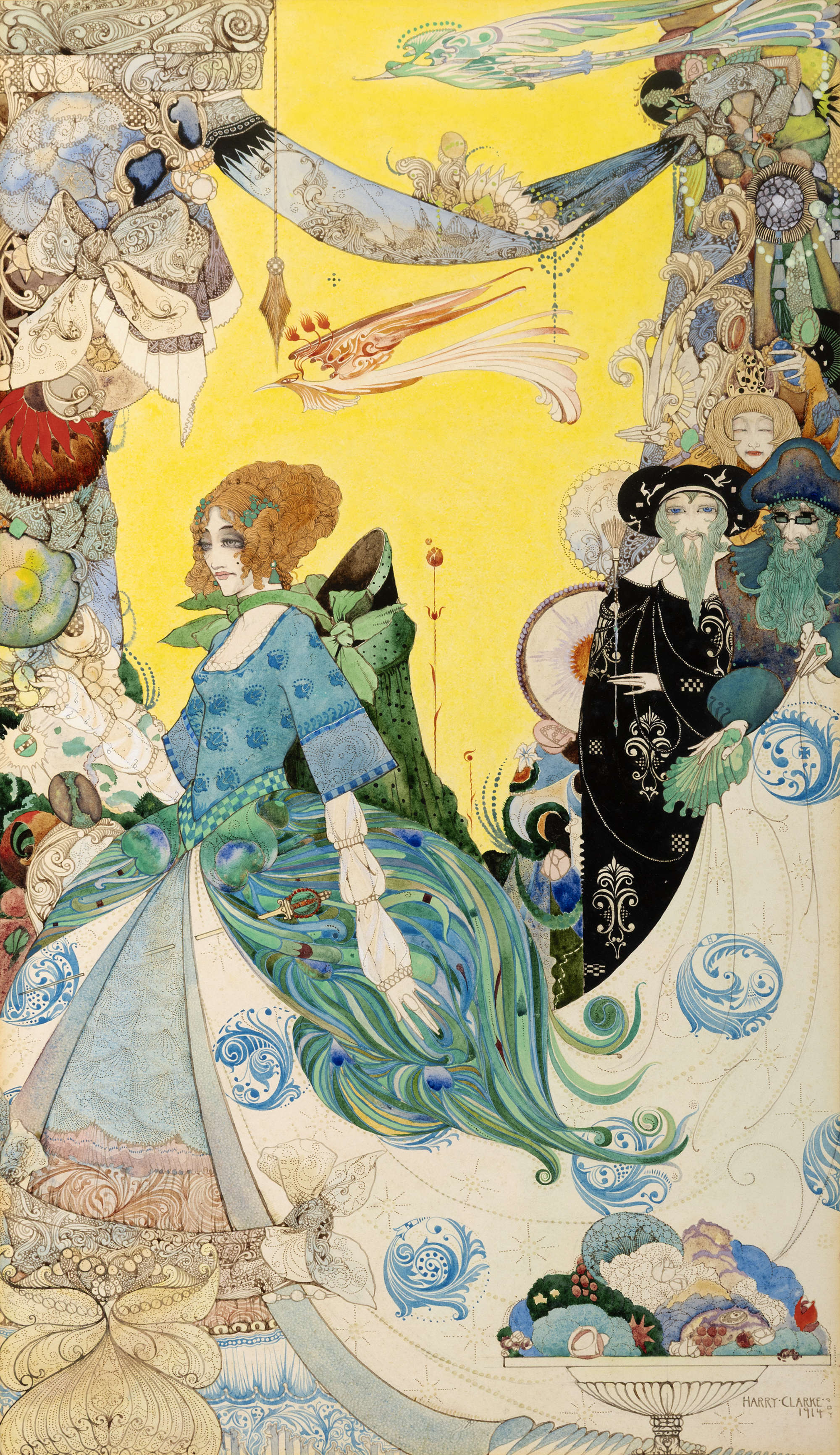
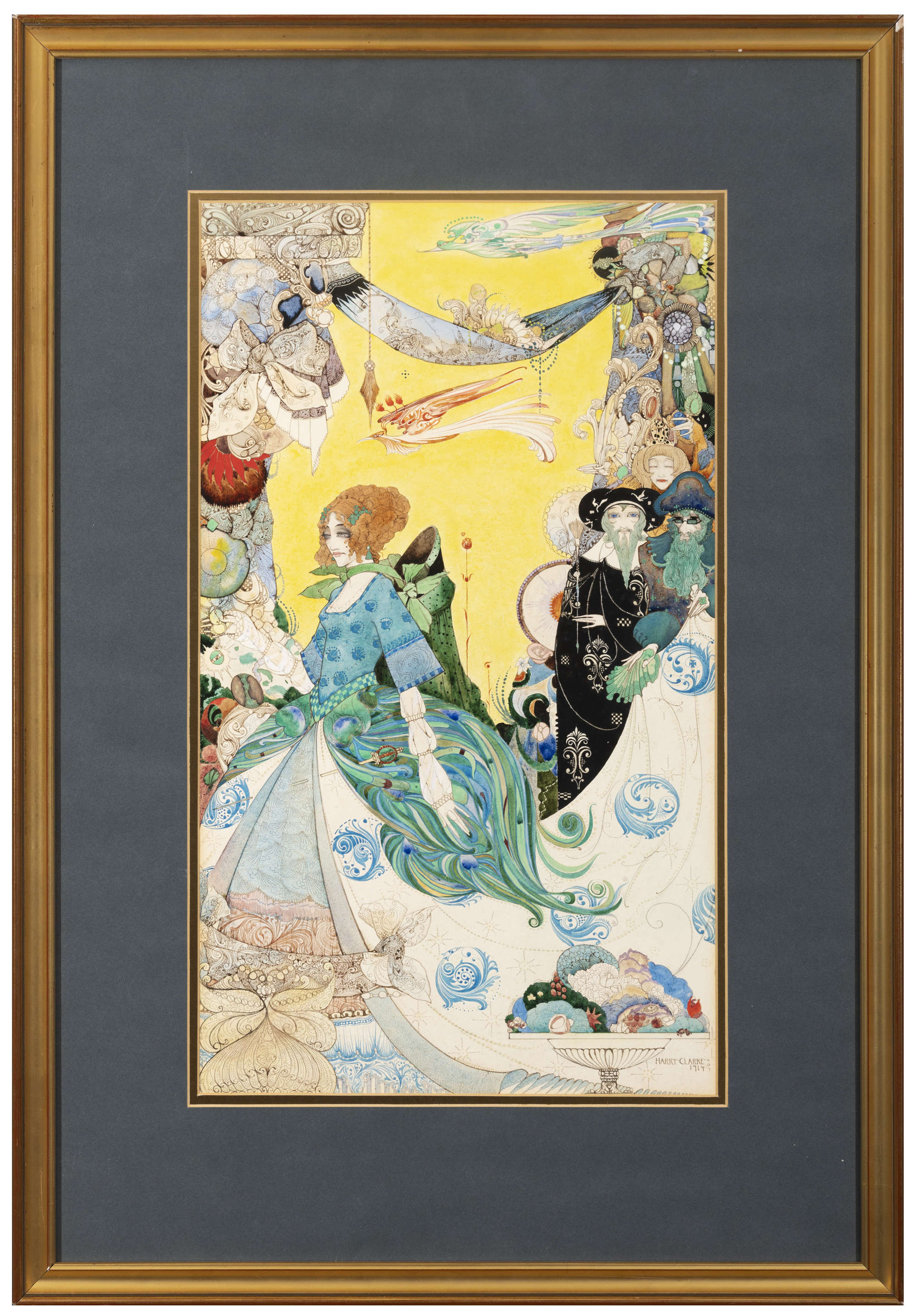
The Lady of the Decoration (1914)
Pen and ink and watercolour, 53.2 x 30.5cm (21 x 12'')
Signed and dated 1914
Provenance: Private Collection, Dublin
Joshua Clarke...
Harry Clarke RHA (1889-1931)
The Lady of the Decoration (1914)
Pen and ink and watercolour, 53.2 x 30.5cm (21 x 12'')
Signed and dated 1914
Provenance: Private Collection, Dublin
Joshua Clarke took great pride in his younger son, Harry’s, success and was eager to promote his dual career as illustrator and stained glass artist. Joshua’s own stained glass business also undertook church murals and his paint supplier, John Duthie of Glasgow, had become a firm friend. With Joshua negotiating, it was agreed that Harry would create a large illustration for John Duthie which, when printed, Duthie could attach a calendar to in order to promote his paint manufacturing business. When Johsua and Harry were in Paris on a short holiday in June 1914 John Duthie had planned to join them to discuss the project but Duthie had to pull out of the arrangement and a long correspondence ensued over the calendar.[1]
On Saturday 31st of October 1914, after a short courtship and to everyone’s surprise, Harry quietly married Margaret Crilley who had been a fellow student at the Dublin Metropolitan School of Art, and the next day the couple moved into the flat above his father’s stained glass business in North Frederick Street. There was no time for a honeymoon and Harry Clarke instead immersed himself working on his calendar illustration for John Duthie. He completed it by November 10th and promptly dispatched it to Duthie in Glasgow. Joshua was eager to learn what Duthie thought of it and wanted to see proofs of the printed image to allay his concern that the printed result might not do justice to his son’s great talent, though any concerns were misplaced.
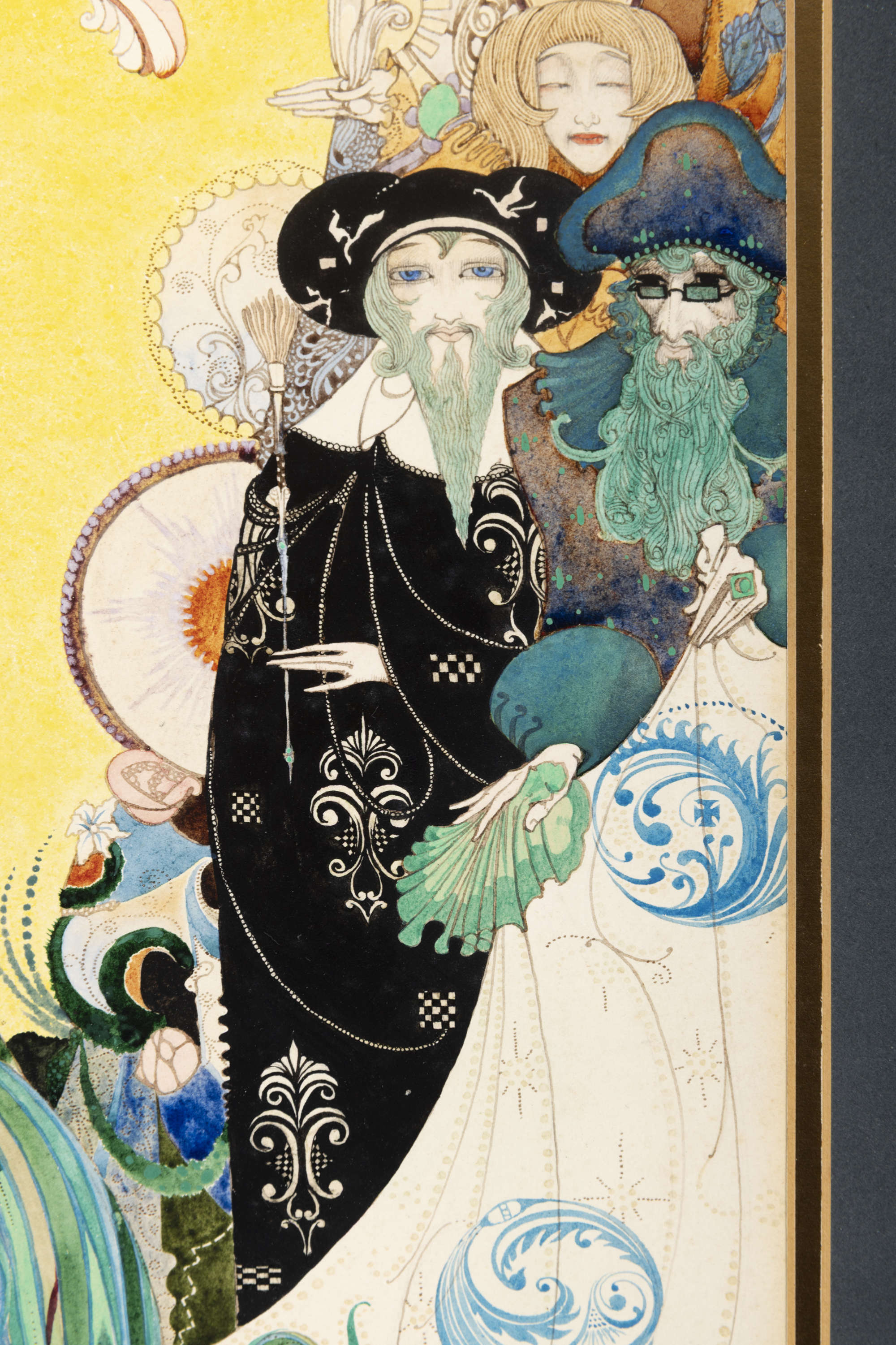
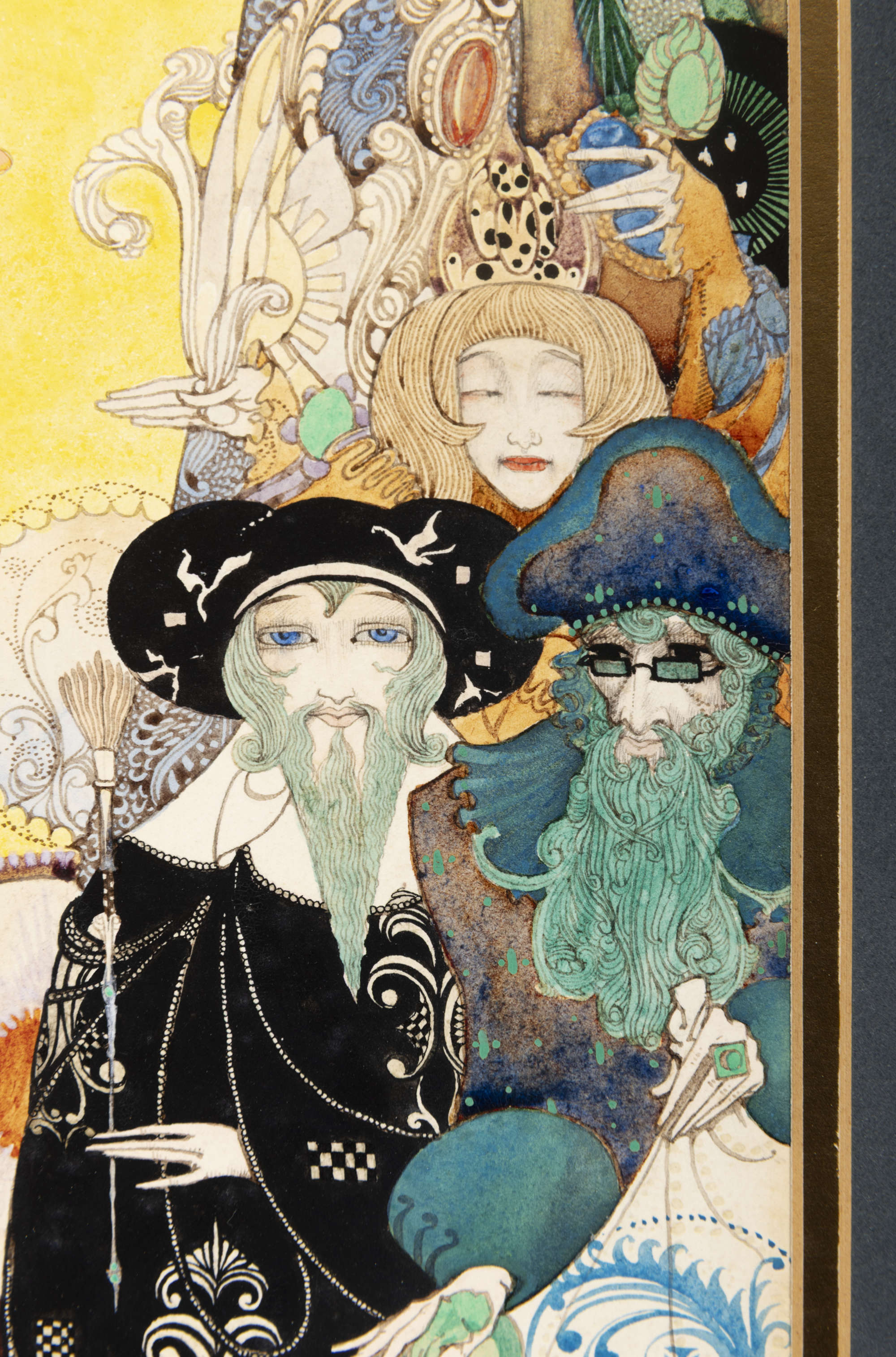
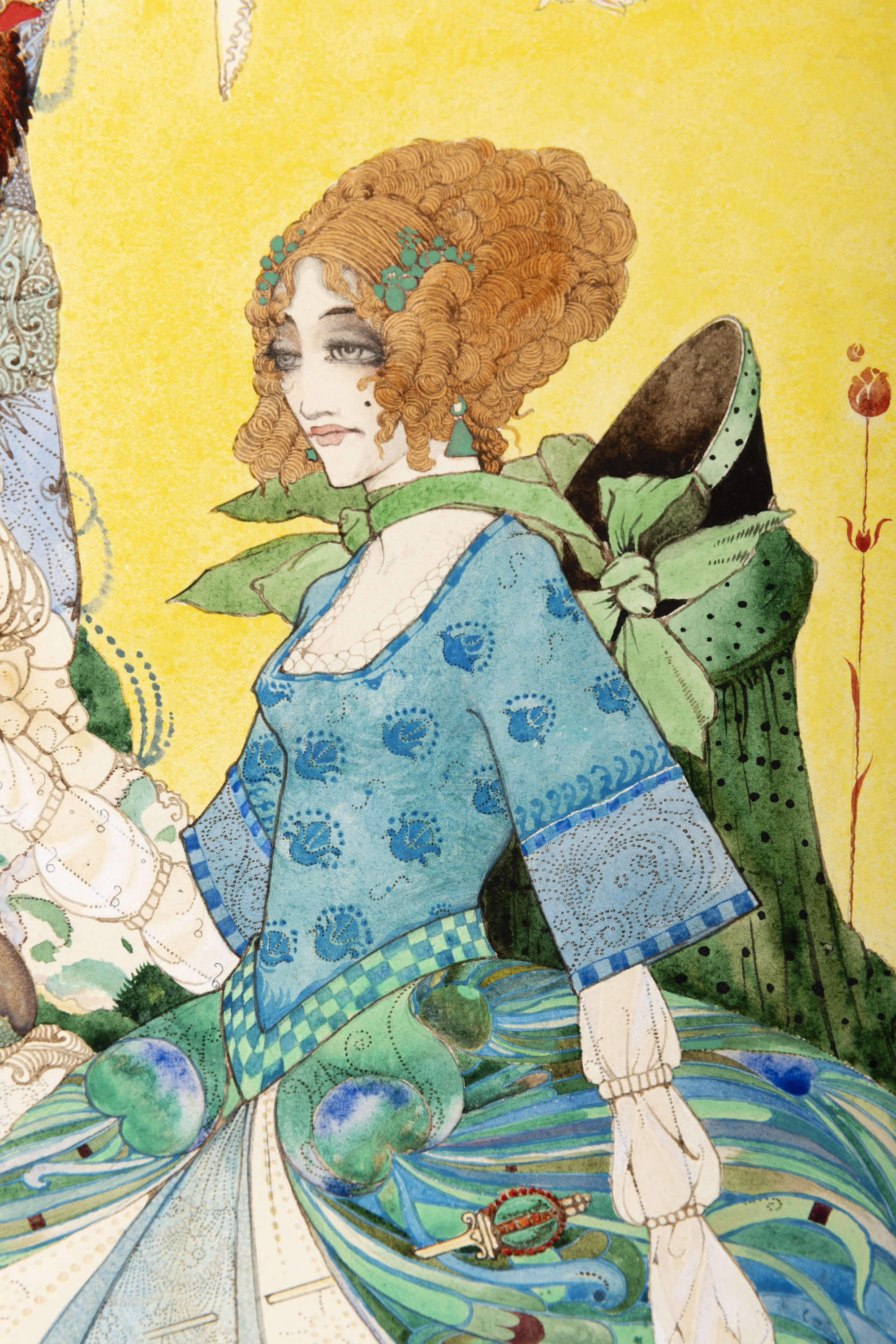
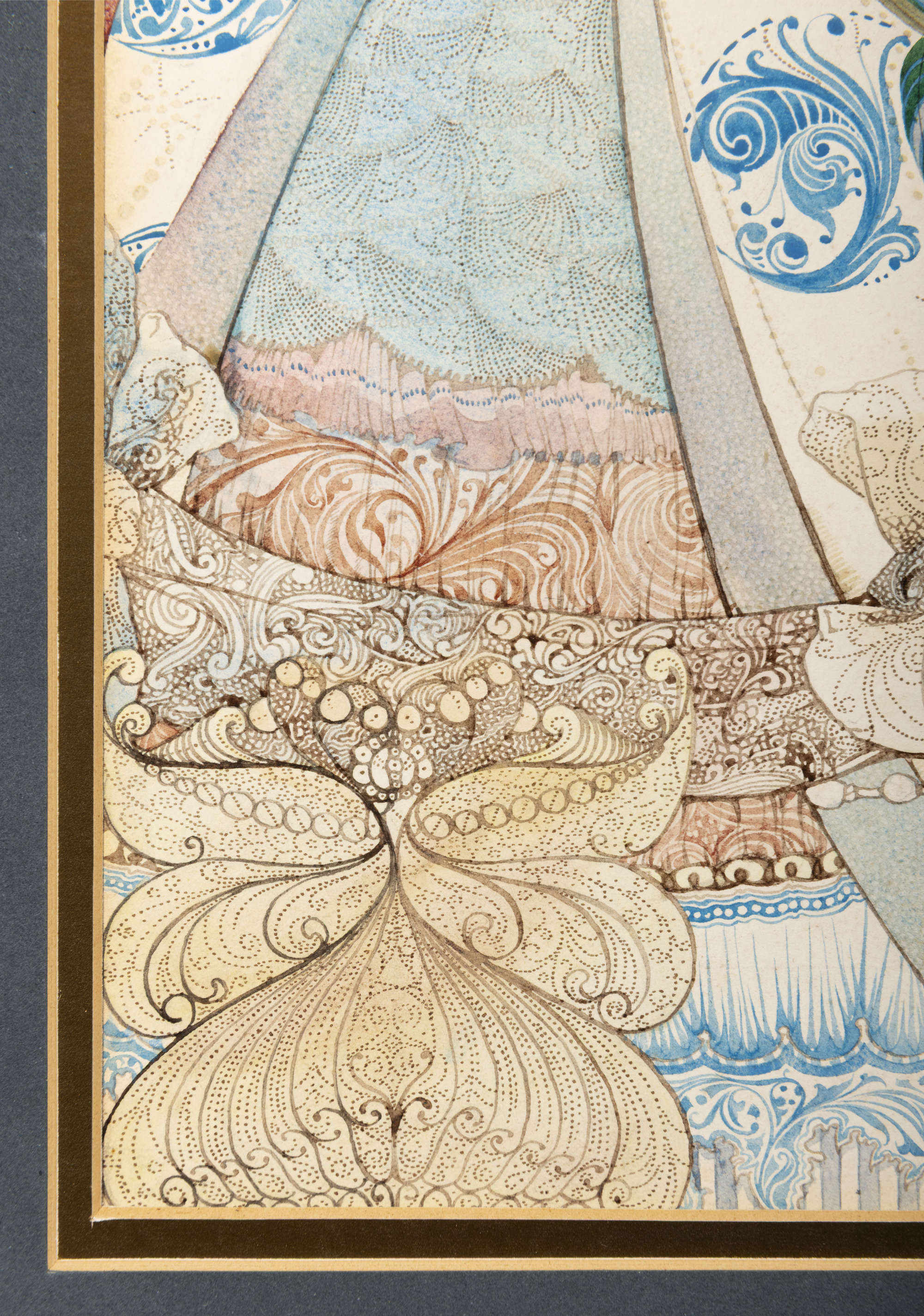
Harry Clarke titled the image The Lady of the Decoration and the main figure shows an elegant lady in profile, lost in reverie. With somewhat sharp features her heavy lidded eyes are enhanced with mascara and she wears a beauty spot on her pale cheek. Her auburn hair, fashioned into a frenzy of tight curls, has been released from its emerald bonnet which is loosely fastened with a ribbon of the same colour, and which languidly trails down her back. Her blue bodice merges into her emerald, turquoise and white gown. Aside from the lady herself, the enigmatic supporting characters on the right, and the copious amount of detail, one is struck by the flat yellow background which acts as a foil for the profusion of elaborate decorative elements. Leading Clarke expert, Dr Nicola Gordon Bowe, described it as ‘a larger, more detailed and sensitive version of the coloured illustration to Hans Andersen’s ‘The Garden of Paradise’.[2]
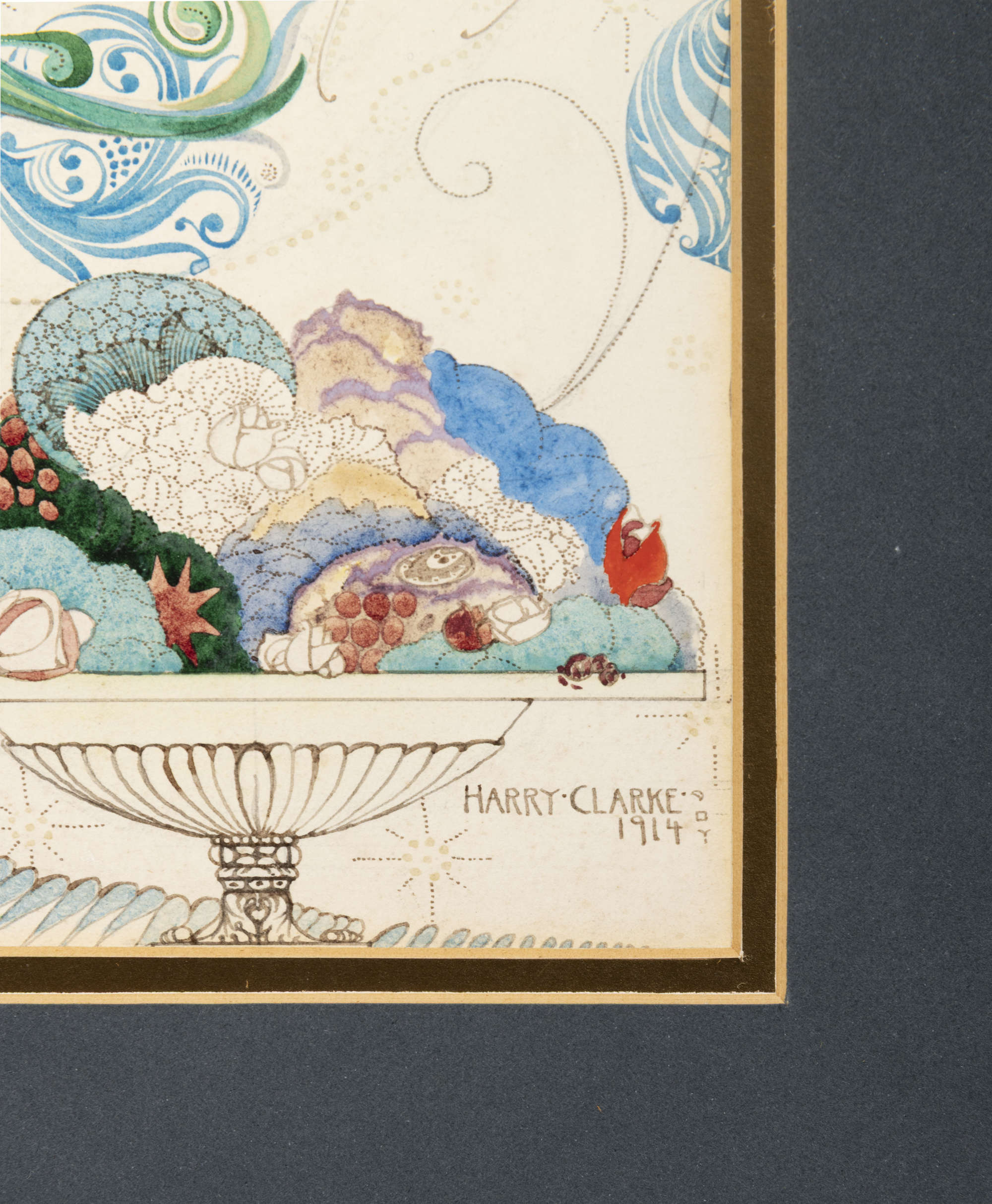
Several aspects of this illustration anticipate some of Clarke’s secular works in stained glass. The Lady herself could be considered a prototype for one of the queens in his series of nine Queens panels (1917) – inspired by Synge’s poem of that title – which he created for the Killiney library of Clarke’s great patron, Larky Waldron. The choice of a limited colour palette and flat background juxtaposed with intense decorative elements are also a feature of the Queens series. The two exotic birds in flight and the tazza, or shallow vase, heaped with assorted blooms are variants of those that would feature in his much admired four Orders of Architecture windows (1928) made for Bewley’s café in Grafton Street.
Clarke signed The Lady of the Decoration in clear elongated capitals rather than his usual handwritten signature, perhaps cognisant that the carefully lettered version would have more clarity and consequently act as a better promotion for him personally.
Dr David Caron, August 2025
[1] This and much of the information in this catalogue entry is derived from Nicola Gordon Bowe’s unpublished PhD, ‘Harry Clarke 1889–1931, his Life and Work’, Trinity College Dublin, 1982, vol. 1.
[2] Nicola Gordon Bowe, Harry Clarke: his graphic art (Dublin, 1983), p. 37.
All bids are placed in Euros (€)
Please note that by submitting a bid you are agreeing to our Terms & Conditions


 Have a similar item to sell?
Make Enquiry
Have a similar item to sell?
Make Enquiry