Click on image to open full size.


Harry Clarke RHA (1889-1931)
Faust (1924/25)
Pen, ink and watercolour, 33.5 x 23.5cm (13¼ x 9¼'')
Provenance: Private Collection, Dublin
Harry Clarke created illustrations for several classic...
Harry Clarke RHA (1889-1931)
Faust (1924/25)
Pen, ink and watercolour, 33.5 x 23.5cm (13¼ x 9¼'')
Provenance: Private Collection, Dublin
Harry Clarke created illustrations for several classic books which were published by the London firm of George G. Harrap & Co., including Hans Andersen’s Fairy Tales (1914), Edgar Allan Poe’s Tales of Mystery and Imagination (1919), and The Fairy Tales of Perrault (1922). His final book with Harraps, and the one with the greatest amount of illustrations, was John Anster’s translation of Goethe’s Faust (1925).
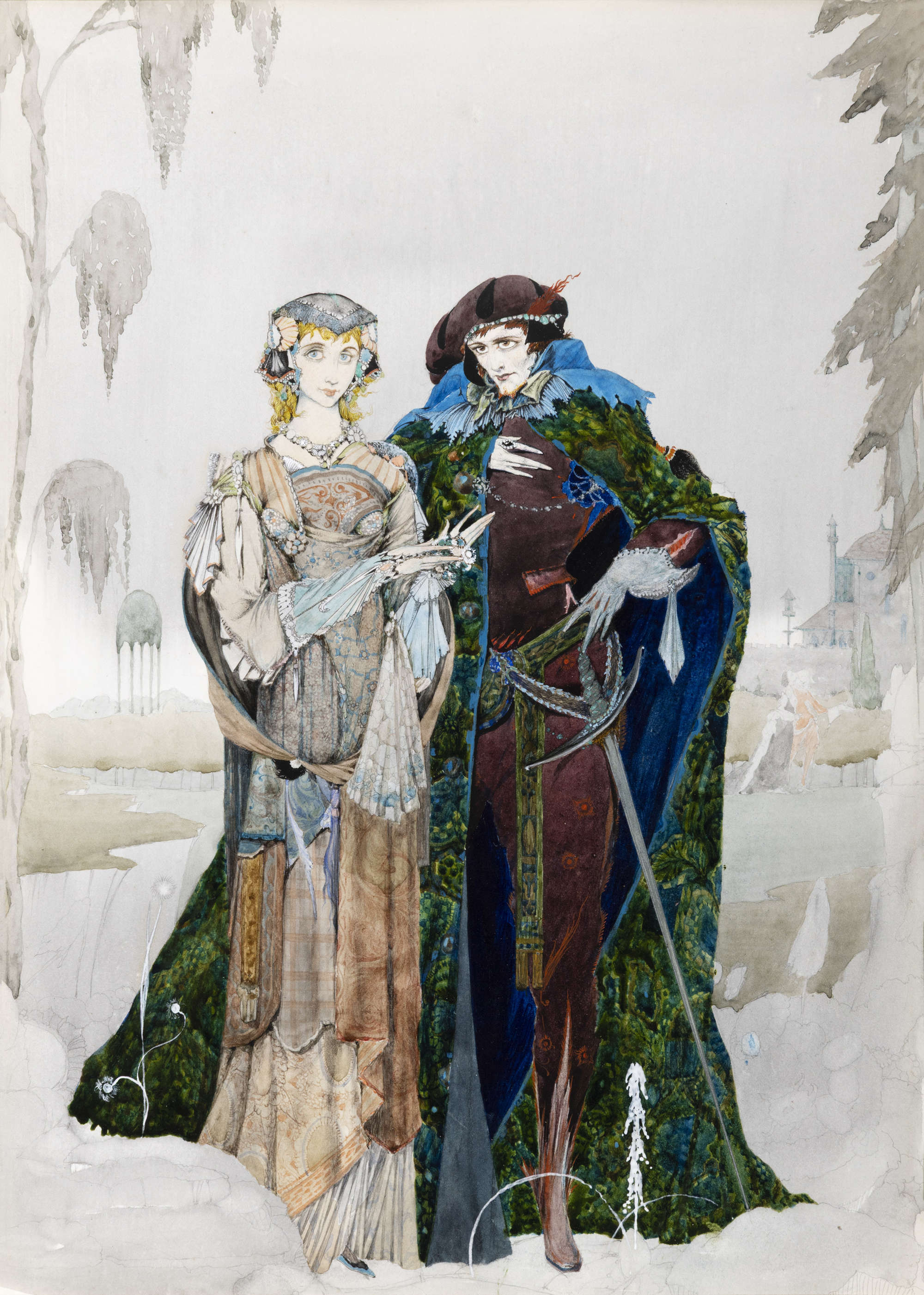
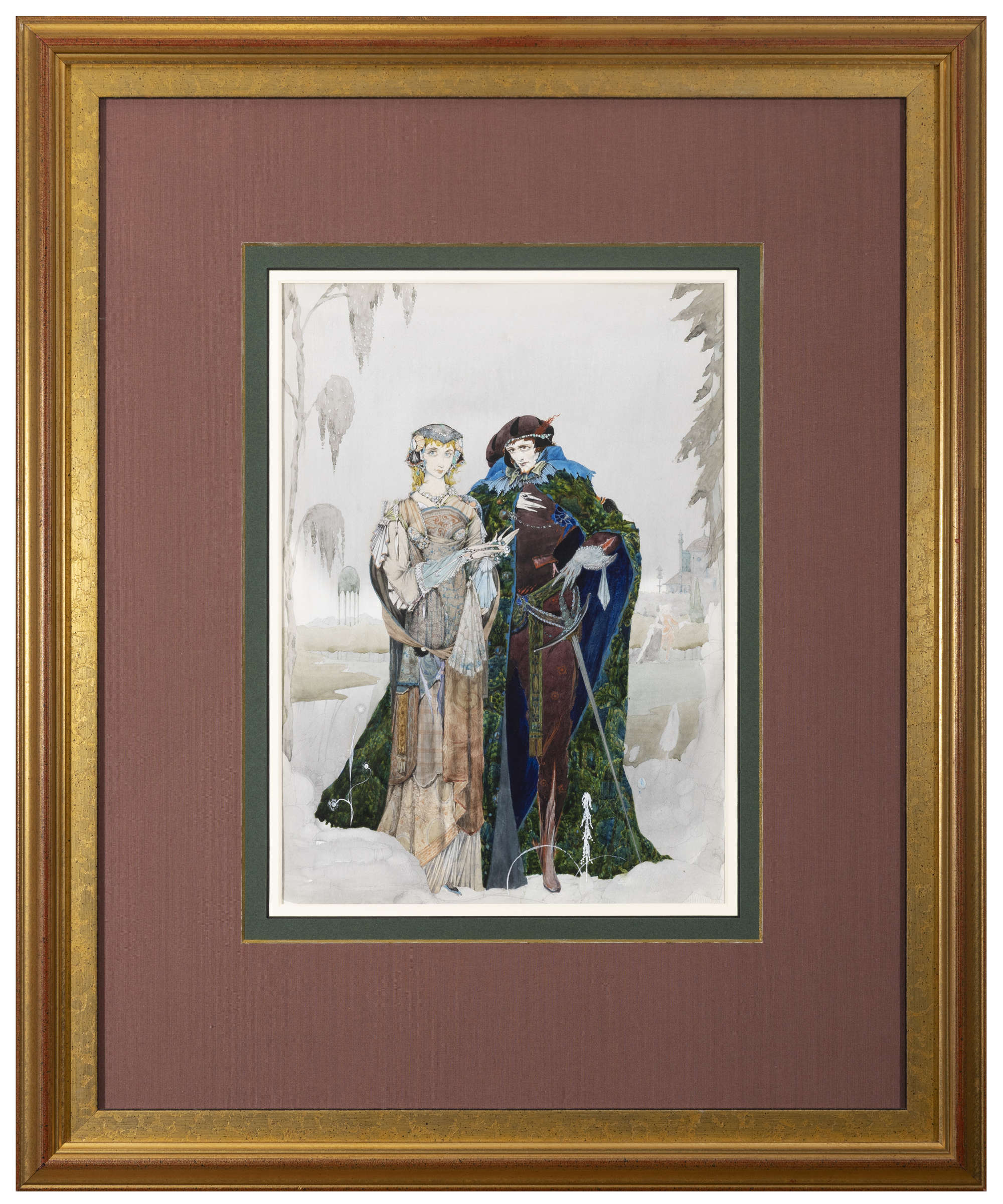
The book’s protagonist, based on the legendary German, Johann Georg Faust (c.1480–1540), enjoyed a successful life, though one that left him dissatisfied, and so he made a pact with the devil to exchange his soul for unlimited knowledge and worldly pleasures. Faust was a mammoth undertaking, for which Harry Clarke created ninety illustrations in all, the majority in crisp black and white, devised to be integrated within the columns of text. It appears he started work on the illustrations in June 1924 and completed the task twelve months later, while fully engaged in important stained glass commissions throughout the same period. Despite the quantity of images featured in Harrap’s deluxe limited edition, some of the illustrations Clarke had submitted were left out, including this full page illustration of a garden scene depicting Faust and Marguerite. Dr Nicola Gordon Bowe, the expert on Harry Clarke’s life and work, described Harrap’s decision to omit this ‘truly beautiful watercolour’ as inexplicable.[1] Many of Clarke’s illustrations for Faust are appropriately dark and macabre, even disturbing, though not this one and it may have been among the last tranche he sent to George Harrap, informing him that they were ‘not quite as gruesome as the first I had sent you’.[2]
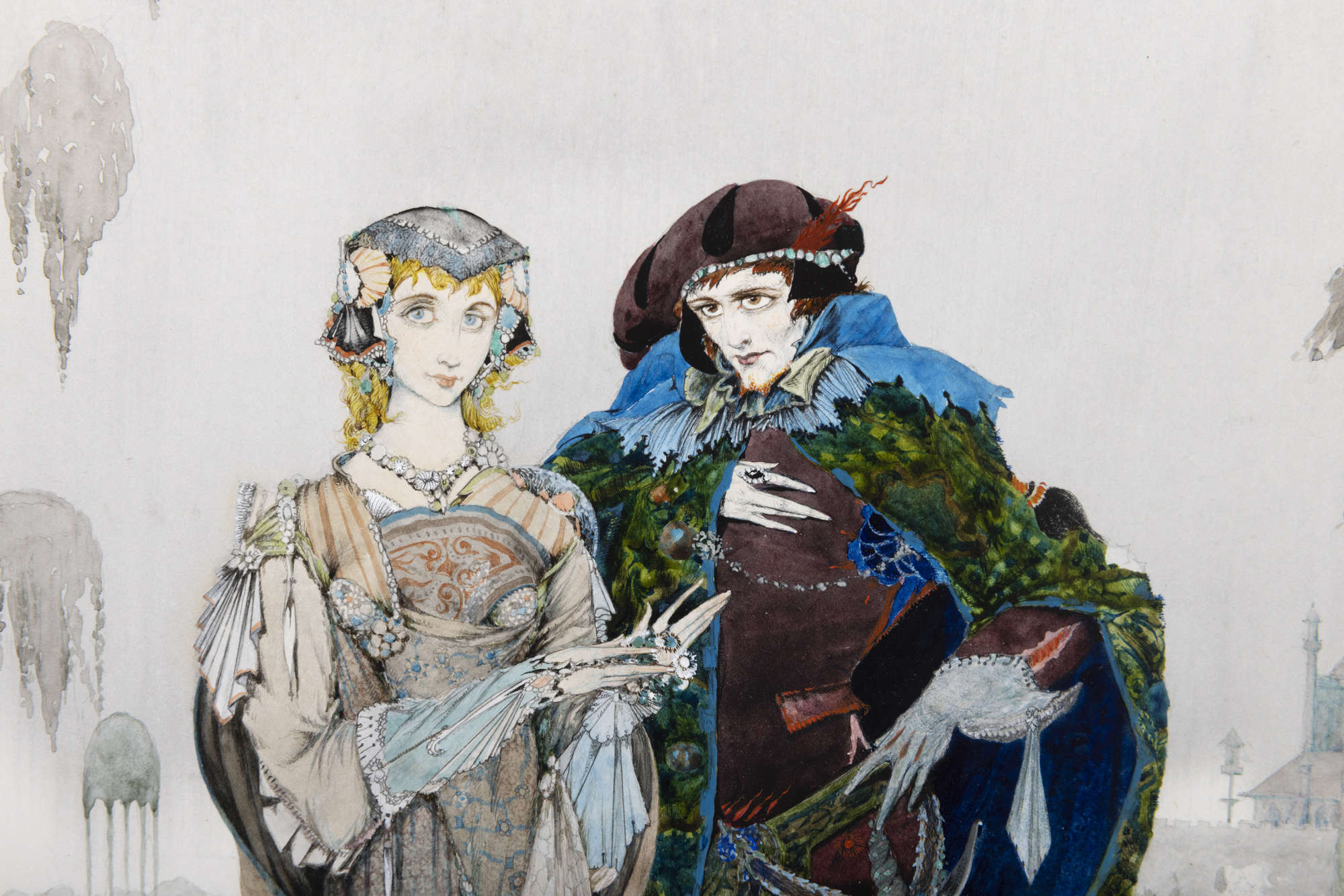
Clarke’s illustration depicts Faust courting Marguerite, a beautiful and innocent young girl with whom he falls madly in love, and who in turn falls in love with him – though in time, with her unexpected pregnancy and the subsequent murder of her brother, it all ends horribly. In Clarke’s illustration, wide-eyed Marguerite gazes out at the viewer while Faust’s attention is fixed on her. The scene takes place in the garden of Marguerite’s neighbour, a wealthy gentlewoman, Dame Marthe Schwerdtlein, and in the right background one can see not only Marthe’s house, depicted by Clarke as a fanciful Hindu-Gothic tempietto, but also the shadowy figures of Marthe sharing an intimate moment with the Devil in the form of Mephistopheles.
Clarke was an enthusiastic attendee at the theatre and ballet, and with the elaborate costumes and simplified flat grisaille background one could be watching the two principal actors on a stage – and indeed the story of Faust was popularised in Charles Gounod’s eponymous opera. The degree of detail and imagination that Clarke has brought to Faust and Marguerite’s costumes is simply mesmerising, and Clarke who had an intense dislike for drawing ears and wrists, has, as was his habit, covered these features with elaborate headwear and gloves.
Dr David Caron, August, 2025
[1] Nicola Gordon Bowe, unpublished PhD, ‘Harry Clarke 1889–1931, his life and work’, Trinity College Dublin, 1982, vol. 1, p. 690.
[2] Ibid, vol 1, p. 626.
All bids are placed in Euros (€)
Please note that by submitting a bid you are agreeing to our Terms & Conditions


 Have a similar item to sell?
Make Enquiry
Have a similar item to sell?
Make Enquiry