Click on image to open full size.


Jack Butler Yeats RHA (1871-1957)
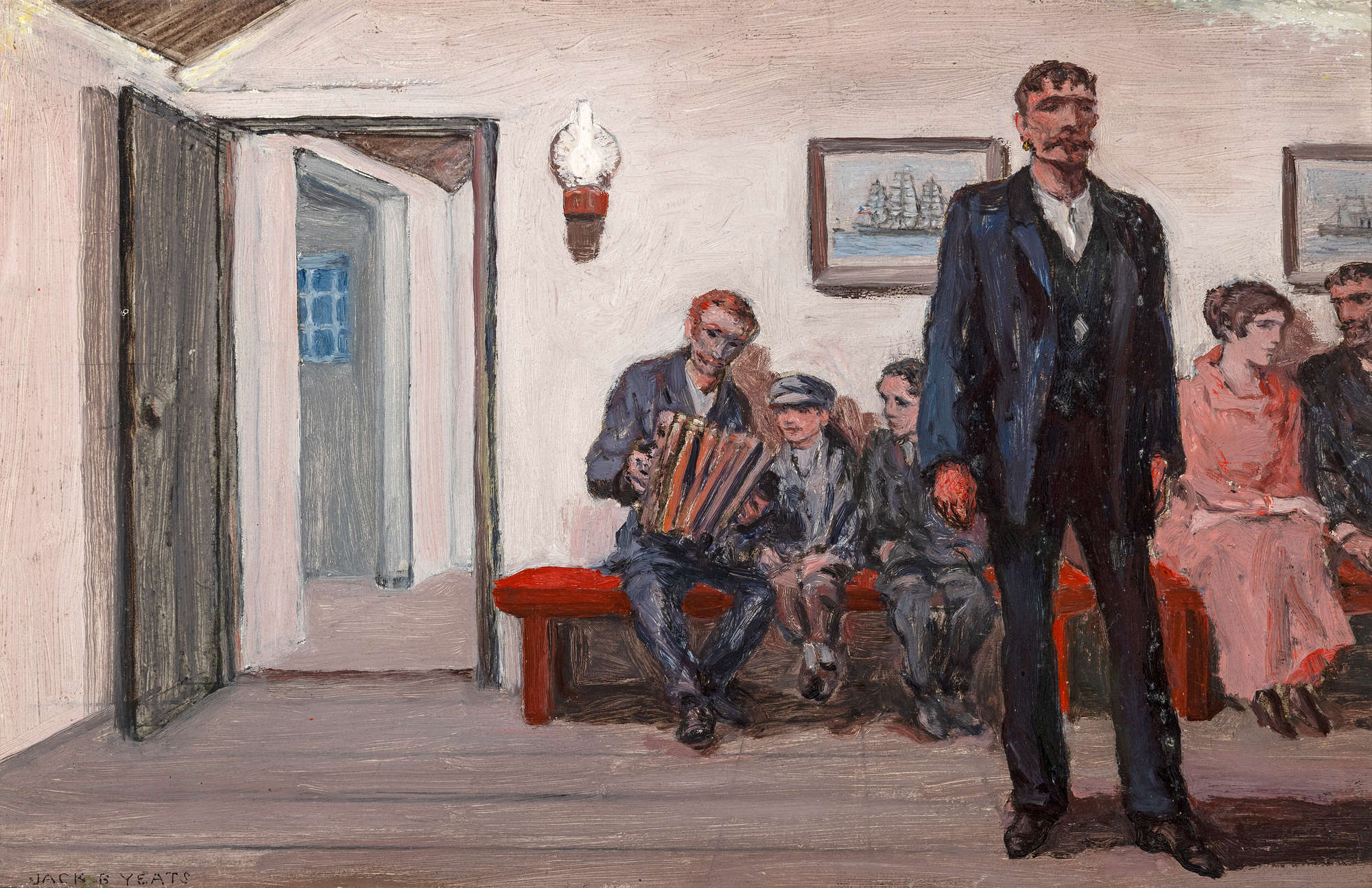
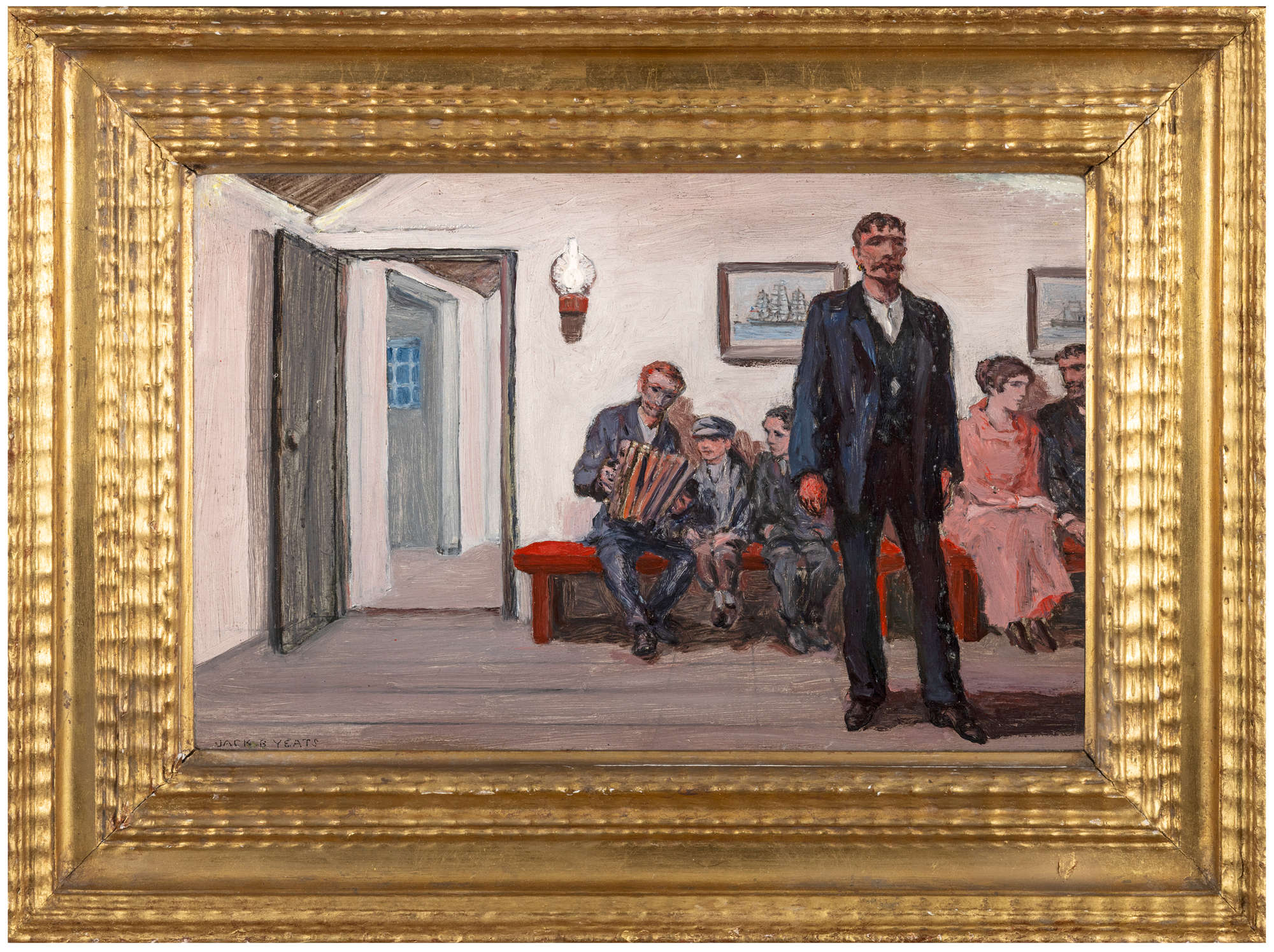
The Dancer (Rosses Point, Sligo) (1921)
Oil on board, 23 x 35cm (9 x 14")
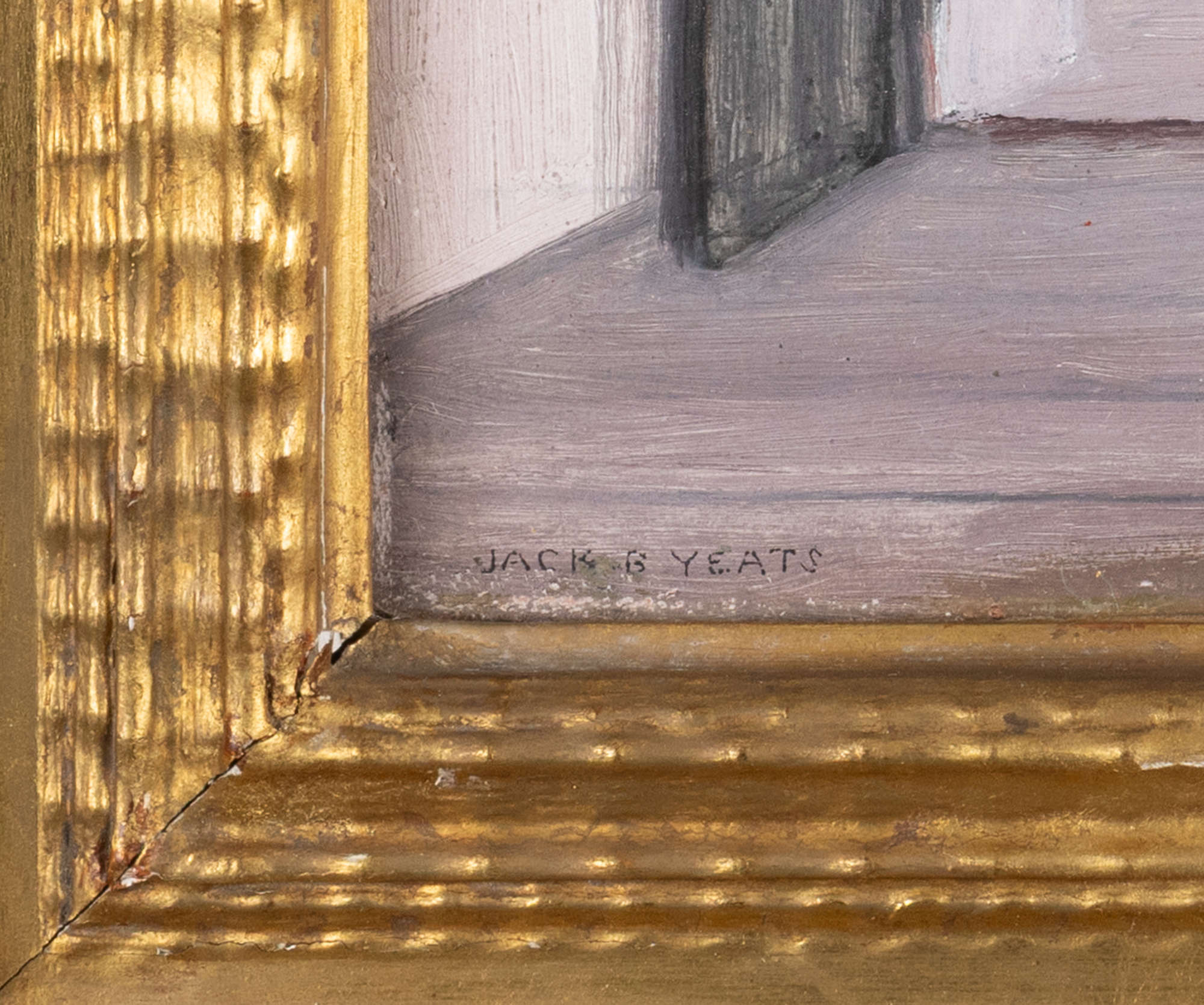
Signed
Provenance: Collection of the late Justice Conor Maguire; Collection of Reeta and...
Jack Butler Yeats RHA (1871-1957)
The Dancer (Rosses Point, Sligo) (1921)
Oil on board, 23 x 35cm (9 x 14")
Signed
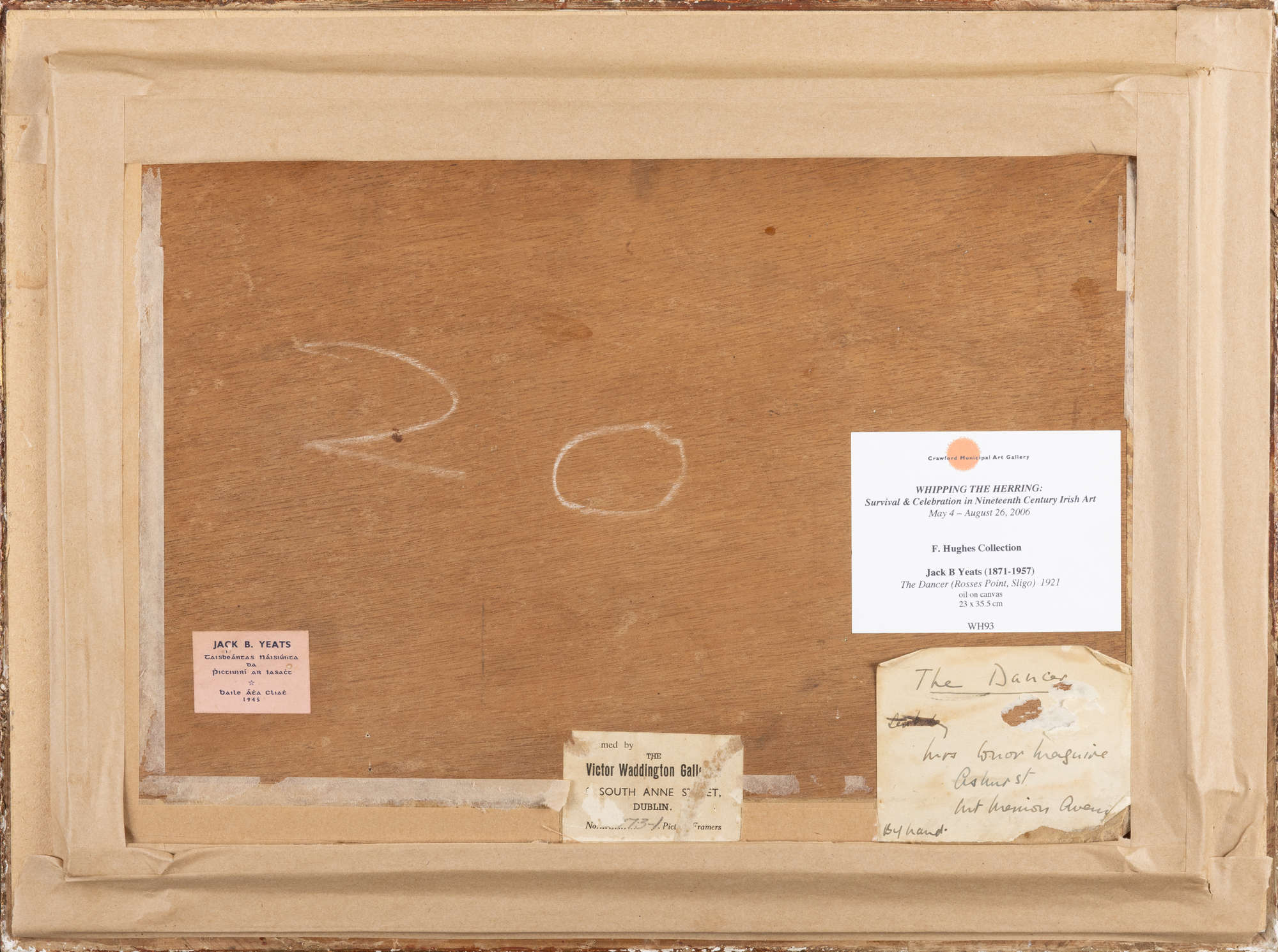
Provenance: Collection of the late Justice Conor Maguire; Collection of Reeta and Frank Hughes, Warrenpoint, thence by descent.
Exhibited: Sligo, County Museum and Art Gallery, ‘Jack B Yeats’ Aug/Sept 1989, cat.no.24
Literature: Hilary Pyle, ‘Jack B. Yeats, A Catalogue Raisonne of the Oil Paintings’ cat.no.152, p.133; ‘Whipping the Herring’ 2006, p.118, illus. p.119; Claudia Kinmonth, ‘Irish Rural Interiors in Art’, p.72 & 190, illustrated p.72
This painting is one three works inspired by the life of people of Sligo, painted by Jack B. Yeats in 1921. The others, A Summer Evening, Rosses Point and Knocknarea and the Flowing Tide show figures outside enjoying the fine weather and the magical landscape of that region. At Rosses Point, 1922, could be seen as a counterpart to A Dancer, as it shows a group of young women dancing outside a cottage. Yeats had a special regard for Rosses Point, a village at the mouth of the Garavogue river, a few miles from Sligo town. He spent much of his childhood there, visiting his uncle, Henry Middleton, and looking at the ships coming in and out from the Atlantic ocean. The setting remained a recurring backdrop in his work.
In the painting, a young man dances with his arms straight by his sides and his face looking directly ahead. His almost rigid pose contrasts with the informality of the figures seated on the red benches behind him. A young woman in a pink dress chats to a man. Two boys look on engrossed at the accordion, whose player inclines his head to one side, evoking the idea of music. The plain surroundings are of white washed walls, grey scrubbed floorboards and an open door that leads to the dimly lit porch with a window on the left. An oil lamp throws white light across the space. Next to it the only decoration are two framed prints of sailing ships, reminding us of the maritime nature of this location.
This simple setting provides a powerful environment for the dancer, whose strong almost sculpted features, long thin face, moustache and curly hair and smart suit convey an air of dignity. According to Hilary Pyle, Yeats said that ‘the dancer deliberately opened his waistcoat in order to make clear that he was wearing a shirt, and not merely a dickey’. When exhibited at the Dublin Painters Gallery in 1921 the Freeman’s Journal
1. This painting is also known as A Summer Evening. Rosses Point. It is listed in H. Pyle, Jack B. Yeats. A Catalogue Raisonné of the Oil Paintings, Andre Deutsch, 1992, 1, p. 149.
2. Pyle, Jack B. Yeats. A Catalogue Raisonné of the Oil Paintings ,1, p. 133.
3. J.W.G, Freeman’s Journal. 21 February 1921.
All bids are placed in Euros (€)
Please note that by submitting a bid you are agreeing to our Terms & Conditions


 Have a similar item to sell?
Make Enquiry
Have a similar item to sell?
Make Enquiry