Click on image to open full size.


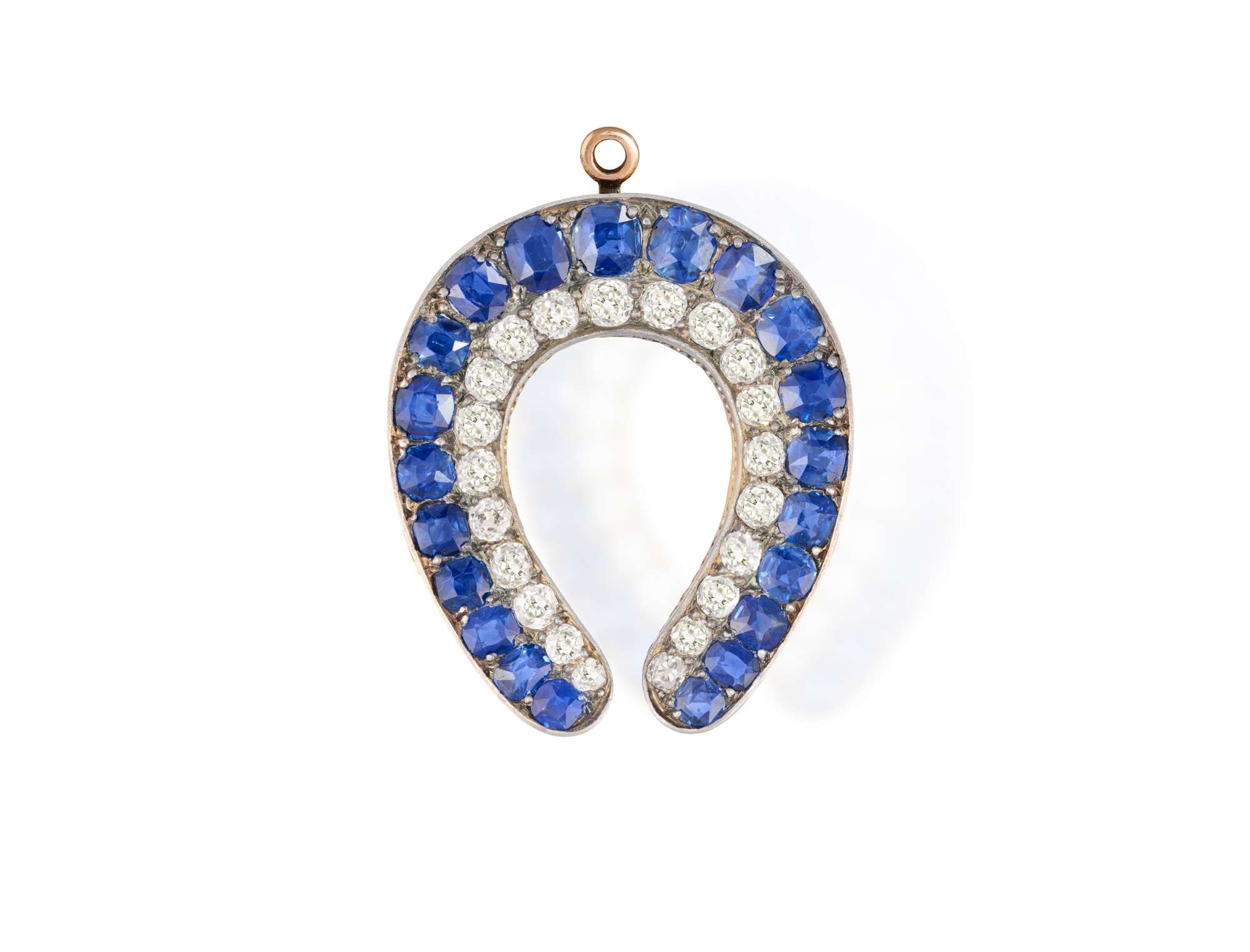
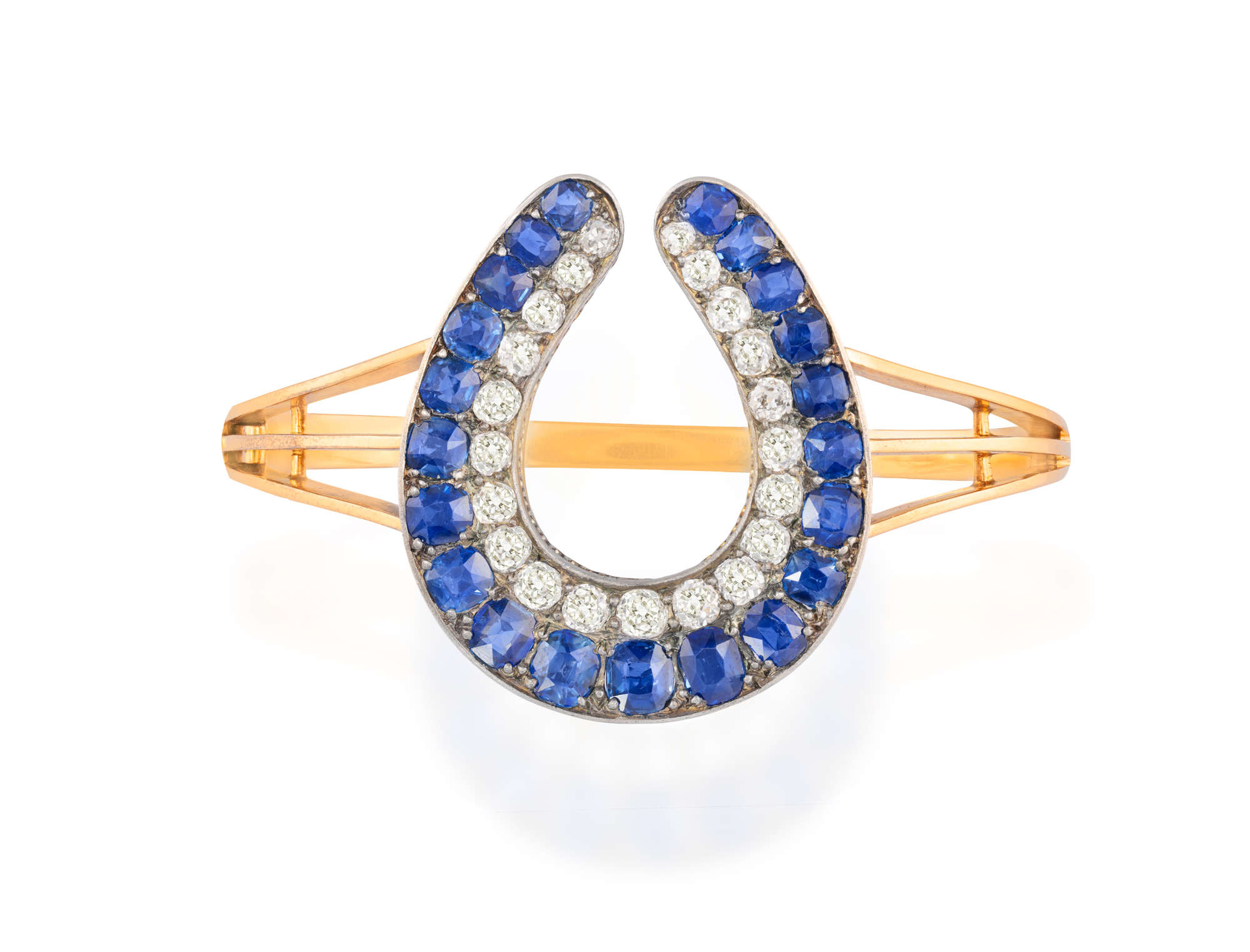
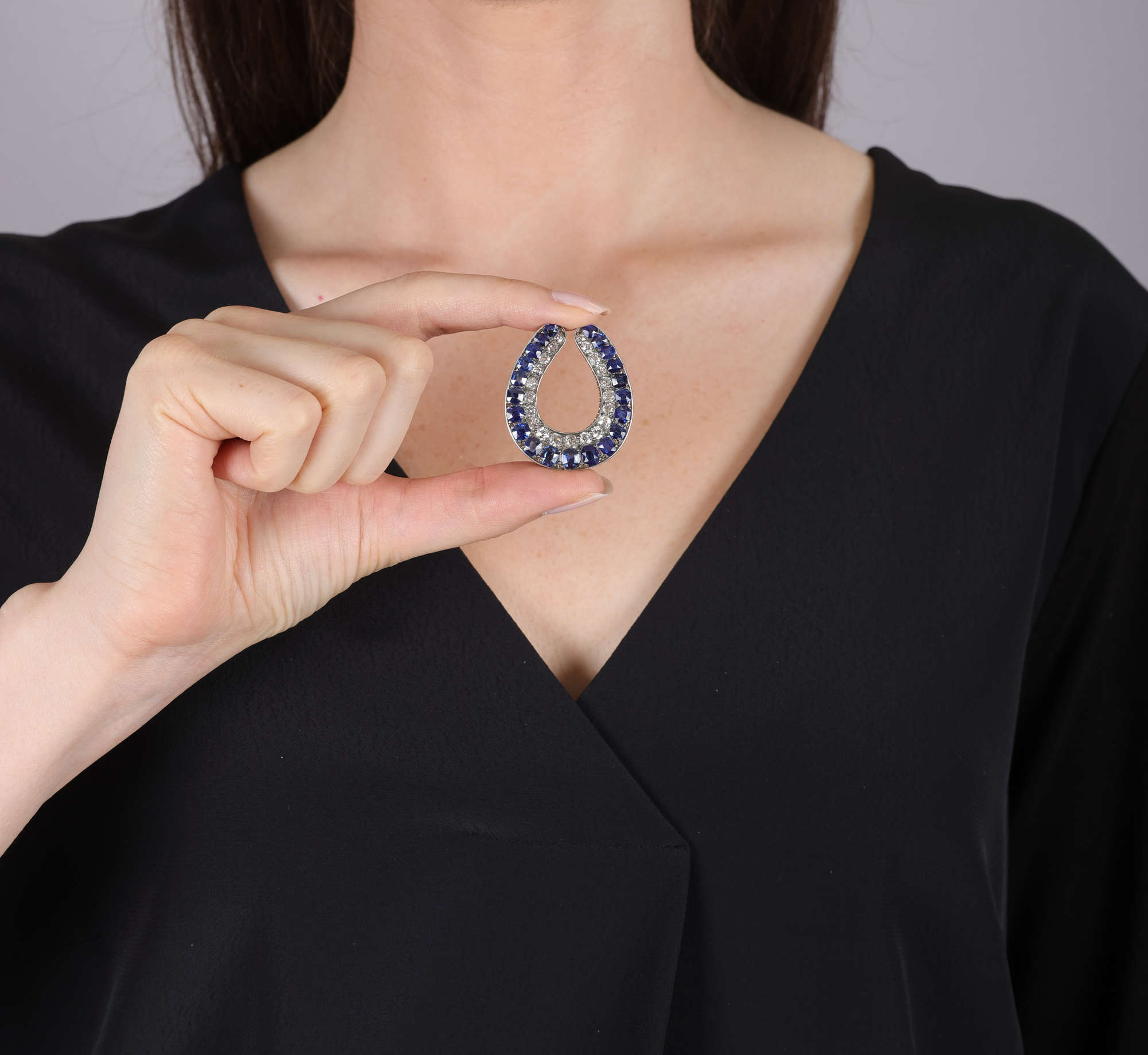
A LATE 19TH CENTURY SAPPHIRE AND DIAMOND PENDANT/BANGLE, CIRCA 1880
The horseshoe motif, set with a series of cushion-shaped sapphires highlighted with a line of old-cut diamonds, mounted in...
A LATE 19TH CENTURY SAPPHIRE AND DIAMOND PENDANT/BANGLE, CIRCA 1880
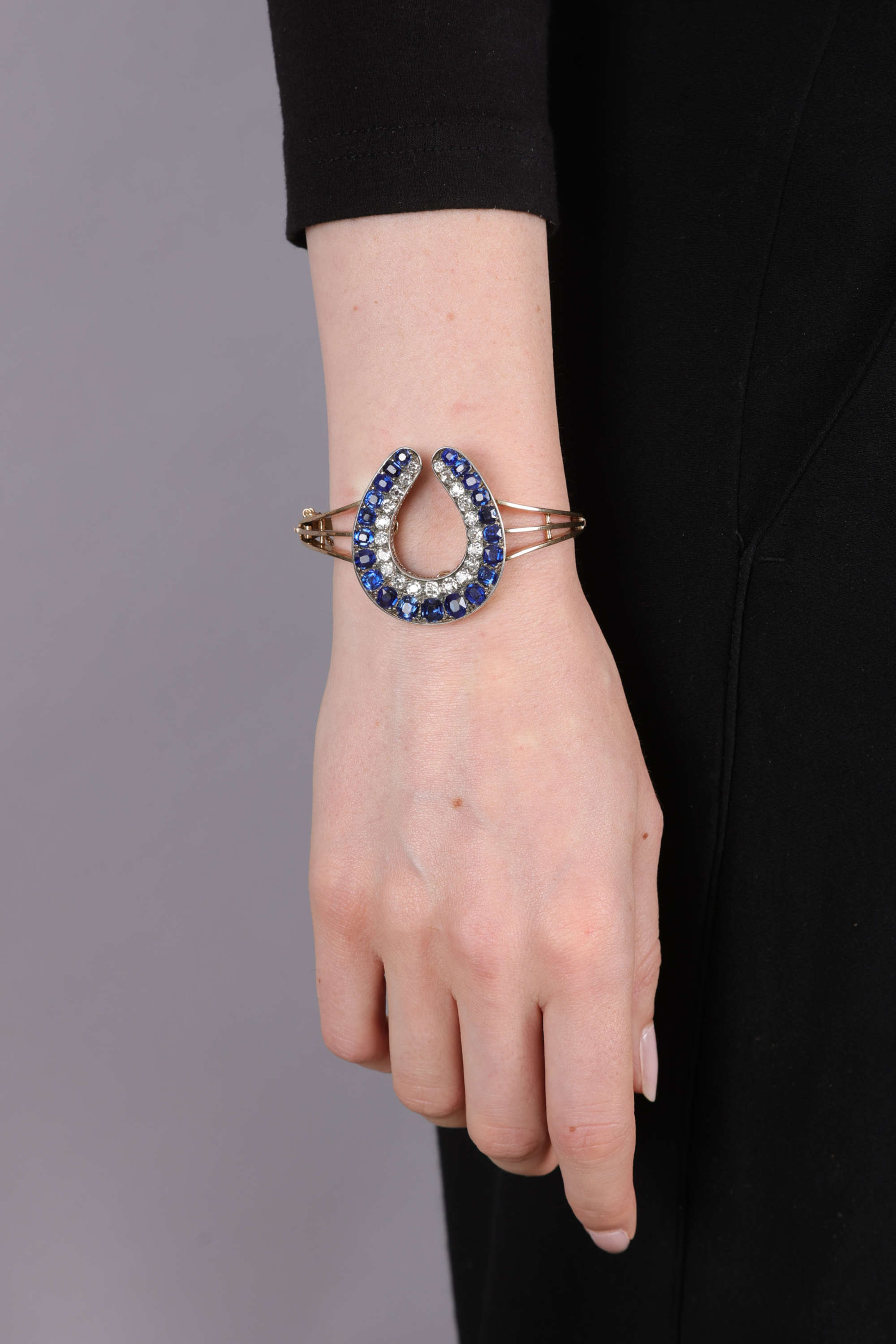
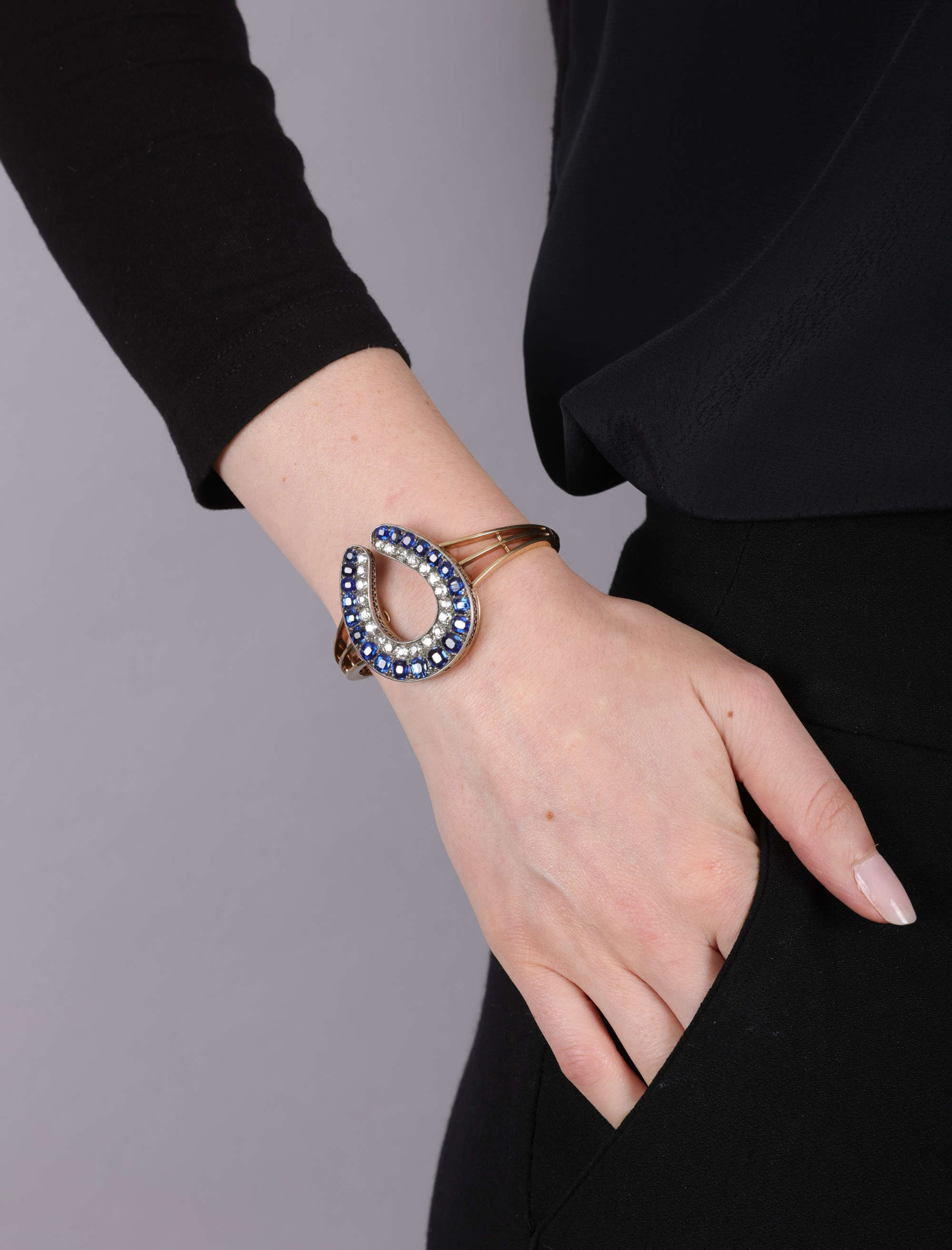
The horseshoe motif, set with a series of cushion-shaped sapphires highlighted with a line of old-cut diamonds, mounted in silver and gold, diamonds approximately 2.50cts total, detachable motif with bale to be worn as a pendant, screws to gold bangle, bangle inner diameter 5.6cm, pendant length 3.7cm
Please note that a random test was carried out on some of the sapphires at GCS laboratory in London in July 2025, these were found to be of Basaltic origin, with no indications of heating.
AN IMPORTANT PRIVATE COLLECTION (lots 39 to 57) Provenance:
For centuries a symbol of good fortune and protection, the horseshoe gained particular prominence in jewellery during the late Victorian and Edwardian eras. Drawing from a rich tapestry of folklore and superstition, these pieces were crafted not merely as decoration but as meaningful talismans.
The horseshoe was long revered as a protective charm and bearer of luck. As one legend asserts, Saint Dunstan nailed a horseshoe to the Devil’s hoof, compelling him to vow never to enter a home adorned with one: an origin story that underpinned the symbol’s protective reputation throughout Europe.
In the Victorian era, especially its latter half, the horseshoe motif soared in popularity. It was frequently worn upwards, so the open end would “catch and hold” good luck, reversing it was thought to spill fortune away. As belief in superstition grew, jewellery featuring the horseshoe offered wearers both aesthetic appeal and symbolic reassurance.
Victorian horseshoe jewellery appeared in versatile forms, such as rings, brooches, pendants, lockets, and charms with horseshoe motifs frequently graced sentimental gifts and love tokens.
AN IMPORTANT PRIVATE COLLECTION
From the gilded age of New York high society to a marriage with a titled family accross the Atlantic
Benjamin Aymar Sands (1853-1917) and his wife Amy Kirby Akin (1850-1934) of 43 East 18th Street, New York, gifted to their daughter May Emily Sands (1879-1941) to celebrate her marriage on 19th September 1908 to the Hon. Hugh Melville Howard (1883-1919) younger son of the 6th Earl of Wicklow (1842-1891) and Fanny Catherine Wingfield (1860-1914); by descent to their daughter Katharine Frances Howard (1910-1990) of Shelton Abbey, Co, Wicklow and Ounavarra House, Co. Wexford; godmother to the present owner
The lineage of the renowned Sands family can be traced back to a Captain John Sands who settled on Long Island in the late 17th century. Over time, the Sands family became one of the original owners and settlers of this area, which is now acknowledged as Sand’s Point. Sand’s Point is probably best known as the location to what is believed to have influenced F. Scott Fitzgerald’s ‘East Egg’ in The Great Gatsby. Fitzgerald was inspired by the opulence and scenic coastal views, which became a haven for old-money families and established social circles in the early 20th century.
Benjamin Aymar Sands (1853-1917) was the son of the well-known New York banker Samuel Stevens Sands I (1827-1892). In 1882, Benjamin assisted with the organisation of the firm Bowers and Sands. Considered an authority on real estate titles, Benjamin was appointed receiver of the Indianapolis, Decatur and Springfield Railroad and was vice-president of the Colorado Midland Railway. The first law firm that he formed was Webb and Sprague. This was a partnership that included H. Walter Webb, a railway executive with the New York Central Railroad under Cornelius Vanderbilt and Chauncey Depew. In 1878, he married fellow New Yorker, Amy K. Aiken.
The marriage of their daughter May to the Hon. Hugh Melville Howard brought together a bond of American society and European aristocracy. The groom was the younger son of the 6th Earl of Wicklow, whose ancestral seat was Shelton Abbey, Co. Wicklow. The New York Times reported on the wedding that took place on 19 September 1908 at the Old Dune Church at Southampton, Long Island. Not without a hitch it was recorded that the groom’s brother, also the best man missed the wedding. This unfortunate circumstance was due to the Mauretania arriving late into New York because of fog. The ambience of the day was described ‘as the sun’s rays streaked through the stained-glass windows and over the slanting eaves fringed with Autumn leaves, the setting for the wedding formed a quaint contrast to the fashionable coterie gathered to witness it’.
Unfortunately, the idyll of married life was not to last, as Hugh died of pneumonia at a young age and May developed psychological problems and had to be institutionalised. Their two children Katharine and Cecil went to live with their uncle the 7th Earl of Wicklow at Shelton Abbey and spent holidays with their adoring grandmother Amy Sands. Katharine remained in Ireland and purchased Ounavarra House, Co. Wexford, where she farmed. Katharine also contributed greatly to Irish society by starting a troop of girl guides and lent support to An Taisce, Council for the Blind, The Society for the Prevention of Cruelty to Animals (SPCA) and the National Fisheries Authority. When Cecil died in New York in 1983, the Earldom became extinct. Katharine died in 1990 and was buried in the family vault in Kilbride Church in Co. Wicklow. As she was the last surviving descendent of the Earls of Wicklow, the vault was sealed for all time. However, Katharine’s legacy remains to this day in the form of the Katharine Howard Foundation. This rediscovered private collection of exquisite jewellery brings to light a charmed time and place, ‘Across the courtesy bay the white palaces of fashionable East Egg glittered along the water…’ (F. Scott Fitzgerald, The Great Gatsby, New York, 1925, p.5)
All bids are placed in Euros (€)
Please note that by submitting a bid you are agreeing to our Terms & Conditions


 Have a similar item to sell?
Make Enquiry
Have a similar item to sell?
Make Enquiry