Click on image to open full size.


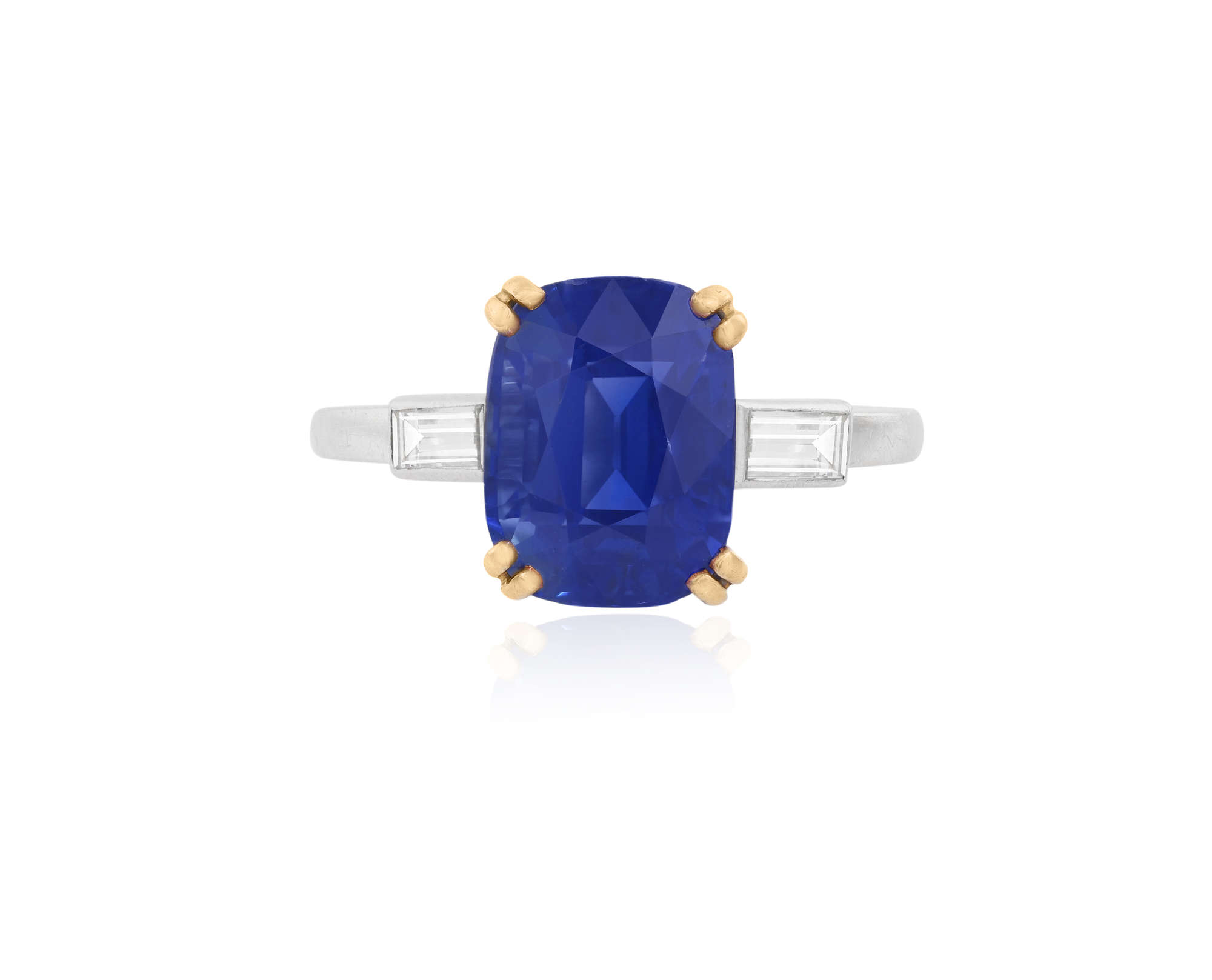
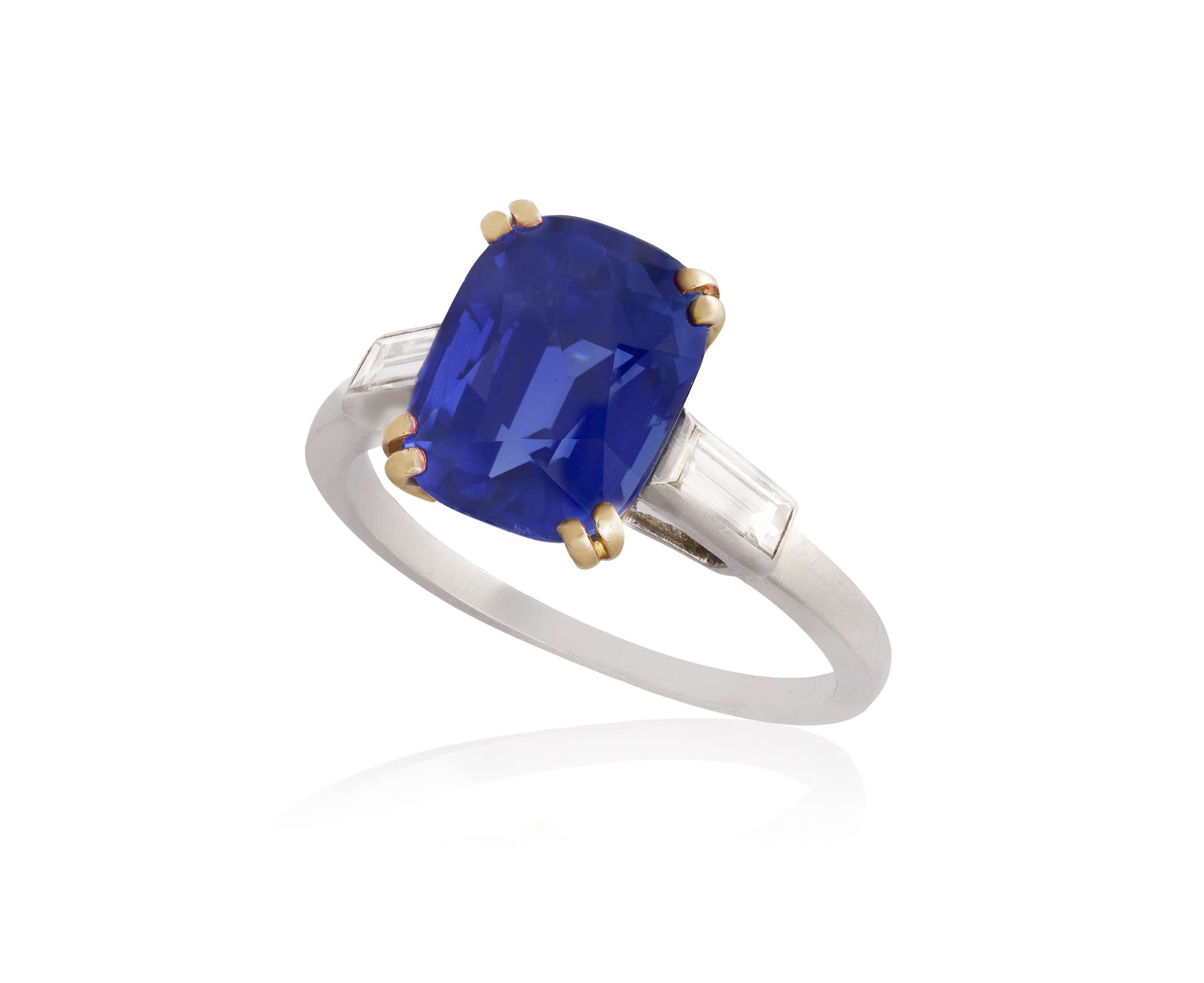
KASHMIR. BOUCHERON: A FINE SAPPHIRE AND DIAMOND RING, FIRST QUARTER OF THE 20TH CENTURY
* No internet bidding for this lot
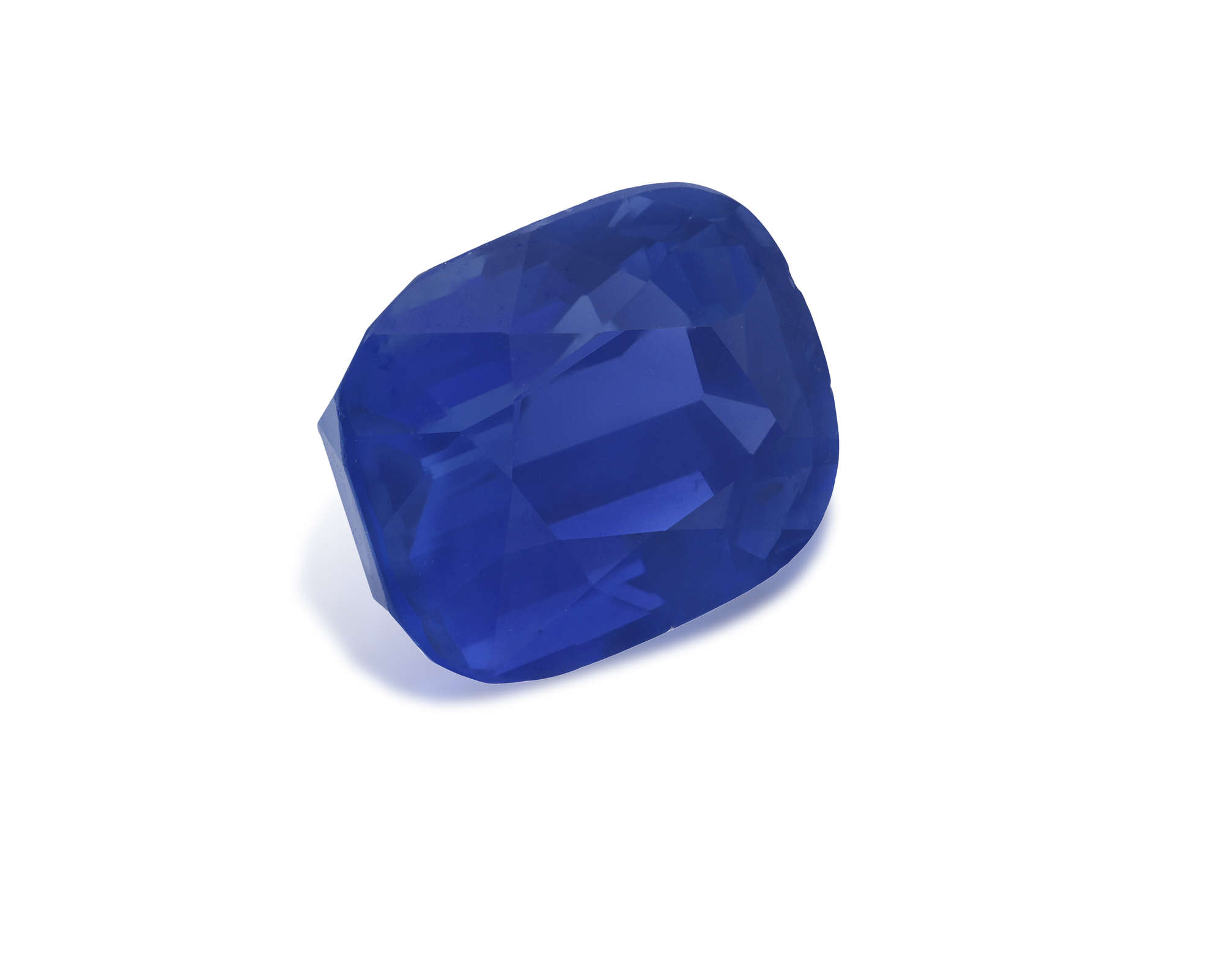
The cushion-shaped sapphire weighing 5.08cts, between baguette-cut...
KASHMIR. BOUCHERON: A FINE SAPPHIRE AND DIAMOND RING, FIRST QUARTER OF THE 20TH CENTURY
* No internet bidding for this lot
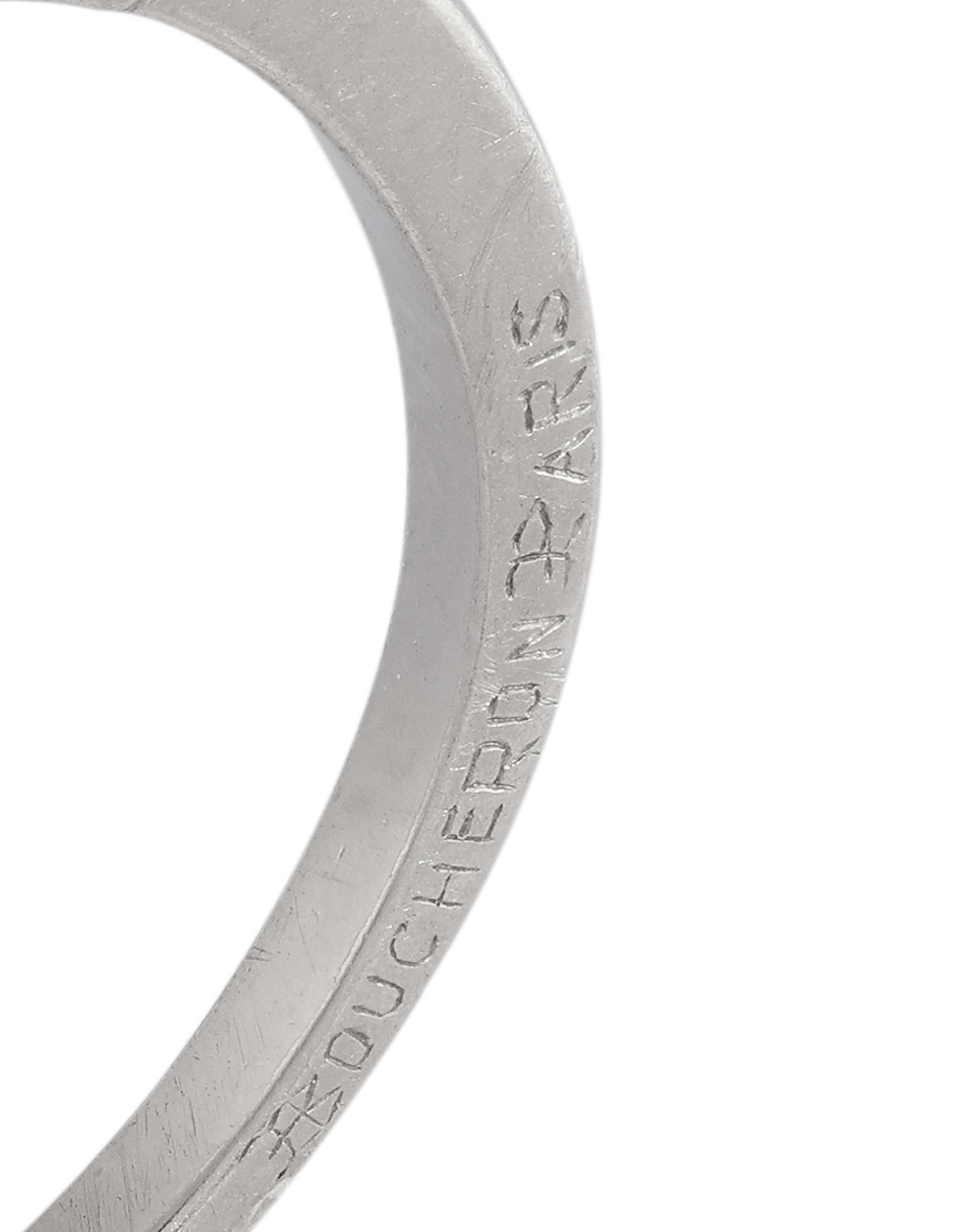
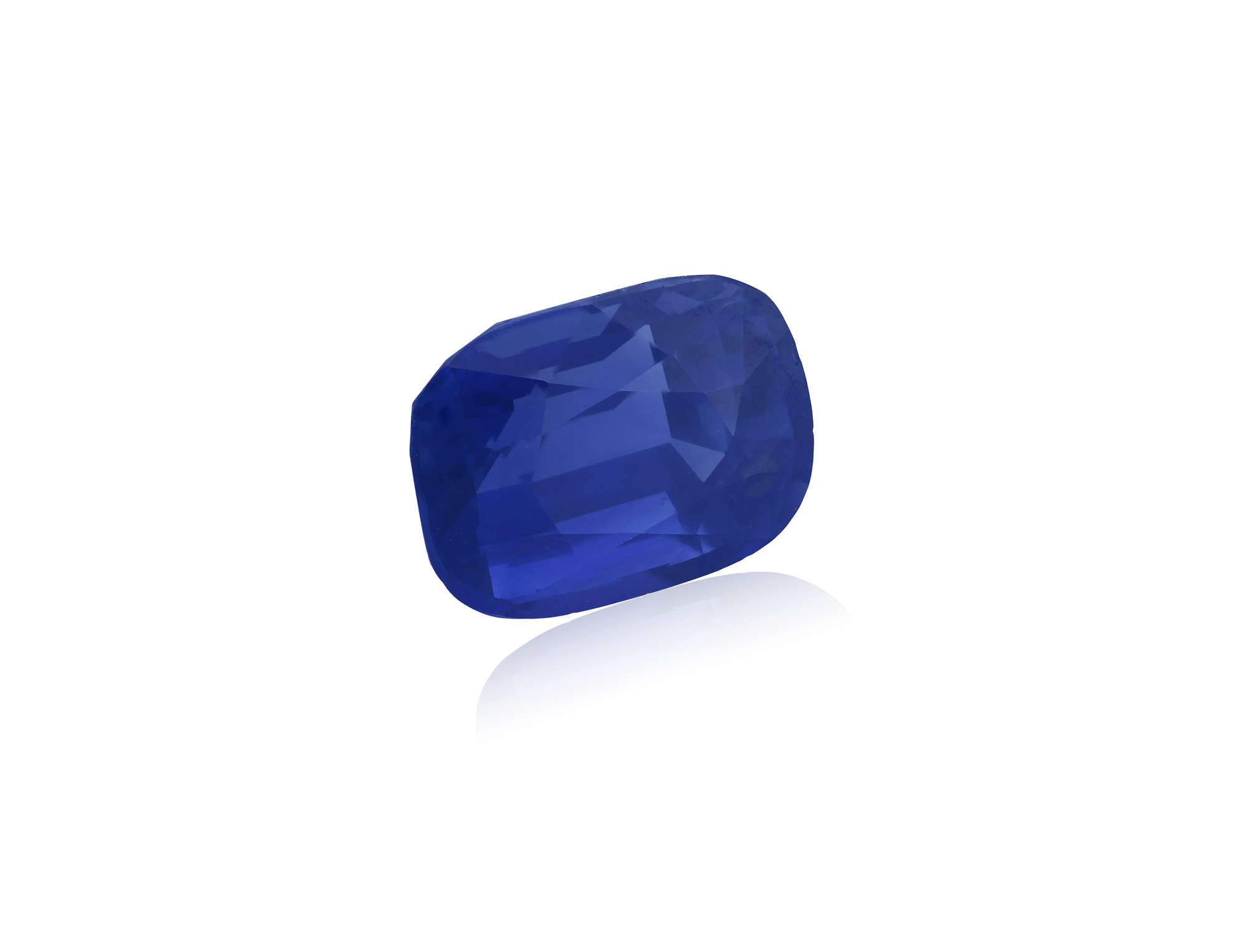
The cushion-shaped sapphire weighing 5.08cts, between baguette-cut diamond shoulders, mounted in platinum and 18K gold, signed Boucheron Paris, French assay marks, ring size K
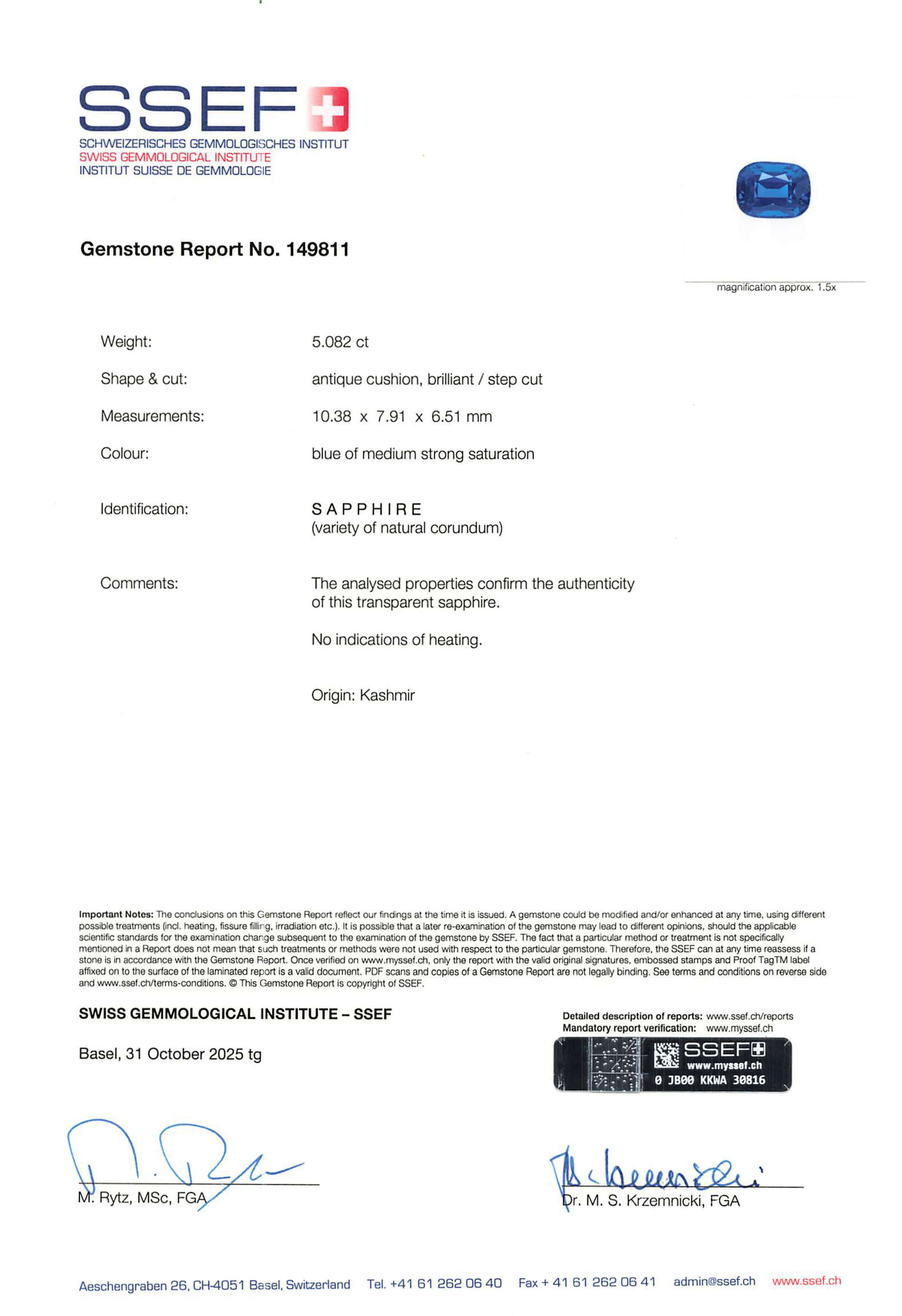
Accompanied by a report from the SSEF laboratory in Switzerland, stating that the sapphire weighing 5.08cts, is of Kashmir origin, with no indications of heating. Report number 149811, dated October 31st 2025.
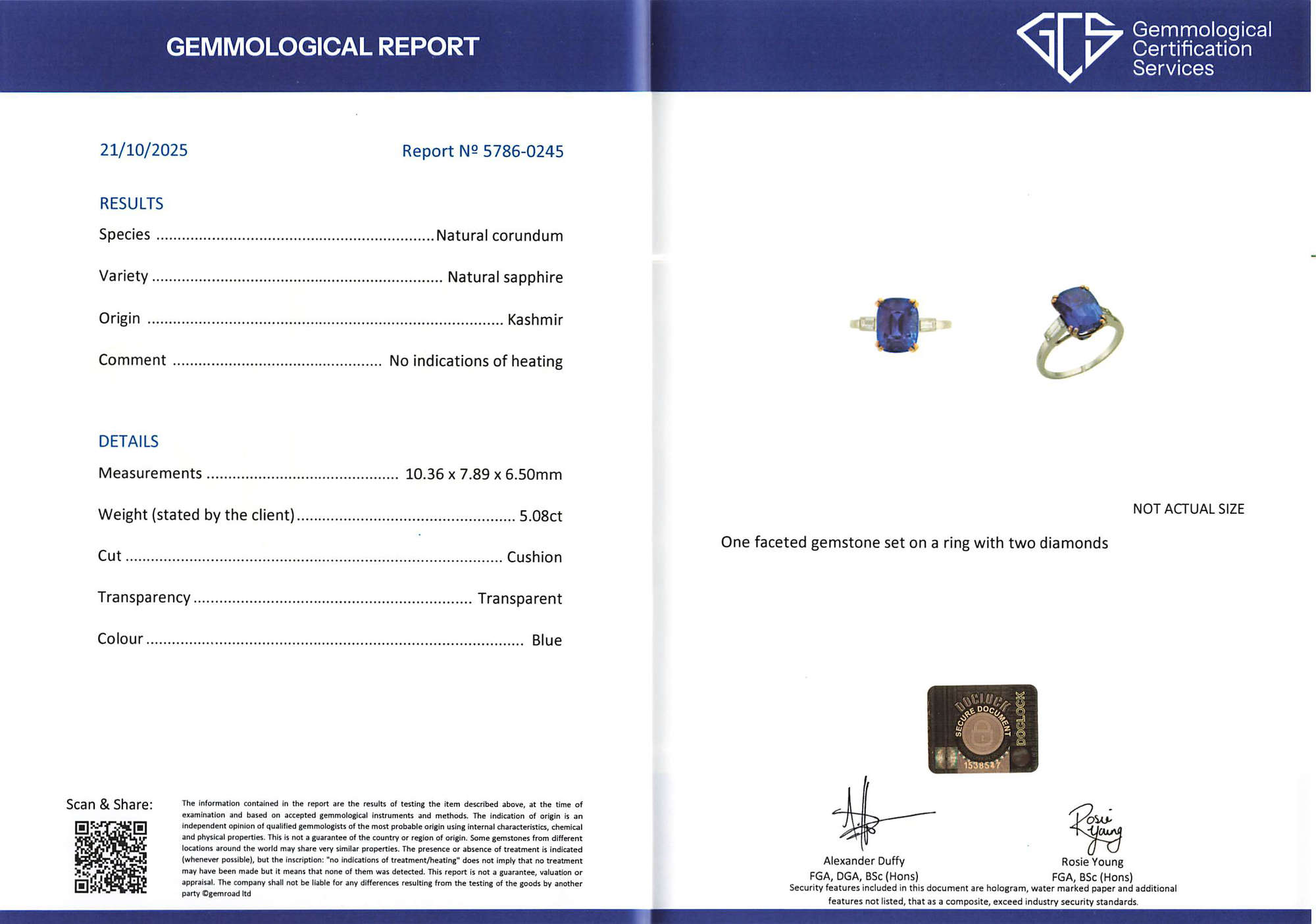
Accompanied by a report from GCS laboratory in London, stating that the sapphire weighing 5.08cts is of Kashmir origin, with no indications of heating. Report number 5786-0245., dated October 21st 2025.
* Please note that the stone was unset for laboratory testing. The stone will be on view loose and will not be reset for the sale.
Provenance: Private Collection (lot 46 to 51) from a Member of the Guerlain Family
This ring was acquired circa 1930s in Paris by a member of the Guerlain family, thence by descent
The Guerlain family name is synonymous with being among the world’s oldest and most prestigious perfume houses. Founded in Paris in 1828, Pierre-François-Pascal Guerlain (1798-1864) opened the first boutique a 42, rue de Rivoli in Paris. Subsequently, Pierre-François became the official perfumer to His Majesty in 1853 after creating the Eau de Cologne Impériale for Empress Eugénie, the wife of Napoleon III. Following the death of Pierre- François, the future of the perfume house was left to his two sons Aimé and Gabriel. The brothers divided between them the integral roles of the business which allowed for expansion. Gabriel managed the company, while his brother Aimé became the master perfumer. It could be said that his greatest composition was in the 1889’s with ‘Jicky’.
The next generation to take on the Guerlain dynasty were Jacques and Pierre, the sons of Gabriel. It was Jacques who is considered as one of the most influential perfumers of the 20th century. He created some of the greatest fragments including Le Mouchoir de Monsieur, Après l’Ondée, L’Heure Bleue, Mitsouko and Shalimar. The complete legacy of his success is perhaps not fully known due to his modest persona. However, Jacques was awarded the Chevalier of the Legion of Honour.
The company continued to pass down through members of the Guerlain family until sold to LVMH in 1994.
In 1930s Paris, the Art Deco façade of 26 Place Vendôme looked out over a square that had become synonymous with luxury.
Frédéric Boucheron first opened a shop in the Palais Royal in 1858, then made the bold move to relocate to the sunniest corner of the square in 1893, transforming the Hôtel de Nocé into his family’s salon. By 1930 this townhouse was recognised as a historic monument, a boutique that felt more like an elegant home than a shop, with secret stairs above the showroom leading to private salons hidden treasures and exquisite decor.
During those years, Place Vendôme had become a jewelled microcosm. Boucheron’s early presence encouraged other Parisian maisons to follow, becoming a place where royalty and Hollywood elites mingled with aristocrats under the square’s arcades.
Their private salons welcomed Russian grand dukes, Middle Eastern sheikhs, Far Eastern princesses, who would entrust the maison with private commissions and often with their own family heirlooms to be reset in modern designs.
Among these foreign patrons, the Indian Maharajas’ presence stood out for both their taste and the scale of their commissions. Their visits to Paris were ceremonial.
The most legendary commission arrived on 2 August 1928 when Bhupinder Singh, Maharaja of Patiala, crossed the square from the Ritz escorted by Sikh guards and six iron safes. Inside were 7,571 diamonds and 1,432 emeralds, as well as sapphires, rubies and pearls of the highest quality. Now head of the Maison, Frédéric’s son Louis and his craftsmen were instructed to create an entire suite of jewels. In just six months, they produced 149 pieces, blending lotus motifs and flowing collars with softened Art Deco geometry, remaining to this day the biggest and most important commission ever carried out by Boucheron. Such extraordinary patronage elevated the Maison’s stature far beyond Paris, and Louis subsequently was invited by the Shah of Iran to appraise his treasury, which included a solid gold throne and a globe set with 51,336 precious stones.
Yet the story of this ring begins far from the glitz and glamour of Parisian saloons. It was the year 1880, when a landslide in the remote Zanskar mountain range, on a windswept plateau in the Himalayas, tore open the mountainside and exposed seams of deep‑blue mineral.
In the aftermath of that avalanche, stories circulated about the first people to recognise the gleaming blue crystals One recounts a hunter who found a blue stone and used it to strike a light for his pipe, while another tells of a merchant’s basket dropping a sapphire in the Simla bazaar where a jeweller recognised its value. Whatever the precise origin, news of these exceptional gems soon reached the ruling Maharaja, who sent troops to secure the site; the finest stones were removed and placed in the state treasury, with some reportedly “bigger than a polo or croquet ball”. During the brief mining boom that followed, the so‑called “old mine” near Soomjam yielded a remarkable cache of sapphires, and just five years later the deposit was effectively exhausted, leaving Kashmir sapphires among the rarest and most coveted gemstones ever extracted.
Kashmir sapphires are prized for their colour: often described as cornflower blue or blue velvet, their rich yet soft appearance is caused in part by minute internal particles scattering the light, a natural effect that adds a gentle glow to the stone. Many contain delicate inclusions that, rather than detract, lend character and depth, allowing their beauty to remain vivid in all kinds of light, a trait that few sapphires share.
Frédéric Boucheron had built his reputation as a jeweller within Parisian salons and among foreign clientele, was a true connoisseur and passionate gemmologist. He and his son Louis were among the first Europeans who travelled widely to secure the finest stones: sapphires from Kashmir, rubies from Burma and emeralds from Colombia, seeking nature’s gifts at their highest form of quality and expression.
All bids are placed in Euros (€)
Please note that by submitting a bid you are agreeing to our Terms & Conditions


 Have a similar item to sell?
Make Enquiry
Have a similar item to sell?
Make Enquiry