Click on image to open full size.
ARTHUR GRIFFITH,
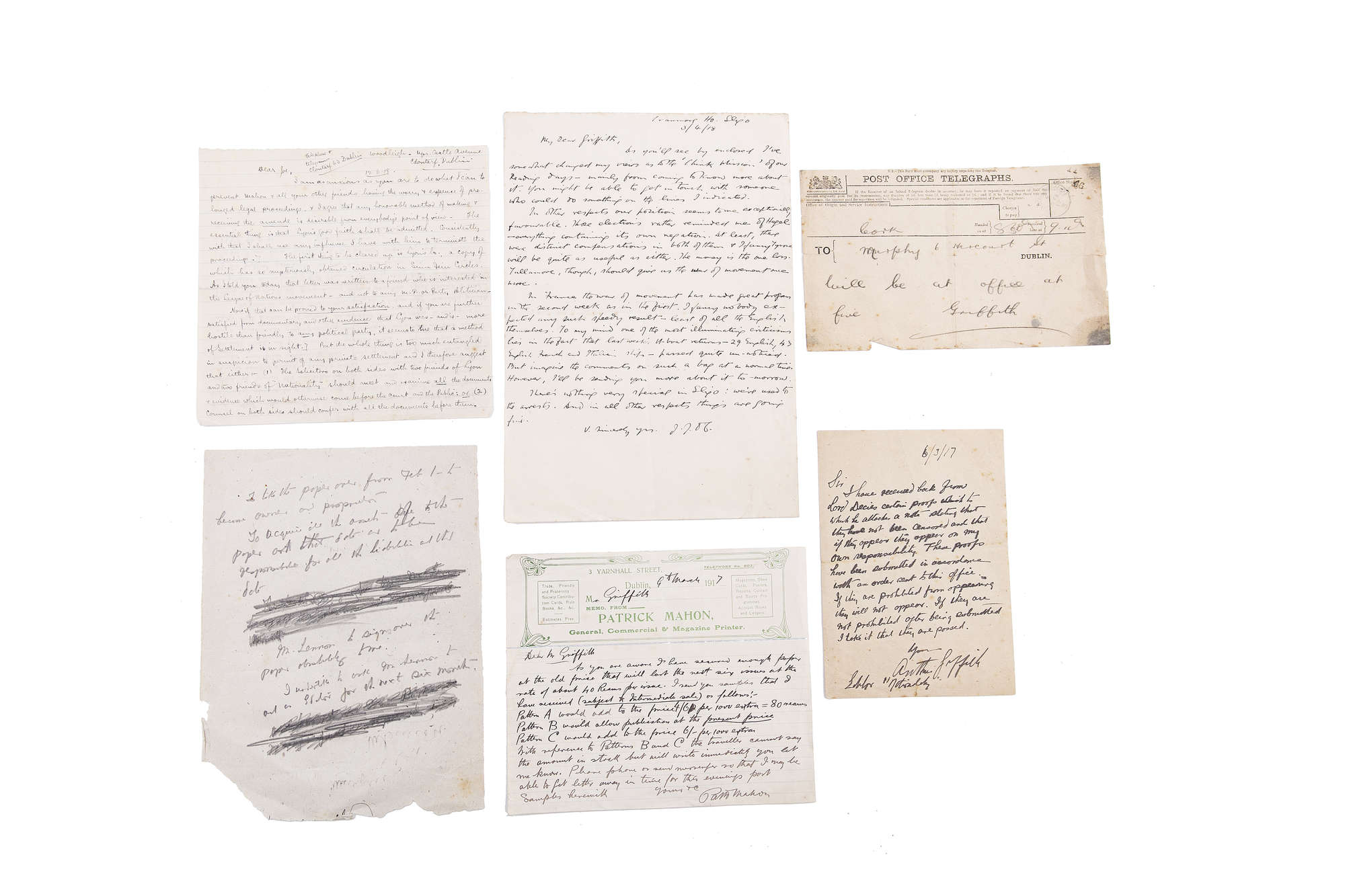
An important collection of documents relating mainly to Griffiths newspaper Nationality and its management during his imprisonment in 1918, including a fine sequence of six...
ARTHUR GRIFFITH,
An important collection of documents relating mainly to Griffiths newspaper Nationality and its management during his imprisonment in 1918, including a fine sequence of six A.L.S. to Griffith from Charles Murphy, a 1916 veteran who managed the paper in his enforced absence; together with photocopies of a letter from Griffith to Murphy, from Gloucester Prison, June 26 1918, and of a cheque payable to Griffith signed by Maud Gonne, June 1917 (supplied for information only, originals not present).
Arthur Griffith [1871-1922] spent most of his life as a struggling journalist, unknown to all but a few, always chronically short of money and resources. After a life in the shadows, he emerged as a political leader and statesman only in the last few years before his untimely death. He took no part in the 1916 Rising, but his writings and his organisational work over many years had prepared the way for what became known as the Sinn Fein Rebellion. Without Griffith, there would have been no Sinn Fein, and probably no Rebellion.
Born in central Dublin, he worked as a printer, and joined the Gaelic League and the I.R.B., though he seems to have dropped out of the latter after a few years. In 1896 he went to South Africa, where he worked in the goldmines, and helped John MacBride to organise a 1798 commemoration. He came home in 1898 to edit a new weekly paper, the United Irishman, in whose columns he developed the policy of national self-reliance summed up in his influential pamphlet The Resurrection of Hungary (1904). After a libel action sank the United Irishman, Griffith started a new paper, Sinn Fein, the first in a series of publications which continued until 1920, and he oversaw the amalgamation of several small nationalist groups under the umbrella of Cumann na nGaedheal, later renamed Sinn Fein. He did not fight in the 1916 Rising, though apparently he offered to do so, but he was arrested afterwards, and spent several periods in jail in England, notably in 1918-19, the period covered by much of the present correspondence.
Elected to the First Dail, he was chosen as its Vice President and (in De Valeras absence in America) was with Collins the effective head of the Republican Government. He went to London with Collins and the other plenipotentiaries to negotiate a settlement with Lloyd George, and negotiated and signed the Anglo-Irish Treaty. When the Treaty was ratified and De Valera withdrew, he became President of the Dail Government. After many years of privation and struggle, the strain of the Civil War eventually became too much for him, and on 12 August 1922 he died suddenly in Dublin.
Charles Murphy, a Dubliner who managed Griffiths paper Nationality, served in Bolands Mills during the 1916 Rising. He was later close to Eamon De Valera. Seumas OKelly, who replaced Griffith as editor during his imprisonment, died suddenly of a heart attack after a British raid on the Nationality office in 1918.
All bids are placed in Euros (€)
Please note that by submitting a bid you are agreeing to our Terms & Conditions


 Have a similar item to sell?
Make Enquiry
Have a similar item to sell?
Make Enquiry