Click on image to open full size.
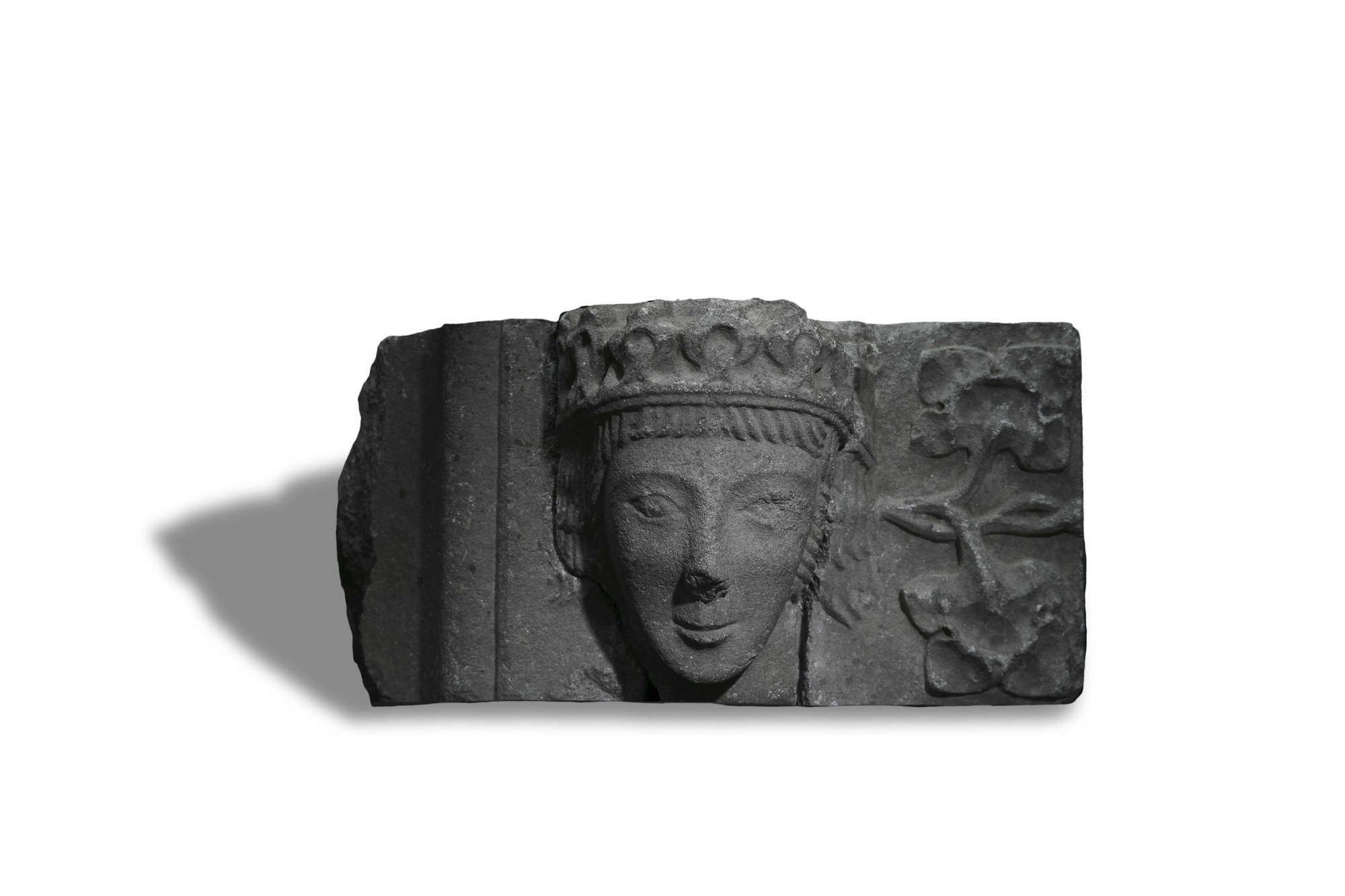
A 15TH CENTURY CARVED STONE HEAD ATTRIBUTED TO BE THE HEAD OF CATHERINE DE VALOIS, 23cm high, the entire 44cm wide
Provenance: Stackallen Co. Meath.
See Elizabeth Hickey Journal of The...
A 15TH CENTURY CARVED STONE HEAD ATTRIBUTED TO BE THE HEAD OF CATHERINE DE VALOIS, 23cm high, the entire 44cm wide
Provenance: Stackallen Co. Meath.
See Elizabeth Hickey Journal of The Royal Society of Antiquaries. (JRSAI Vol. 115, (1985): 140-145)
During some building work being done near Stackallen in county Meath in the 1970s, a landowner came across a finely carved head of a woman amongst some stone rubble being used for in-fill. Spurred on by curiosity, contact was made with historian, Elizabeth Hickey who undertook to investigate the stone heads history. Her findings were published in the Journal of the Royal Society of Antiquaries of Ireland, (JRSAI Vol. 115, (1985): 140-145). Hickey claimed that the head in question was the daughter of the King of France, Catherine de Valois, who was married for two years to Englands Henry V, the Victor at Agincourt.
Catherines marriage to Henry had been arranged under the terms of the Treaty of Troyes in 1420. In 1421, she gave birth to a son who became the future King Henry VI, the last Lancastrian and a pious but ineffectual ruler who founded Eton College and Kings College, Cambridge. Her husband died in 1422. Left to her own devices as a young widow, Catherine fell in love with the clerk of her wardrobe, Owen Tudor, who belonged to a barbarous clan of savages, whom she married and with whom she had four children. It was through this line that Catherine was to have her most enduring impact. She was the grandmother of the later Henry VII and great grandmother of Henry VIII.
This stone head formed part of the decoration of the east window of Stackallen Church, most likely partnering another similarly sized head. The church itself was demolished in 1960 and some of its decorative features were removed to nearby Slane Protestant Church.
The medieval Stackallen Church, it is believed, was established by the Dexter family as they may have owned Stackallen in the late 14th century/early 15th century and are thought to have built a church on their lands. It was built on the site of an early Christian establishment.
In the summer of 1958, Inspector of National Monuments, OPW architect and antiquarian Dr. Harold Leask visited Stackallen, making notes and taking photographs of the soon to be demolished building. According to Hickey he concluded that the Church most likely dated to the 16th century, was possibly pre-reformation but that it included decorative stones from an earlier church. One of his photographs shows a 16th century window with a hood moulding and a crowned head at each stop. Hickey states that the decoration, vine leaf and tendril forms, seen in the old photograph corresponds closely to the decoration on the head of the Queen Consort. Overgrown ivy sadly obscures the detail of the actual heads in the photograph.
Hickey described the carving thus : It is a very beautiful piece of carving, the delicate, almost life-sized, features of the young woman tapering to the chin, are carved to be looked up at from below. Her lips bear that elusive smile typical of 15th century portraiture; her hair is fringed and plaited and on her head she wears a crown of fleur-de-lis. On grounds of style and fashion I would date this head to the early part of the 15th century and say that it represents a queen. I would suggest that it came from the medieval church and was re-used when that church was rebuilt early in the 16th century and, with the window, survived the 18th century rebuilding.
In medieval times churches in the Pale had their Gothic windows adorned with heads, in each case a king and a queen at the stops of the moulding, and with a bishop at the apex. This seems to have been a conventional arrangement with the Pale gentry honouring the reigning king of England from whom they held their lands, and his consort. The date of the marriage of Catherine and Henry in early 1421 ties in directly with the beginning of the Succession List of the Clergy in 1421 and the generally agreed date of the building of the 15th century Stackallen Church thus seemingly confirming that the stone head is a portrait of Queen Catherine de Valois.
What convinced Hickey that the head may have been that of Catherine de Valois was its undeniable similarity to a life size painted wood and wax effigy carried at her funeral, when she was still a young woman, and preserved to this day at Westminster Abbey. Because her tenure as Queen was so short, less than two years, images of Catherine are rare.
While the depiction of English royal subjects in Gothic windows within the Pale where loyalty to reigning kings and their consorts is understandable, particularly at what was a time of vigorous Gaelic resurgence across the rest of the country, the questions of the origin and nationality of the carver remain to be explored.
All bids are placed in Euros (€)
Please note that by submitting a bid you are agreeing to our Terms & Conditions


 Have a similar item to sell?
Make Enquiry
Have a similar item to sell?
Make Enquiry