
Click on image to open full size.


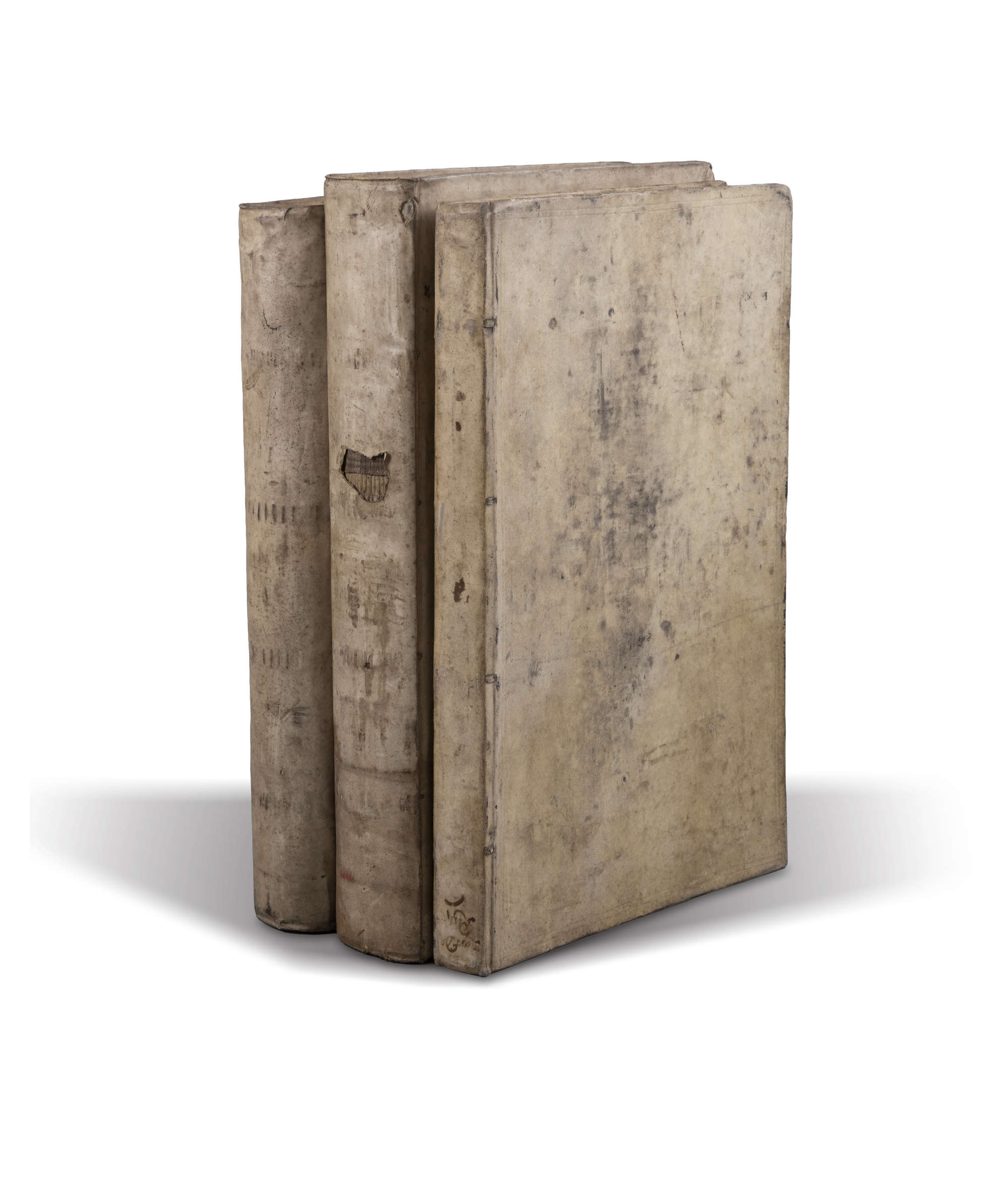
A COLLECTION OF THREE VELLUM BOUND DOCUMENT/RECORD BOOKS, LATE 17TH /EARLY 18TH CENTURY MAINTAINED BY THE ENGLISH DIPLOMATIC SERVICE DURING THE REIGN KING WILLIAM III (1689 - 1702)
containing...
A COLLECTION OF THREE VELLUM BOUND DOCUMENT/RECORD BOOKS, LATE 17TH /EARLY 18TH CENTURY MAINTAINED BY THE ENGLISH DIPLOMATIC SERVICE DURING THE REIGN KING WILLIAM III (1689 - 1702)
containing handwritten transcriptions of diplomatic letters, treaties and military correspondence between King William III and the Electorate and Kingdom of Hanover, focused on two successive English Envoys Extraordinary of Sir William Dutton Colt (1649 - 1693) and James Cresset (c.1655 - 1710). With French, English and Latin transcriptions and cipher notation.
Book 1:
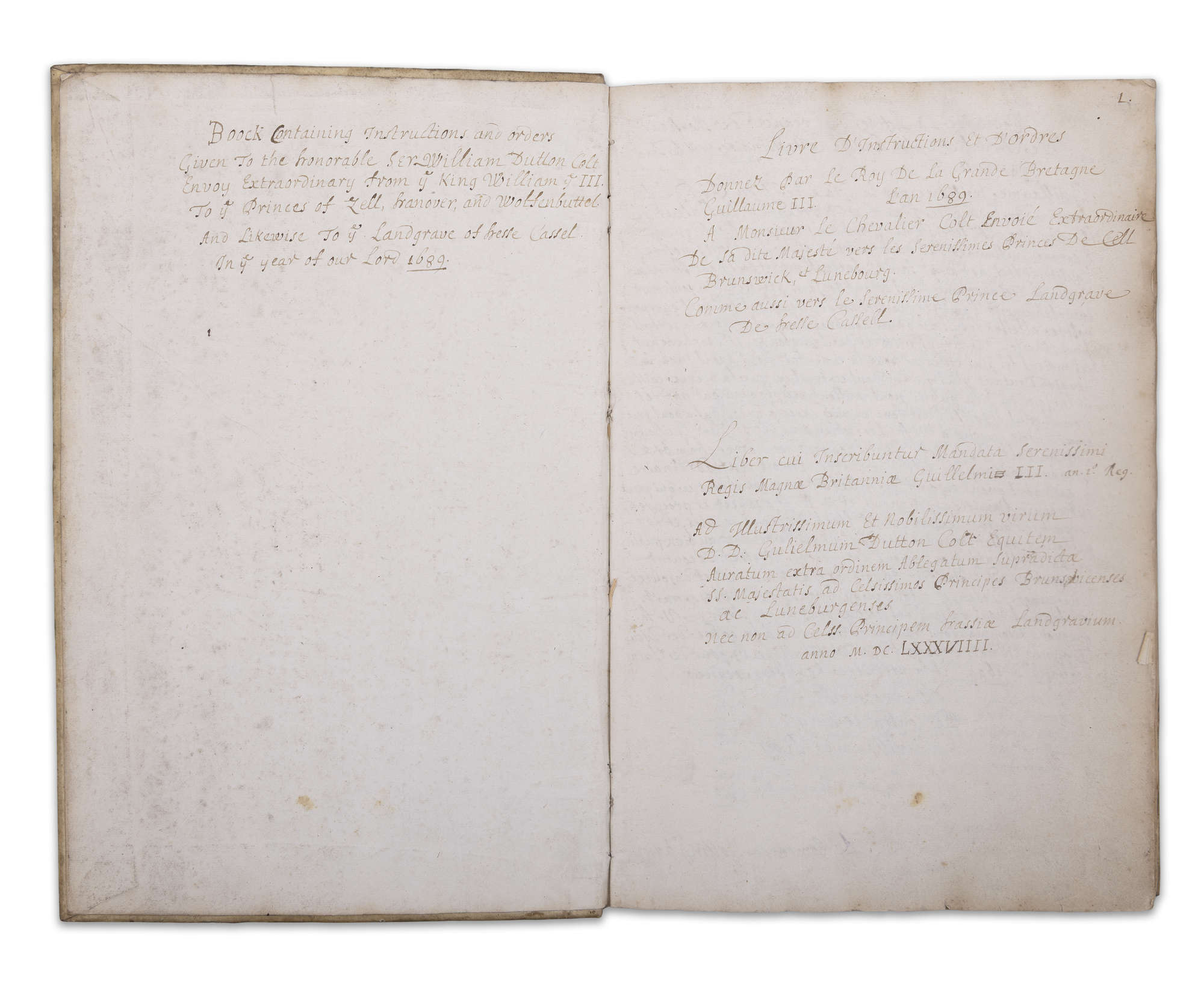
Inside page with inscription 'Book containing instructions and orders given to the Honorable Sir William Dutton Colt. Envoy extraordinary from King William III to Princes of Zell (Celle sic), Hanover and Wolftenbuttel and likewise to Landgrave of Hesse Cassel in the year of our Lord 1689' - this is transcribed again in French and Latin.
Sir William Dutton Colt (1649 - 1693) served with a British embassy to Germany (Brunswick-Luneburg) and Denmark between 1689-1691.
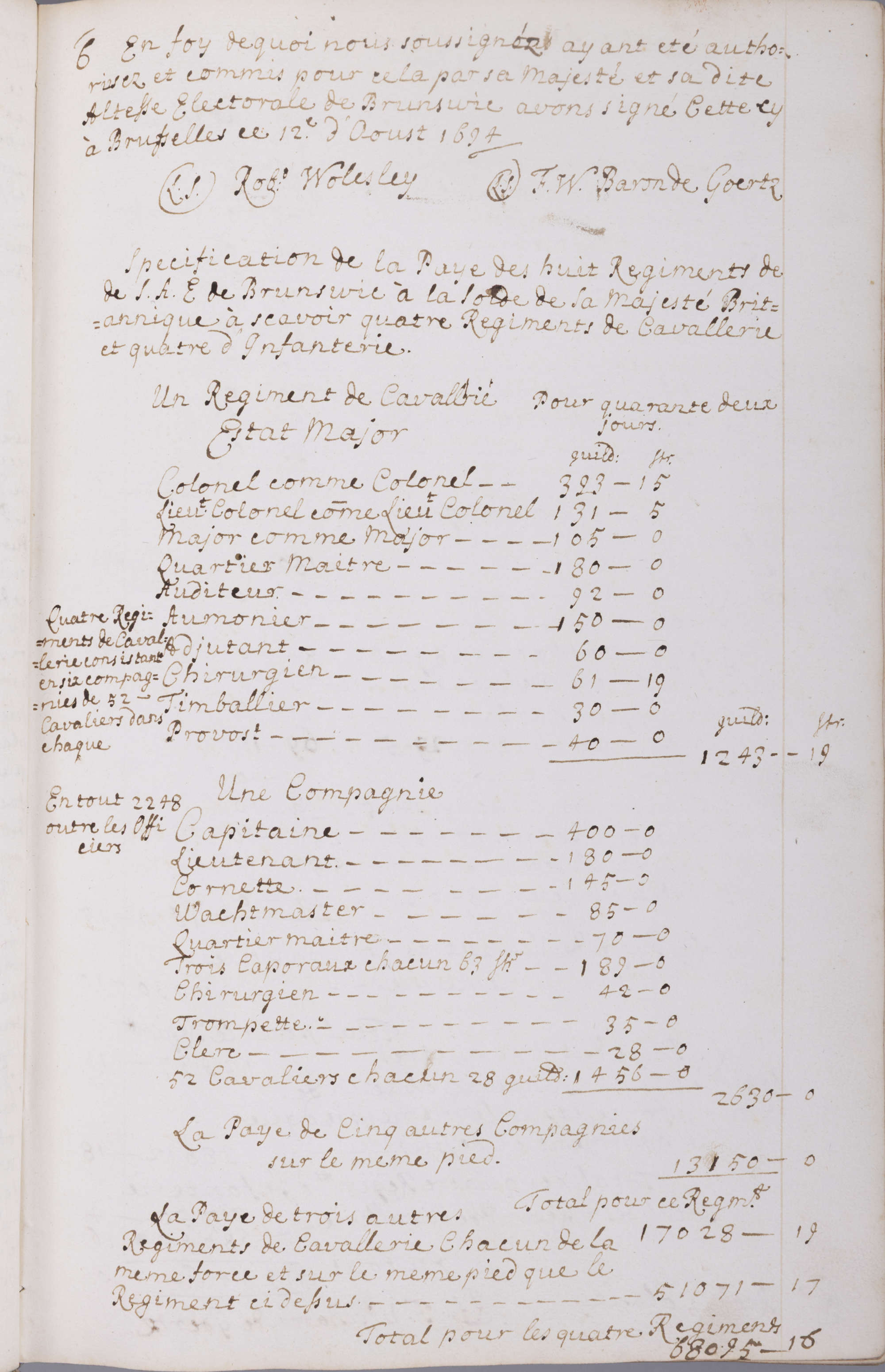
All transcribed in ink - With table of contents at the back of the book of all correspondence, pg. 2 - 236
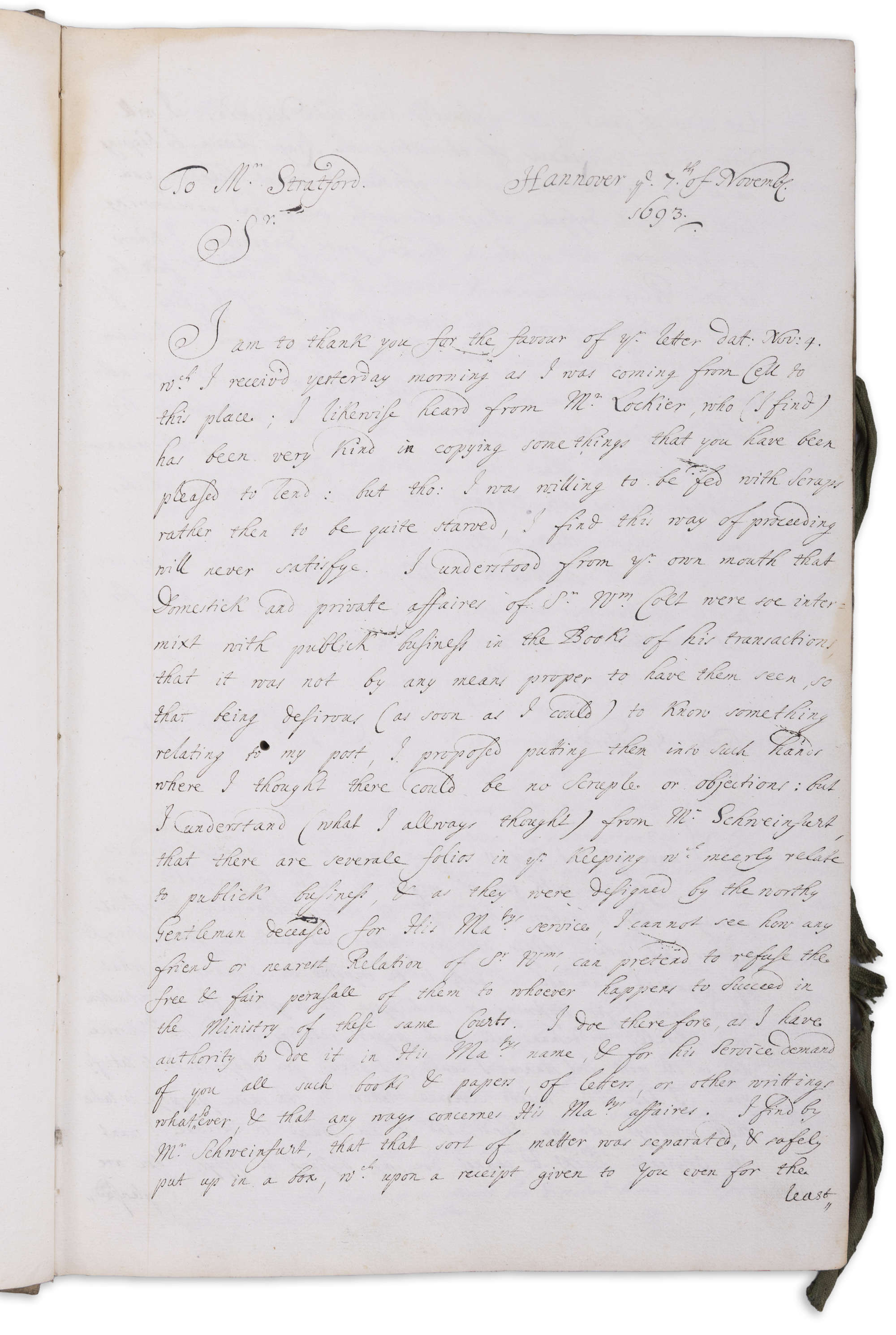
- Various letters between King William and the Envoys of these states. Dated August 1689 - 1693
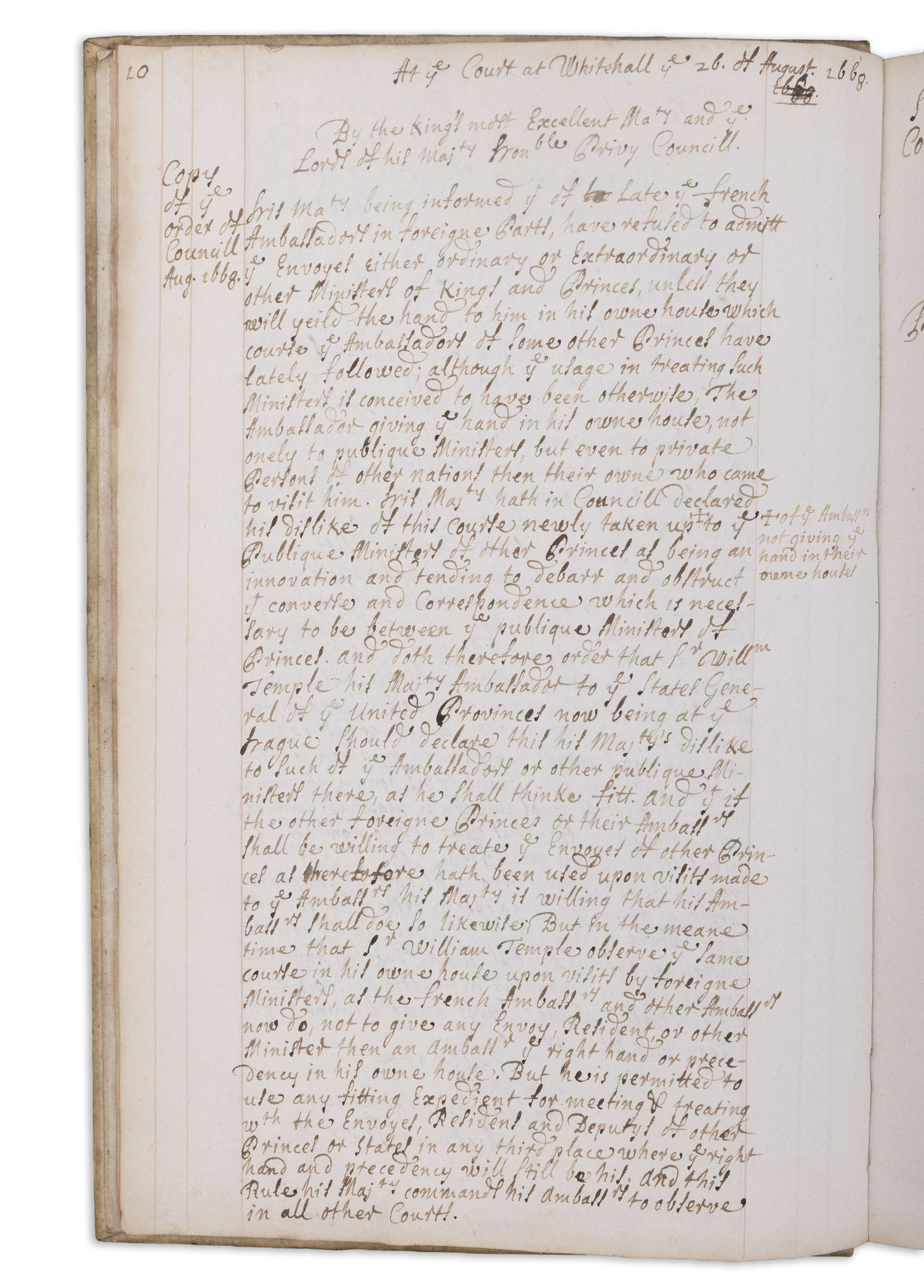
- Instructions to William Dutton from the Court at Whitehall
- Agreements between King of Demark and the Duke of Holstein-Gottorp
- Treaty between King William and States General and Elector of Bavaria
Book 2:
Contents including:
- Letters to Mr. Stratford, Hanover November 1693 & Cell Nov,. 1694
- Letters to Comte de Platen, Cell 19th December 1693
- Various other individuals referred too including Mr Dalome, Mr Woolesley, Wolftenbuttel, Sir Paul Rycaut
- A long letter in transcribed in English possibly from Cressett to Sir Josiah Child (1630 - 1699) dated Sept 8th 1696, Hamburg, who has been recently given the role to assist with the Treaty of Pinnerberg for 'composing differences' between the King of Denmark and Duke of Holsteyn but also to inform him that he has gotten information from 'sure and undoubted hands' that Scottish East India company are sending commissioners chosen out of their chief members to treat with this government for erecting a free port in this city arriving in 15 days. - Something the writer is confident they can prevent happening - A Mr. Stratford is mentioned who letter writer he believes to already be in conjecture with the Scots. He asks Childs to not mention his name in relation to the information provided.
Break in pages
- Letters from King William to Monsieur de Greffet and Duke of Holstein-Gottorp 25th October 1701 - all transcribed in French
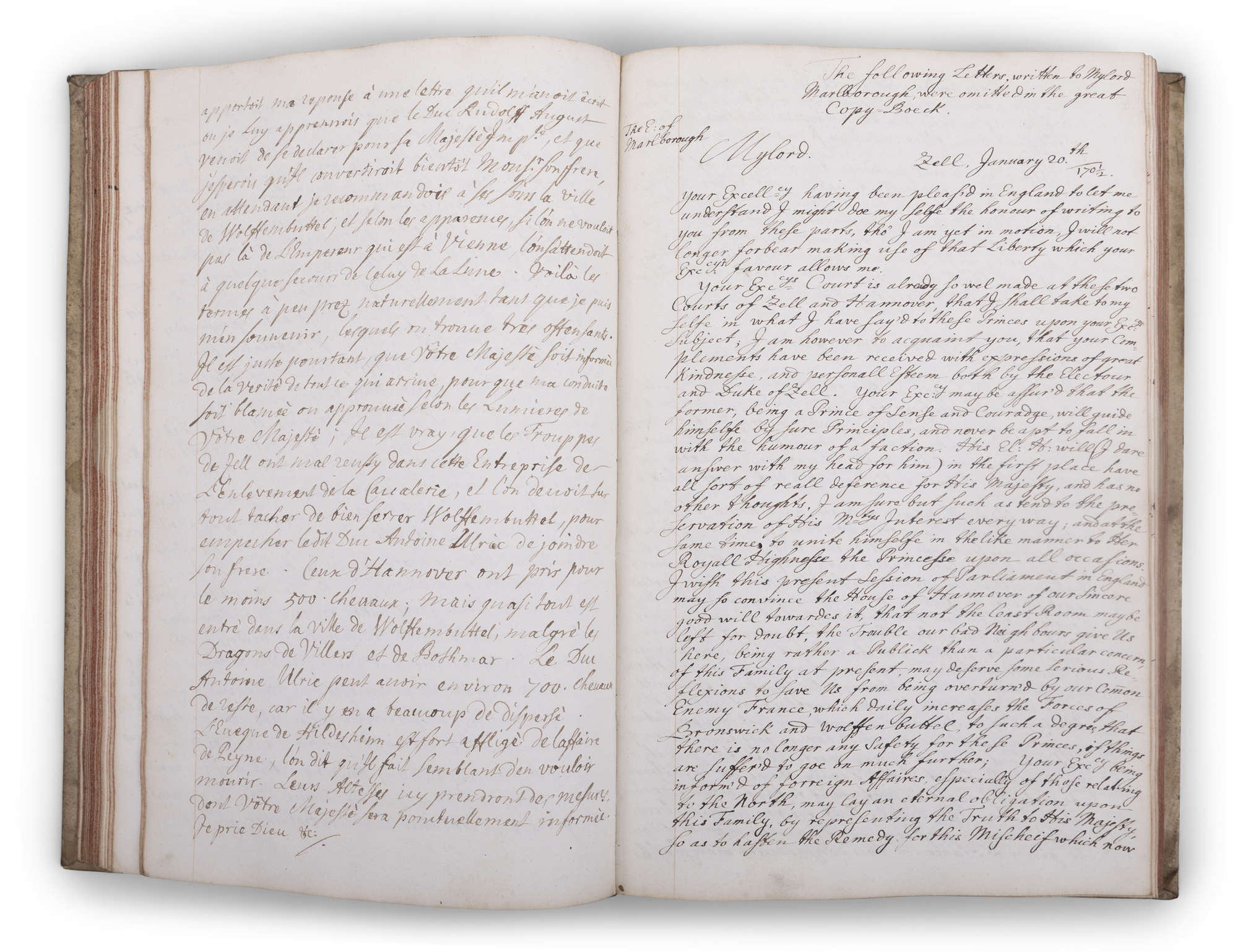
- Letters written to Earl of Malborough, Cell January 1702- regarding the common enemy in France, his favour in the courts of Zell and Hanover
Break in pages begins in French with letter to the English Camp 18th August
- Treaty and Defensive alliance between Princes and Lords Rudolph Augustus and Anton Ulric Duke of Brunswick - signed P. HE De Krosick and with note stating it agrees with original and signed F. Fagel (possibly Francois Nicolas Fagel (1655 - 1718) Dutch States army officer and nobleman).
- Notification of his majesty arrival in Holland to the Duke of Holsteyn Gottorp 1697
- Further memorandum & declarations - some signed by Fagel
Book 3
Relating to envoy James Cressett (c.1655 - 1710), including (inscribed 'No. 4' on vellum cover)
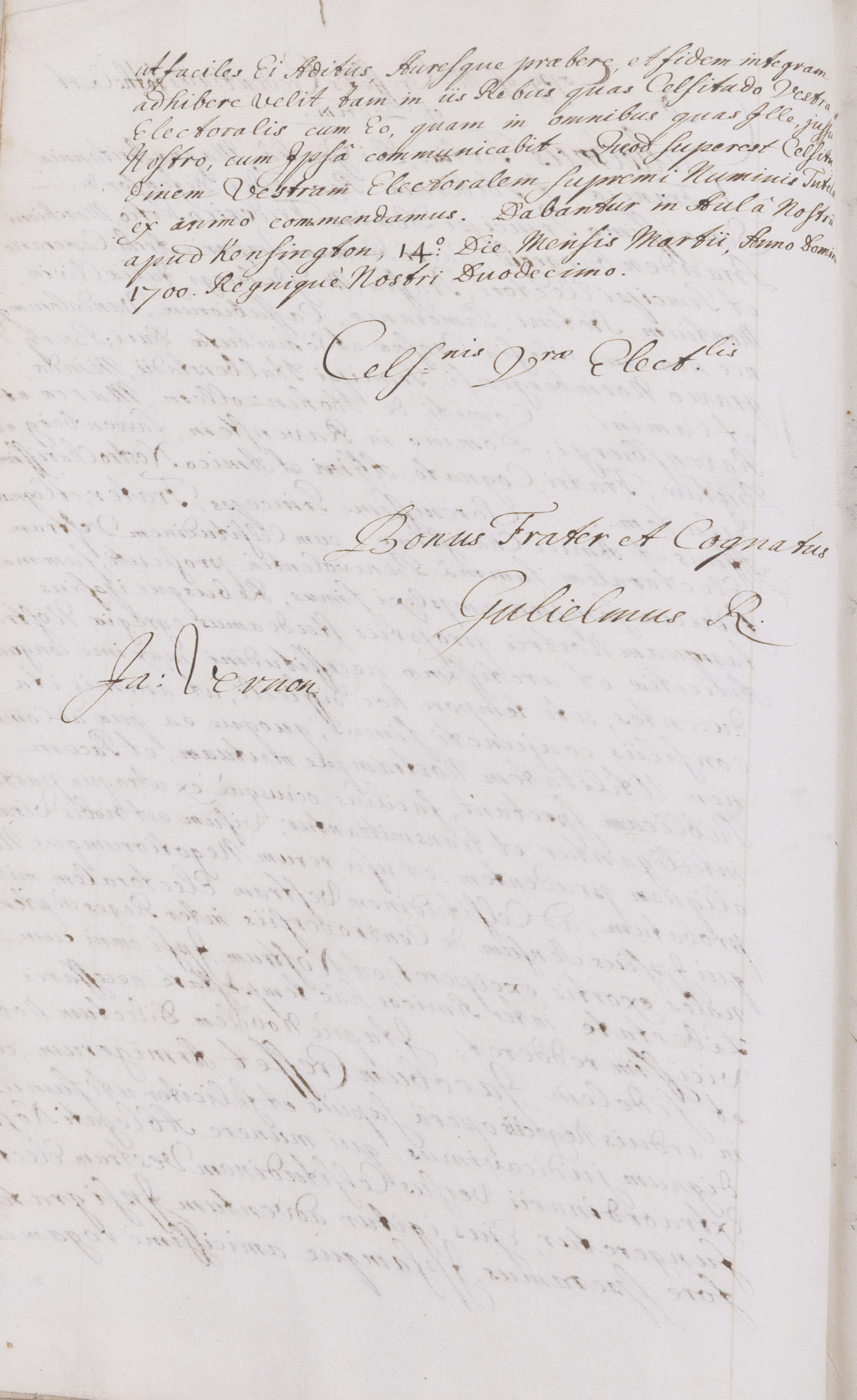
- Instructions for Cressett as the Envoy to Elector of Brandenburg from the Court of Kensington 14th March 1700
- Letter to the Duke of Curland from King William to assist at March in Riga
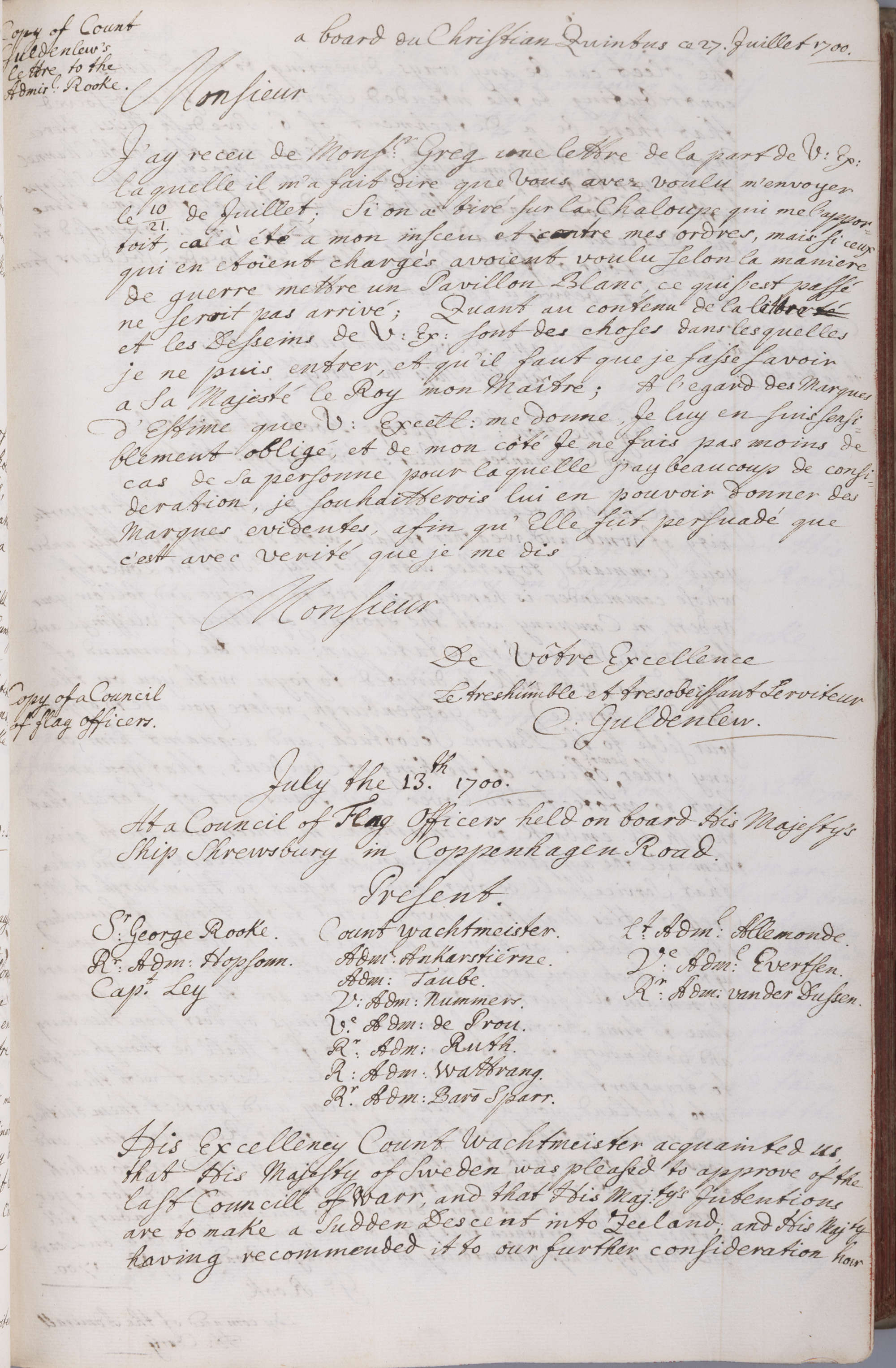
- Correspondence between Admiral Sir George Rook (1650 - 1709) and Duke of Holsteyn
- Correspondence between Rooke and Cressett - envoy and representative to Holsteyn - transcriptions in English and French
- Correspondence between Rooke and Count Guildenlew
- Copies of the Council of Flag officers on board his majesty ship Shrewsbury in Copenhagen Road July 1700 -
- Capt. Francis Dove's order to sail on Carlisle to Gottenburg from Rooke
Break in pages
- Treaty between the Emperor 7 states May 1689 with government admitting the King into the same
- Various Treaties between King of England and States of Bavaria; States of Holland; States of Saxony; King of Denmark
- Treaty and Defensive Ally with Princes and Lords of Rudolph August & antony ulric duke of Brunswick and Lundeberg - Signed by Krosick & Fagel
These three volumes appear to be official working record books maintained by the English diplomatic service during the reign of King William III (1689–1702), most likely compiled and used by the envoys themselves or a senior secretary within the diplomatic mission network operating in Northern Germany and the Baltic states for the Kingdom of Hanover which included the Duke of Celle, The Electress Sophia and the Duke of Brunswick-Wolfenbüttel.
They are transcribed diplomatic registers — carefully organised, indexed copies of outgoing and incoming correspondence, treaty texts, and royal instructions. The presence of tables of contents, trilingual transcriptions (English, French, Latin), cipher notation indicate documents designed for active official reference rather than as archived material. With this in mind the books can be viewed as field reference copies, of the type that an envoy would keep with him to consult prior instructions, verify treaty terms, and maintain continuity across a long posting. The primary users appear to have been two successive English envoys extraordinary to the electorate and Kingdom of Hanover.
Sir William Dutton Colt (1649–1693) is the central figure in Books one who served with a British embassy to Germany (Brunswick-Luneburg) and Denmark between 1689-1691. The Colt family descended from Thomas Colt, of Essex and Suffolk, Keeper of the Rolls of Chancery in Ireland and a member of Edward IV's Privy Council. George Colt, great-grandfather of the first Baronet, was High Sheriff of Suffolk in 1586. Sir William Dutton Colt, brother of the first Baronet, was Master of the Horse to Prince Rupert of the Rhine and Envoy to the courts of Hanover and Saxony.
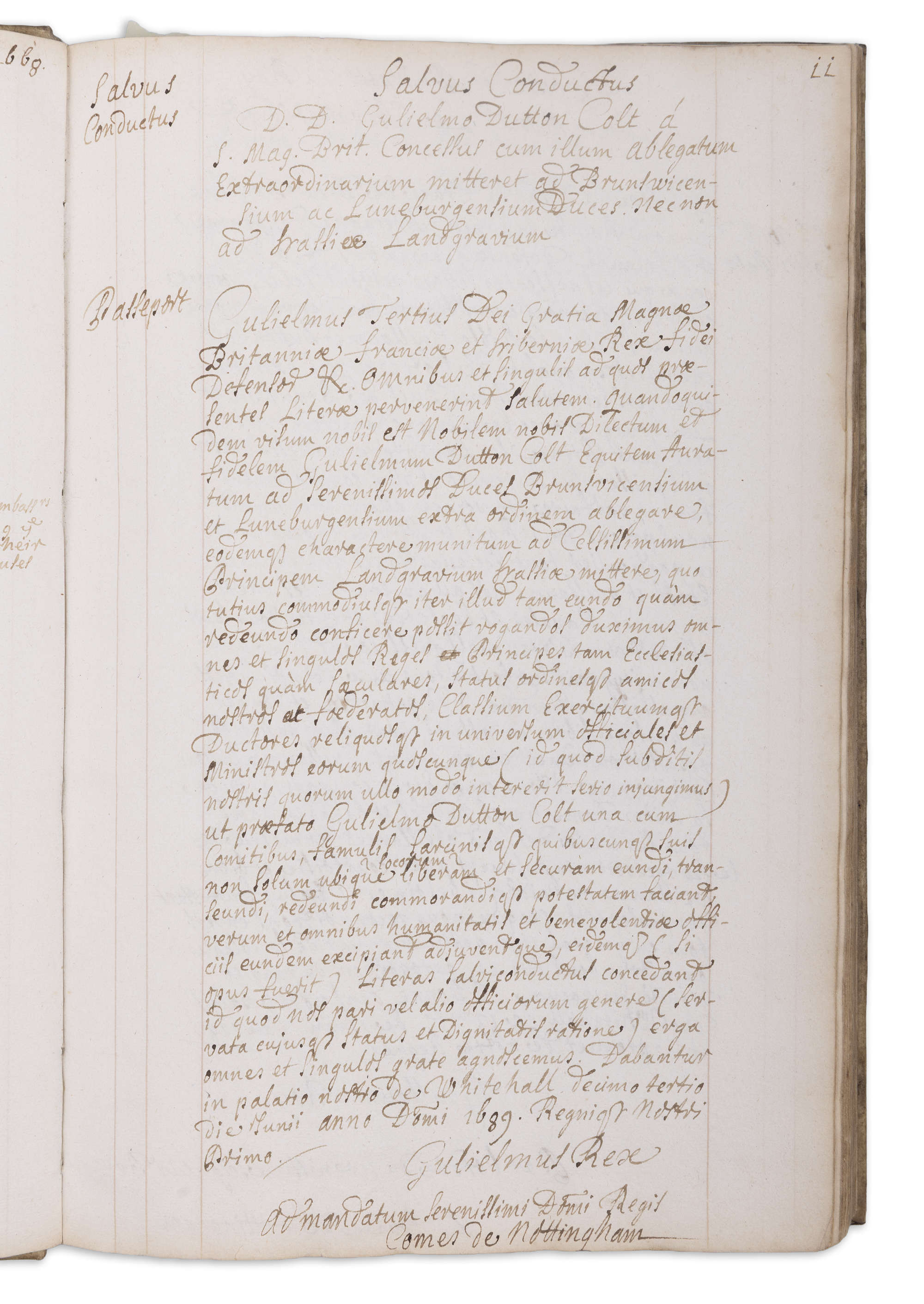
Colt was dispatched to the courts of Hanover, Celle, Wolfenbüttel, and Hesse-Cassel at a critical moment — 1689 was the year William III acceded to the English throne and immediately began building the Grand Alliance against Louis XIV of France. Colt’s mission was essentially to secure and maintain German princely support for William’s war effort. The ciphers noted in Book 1 are a strong indicator that these were live intelligence and negotiation documents, not merely ceremonial records. Many transcriptions are signed ‘Your most Humble Servant Nottingham’, which almost certainly relates to Tory politician and peer Daniel Finch, 2nd Earl of Nottingham (1647 - 1730), who served as Secretary of State (1689–1693 and again 1702–1704). This strongly suggests these volumes passed through, or were directed by, the office of the Secretary of State for the Northern Department, which had jurisdiction over diplomatic relations with precisely these German and Baltic states.
The second book dates from 1693 onwards marking the handover between Colt and Cressett. It contains a remarkable letter to Sir Josiah Childs, the English economist, and the governor of the East India Company. It details the Scottish East India Company (the Darien Scheme) sending commissioners to Hamburg to negotiate a free port - a fascinating outlier, as it reveals that the diplomatic network was also being used for commercial and domestic political intelligence, with the writer (likely Cressett) actively trying to obstruct the Scottish venture, possibly on behalf of the English East India Company. The request not to be named strongly implies this channel was being used for semi-covert lobbying.
In the third book James Cressett (c.1655–1710) takes central focus, who served as envoy from 1693 – 1703 and is presented with credentials to the Court of Brandenburg in 1700. His correspondence with Admiral Sir George Rooke places him directly in the context of the opening phases of the Great Northern War, coordinating naval and diplomatic efforts in the Baltic. Rooke hoisted his flag in the second-rate HMS Shrewsbury in Spring 1700 and took command of an Anglo-Dutch Squadron, which while working in co-operation with a Swedish fleet under Admiral-General Hans Wachtmeister, attacked Copenhagen so facilitating the landing of King Charles XII of Sweden and his army in Denmark in August 1700. This was extraordinarily sensitive work — the Anglo-Dutch intervention at Copenhagen in 1700 was a major strategic operation.
Taken together, these three books document the diplomatic scaffolding of William III’s grand strategy: assembling and maintaining a coalition of German princes, Baltic powers, and the Dutch States General to contain French expansion in the War of the Grand Alliance (1688–1697) and its aftermath. The treaties recorded — Bavaria, Saxony, Holland, Denmark, Brunswick, the Emperor — are exactly the agreements that constituted the League of Augsburg / Grand Alliance. These books are exceptionally rare survivals — not state papers filed at Whitehall, but the envoys’ own copies, which may suggest why they entered private hands rather than the Public Record Office. Their combination of treaty texts, royal instructions, military coordination, and intelligence reporting makes them a remarkably complete picture of English foreign policy in action during one of the most consequential decades in European history.
All bids are placed in Euros (€)
Please note that by submitting a bid you are agreeing to our Terms & Conditions


 Have a similar item to sell?
Make Enquiry
Have a similar item to sell?
Make Enquiry