Click on image to open full size.


GEORGE BARRET SNR (c.1728-1784)
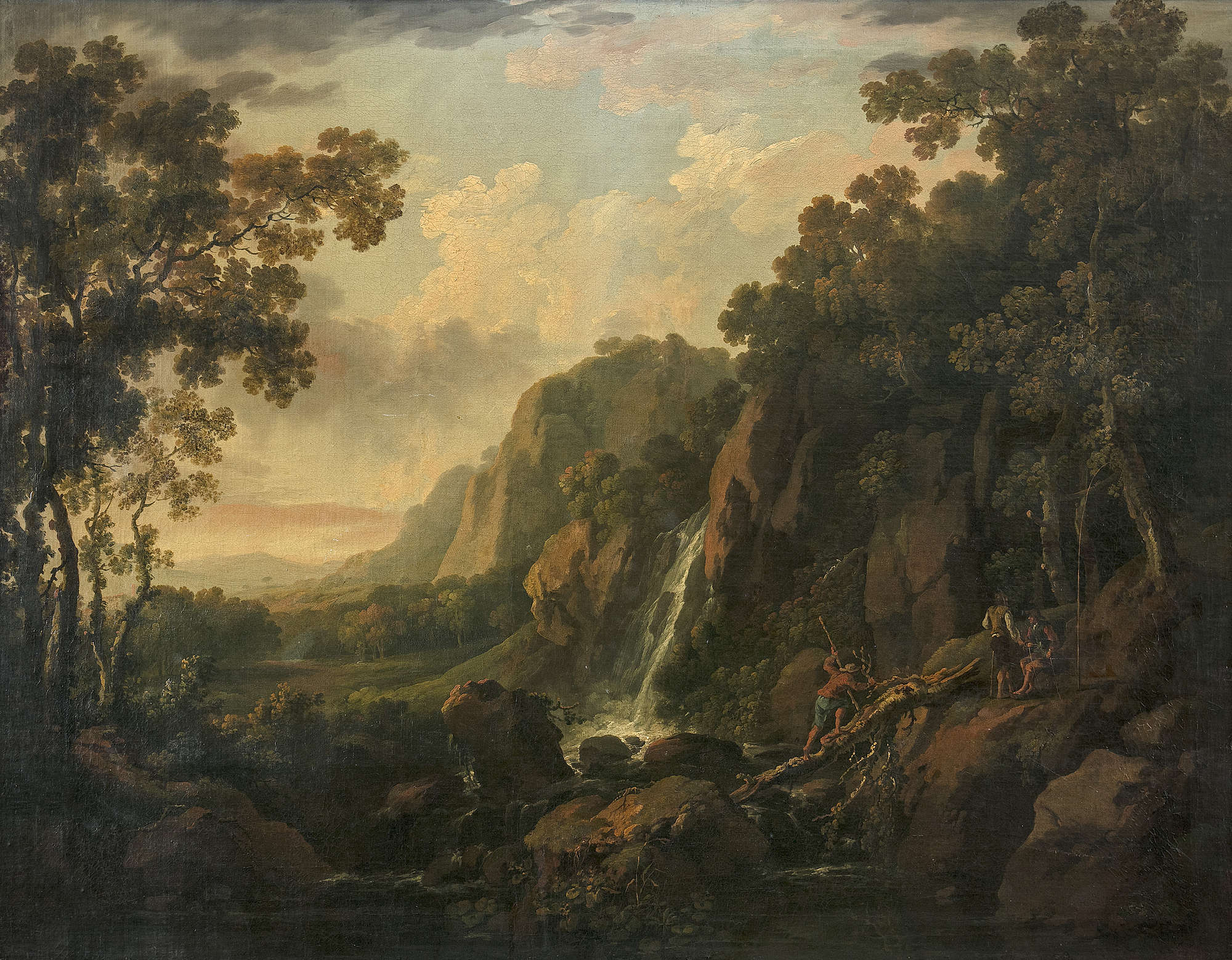
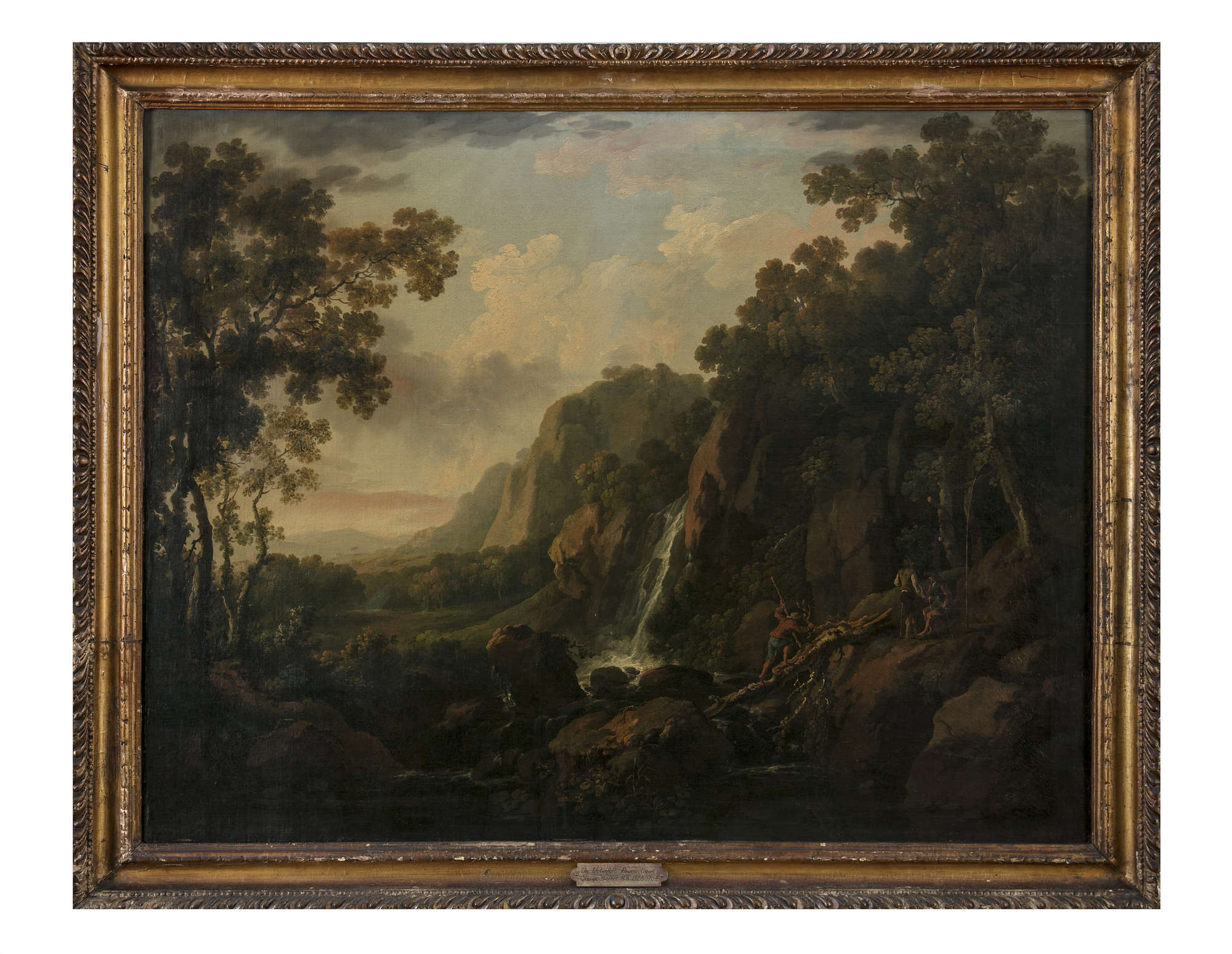
A Mountainous Wooded River Landscape with a Waterfall and Three Figures
Oil on canvas, 96.5 x 125.7cm
Provenance: Senator Edward McGuire, Newtown Park,...
GEORGE BARRET SNR (c.1728-1784)
A Mountainous Wooded River Landscape with a Waterfall and Three Figures
Oil on canvas, 96.5 x 125.7cm
Provenance: Senator Edward McGuire, Newtown Park, Blackrock, Co. Dublin; Christie's, 21st March 1969, Lot 80
George Barret was a friend of Edmund Burke (1729-1797) and their work therefore engages an Anglo-Irish perspective on landscape which requires an inherent connection between aesthetics and politics which, like other aspects of Irish history, have been underplayed in the dominant narratives of British art. The son of a tailor, Barret was born in Dublin. He was to become a founding member of the Royal Academy in 1768, and his work was popular in his lifetime. According to Thomas Bodkin, George Barret, the elder, was reputed in his day, to be the greatest landscape painter whom Ireland, England, or Scotland had till then produced. Despite this Barret experienced the vicissitudes of the eighteenth century art market and ended his life in relative obscurity and bankruptcy.
Although he attained the title of Official Painter to the Chelsea Royal Hospital in 1782 thanks to Burkes intervention, Barret died before he was able to take it up. In his stead, his son James assumed the role. As friend of Burke, with whom Barret shared an Anglo-Irish background, Barrets work explores the ideas of the Sublime, reflecting the influence of Burkes treatise A Philosophical Enquiry into the Origin of our Ideas of the Sublime and the Beautiful (1756). A panoramic view of the Lake District (c.1780) commissioned by William Locke to decorate a room at his house, Norbury Park, Surrey, is considered Barrets masterpiece.
Despite Barrets success as a painter, his position at the Royal Academy and the support he received from Burke, he has historically been seen as belonging to a lower tier of artistic merit than his better-known contemporaries. Contemporary painters such as Wilson themselves perceived this inequality, describing Barrets paintings as depicting foliage like spinach and eggs. Unlike Wilson, Barret did not travel to Italy, and borrowed his classical motifs from prints or from Wilsons paintings in order to cater to the tastes of his grand tourist patrons.
Barret required to make a living from his work and many of his paintings were primarily intended for sale or as part of interior decoration commissions, for which Barret gained much contemporary commercial success as at Norbury Park. Similarly lucrative commissions include ten views of Welbeck Abbey, Nottinghamshire, which Barret had painted in 17657 for William Henry Cavendish-Bentinck, 3rd Duke of Portland, and 1768 he received a similar commission from Henry Scott, 3rd Duke of Buccleuch to record the mountainous landscapes around Dalkeith Park, Lothian, as in A Rocky River Scene. These pictures were exhibited at the Royal Academy between 1769 and 1771.
Based on a stylistic analysis the present picture was painted before Barrets move to London around 1763 and is most certainly an Irish view. The composition was influenced by Burkes ideas on the Sublime and the Beautiful. The enhanced detail of this early painting in the style of romantic realism creates a sublime mood. It is rumoured that Burke introduced Barret to the Dargle Valley near Powerscourt Falls during the early 1760s leading to a connection with one of Barrets earliest patrons, Lord Powerscourt, owner of this property. Patrons such as the Taylours of Headford and the Conollys of Castletown began to commission series of topographical paintings. These landscapes demonstrated the extent of Barrets talent and helped him establish his reputation in London. Barret soon began exhibiting views of the Dargle Valley at the Society of Artists of Great Britain. This painting has several characteristics typical of Barrets work including the framing of the trees, diffused light and the heavy application of and the use of saturated colour. To the right of the composition, a cluster of trees and foliage almost reach the top of the canvas. In the centre there is a view of distant hills beyond a waterfall in the middle ground slightly to the right. The finely detailed figures in the foreground towards the bottom right corner catch the viewers eye, given the complimentary use of red to depict their clothing. One balances on a fallen tree near two anglers apparently in conversation. The distinctive brown palette is vaguely reminiscent of the Dutch artist Jacob van Ruisdael whose work Barret had studied while painting under Robert West in the Royal Dublin Society.
A considerable number of Barrets early stylistic features are present in the painting and can be seen in other pictures executed around the same period. The repeated traits typically include a dominating tree on one side of the painting; a body of water or waterfall in the centre, or slightly placed to the right, and a distant view of mountains or hills. For example, an ex-Gorry Gallery piece, An Irish Landscape inspired by the Dargle Valley, must have been painted around the same time. The views are similar in size, composition and, colour palettes. Both paintings have anglers dressed in red and are lit by diffused light. The National Gallery of Irelands: An Extensive Wooded Landscape with Fishermen Hauling in their Nets in the Foreground also shares the same basic elements with the overall effect of creating the sublime grandeur, as inspired by Burke.
Logan Morse
August 2017
All bids are placed in Euros (€)
Please note that by submitting a bid you are agreeing to our Terms & Conditions


 Have a similar item to sell?
Make Enquiry
Have a similar item to sell?
Make Enquiry