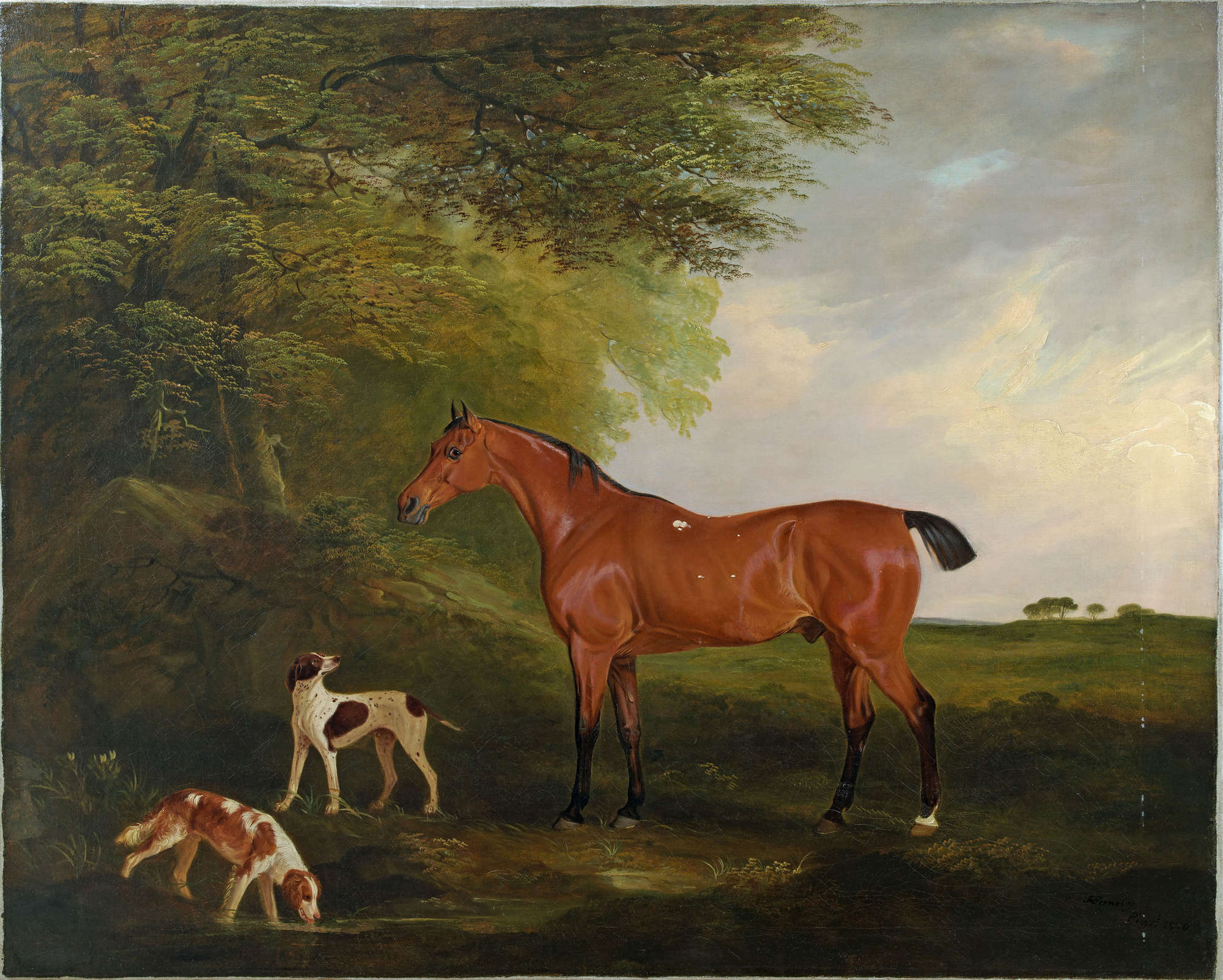
Click on image to open full size.
JOHN FERNELEY SNR. (1782-1860)
Lady Nugent's Hunter, with a Pointer and Setter in a Wooded Landscape
Oil on canvas, 101.6 x 127 cm
Signed and dated lower right: ‘J. Ferneley. / Pinx....
JOHN FERNELEY SNR. (1782-1860)
Lady Nugent's Hunter, with a Pointer and Setter in a Wooded Landscape
Oil on canvas, 101.6 x 127 cm
Signed and dated lower right: ‘J. Ferneley. / Pinx. 1810'
Provenance: Commissioned by Colonel Andrew Nugent (1770-1846), of Portaferry House, County Down by family descent, via Margaret Talbot, née O'Reilly (daughter of Barbara Nugent), wife of Richard Talbot of Malahide; by family descent at Malahide Castle, County Dublin; to the Hon. Rose Talbot (1915-2009); By whom sold, Christie's, London, 26 March 1976, lot 35
Literature: Oliver Millar, The Pictures at Malahide Castle, privately printed 1953, no. 144. The picture is listed in Robert Fountain's catalogue of Ferneley's paintings (British Sporting Art Trust, D.10.000.004: 10.000.006) http://www.bsat.co.uk/sites/114/upload/userfiles/ferneley-catalogue.pdf
This highly significant example of Ferneley’s second Irish period was painted on his fruitful visit here in 1810. It was commissioned by Andrew Nugent of (1770-1846), of Portaferry House, County Down. Colonel Nugent had succeeded his father in 1797 and served as Lieutenant-Colonel, of the North Down Militia, and High Sheriff of County Down. In 1800, he married Selina, youngest daughter of Thomas, 1st Viscount de Vesci of Abbey Leix house, County Laois and the famously beautiful Elizabeth-Selina (née Brooke). Here Ferneley was called upon to depict Selina’s favourite hunter, with a pointer and setter, all located in the lush verdure of an Irish landscape. The picture descended through the Nugent family, via the remarkable Margaret Talbot (daughter of Barbara Nugent, who was created baroness Talbot of Malahide in her own right in 1831), until the famous dispersals from the castle in 1976.
The absence of a native school of equestrian painting has long surprised art historians, especially given Ireland’s close association with the turf. However, this lacuna is compensated for by the fact that one of the finest of all English sporting painters, John Ferneley, enjoyed close links with Ireland. This was noted by Anne Crookshank and the Knight of Glin: ‘It should be remembered that the great English horse painter John Ferneley of Melton Mobray paid four visits to Ireland, the first in 1808 when he had introductions from the fifth Duke of Rutland, whose father had been Lord Lieutenant. Ferneley returned for long visits in 1810, 1811 and 1812’.
John Ferneley was born at Thrussington in Leicestershire, in the midst of the English ‘Hunting Shires’. His precocity attracted the attention of the Duke, who persuaded his wheelwright father to apprentice him to the equestrian painter Ben Marshall. The latter became a life-long friend as well as teacher. Ferneley first arrived in Ireland in late 1808 and stayed about a year, returning to Thrussington in November 1809. He clearly found the country congenial and won significant commissions, painting for such distinguished patrons as the Lords Lismore and Rossmore and the Trenches and O’Callaghans. He contrived to earn and save £180, enough to pay for his marriage to Sally Kettle shortly after his return to England. They stayed in England only a few weeks, returning to Ireland in the spring of 1810, where they were received with generosity and affection by his clients of the previous year. In five months he amassed a small fortune of over £200.
Ferneley is without question the finest sporting artist to have worked in Ireland, and yet few indeed of his paintings of this prolific period survive or at least can be identified today. There are still two such in the collection of the Earls of Belmore at Castle Coole, which show ponies (‘Plenipo’ and ‘Buffer’) while this significant example long hung at Malahide Castle. Fereneley’s portrayal of Hugh Dick’s mare and pointer outside his home of Humewood, County Wicklow, was sold in these rooms on 19th October 2021 (€95,000 hammer).
On his return to England, Ferneley rapidly established a distinguished clientele, and he and John Herring were the sporting painters par excellence in the period 1810-1850. Ferneley was himself a keen sportsman, and he recounts his exploits in the field in his (eccentrically spelled) letters.
All bids are placed in Euros (€)
Please note that by submitting a bid you are agreeing to our Terms & Conditions


 Have a similar item to sell?
Make Enquiry
Have a similar item to sell?
Make Enquiry