Click on image to open full size.


HUGH DOUGLAS HAMILTON RHA (1740-1808)
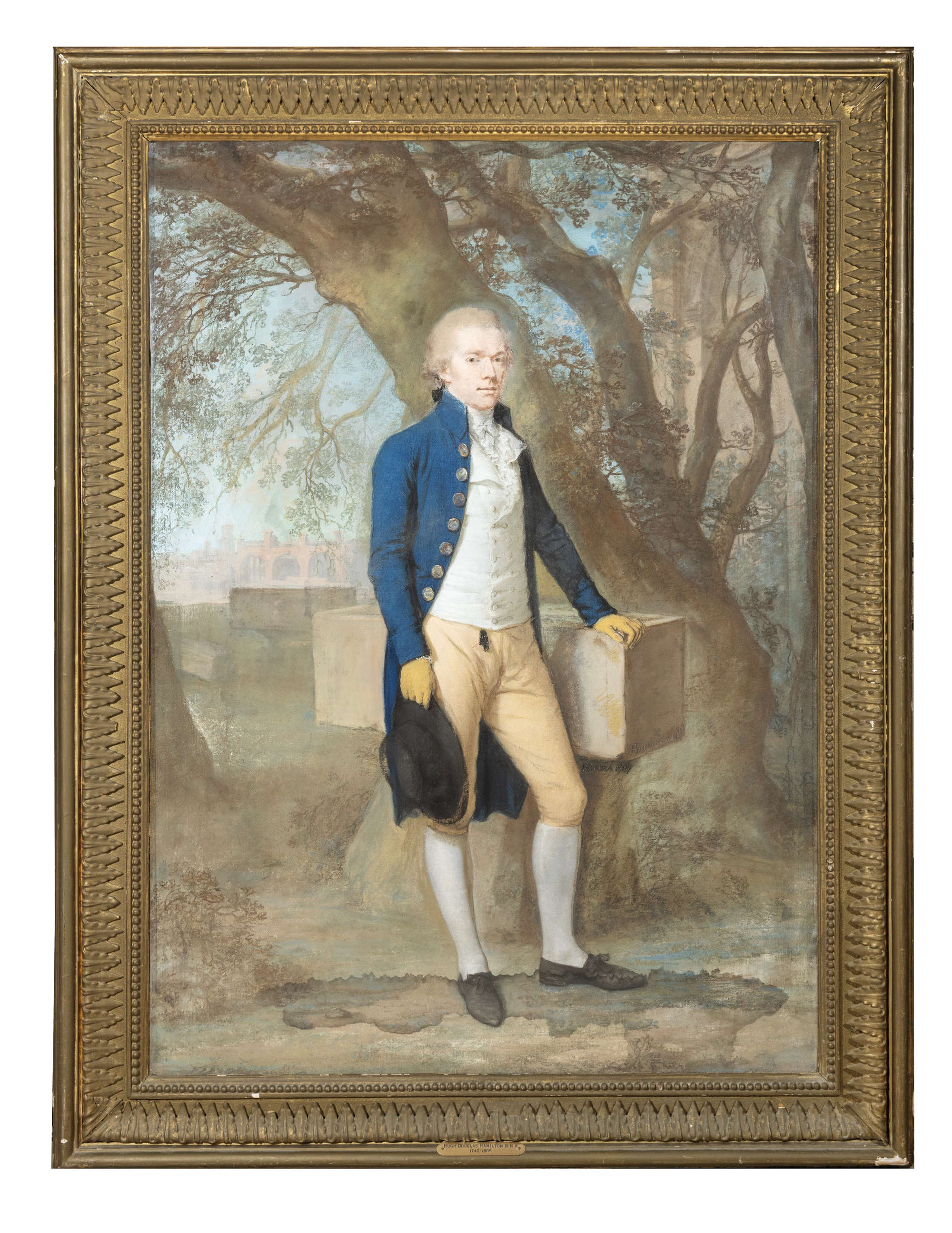
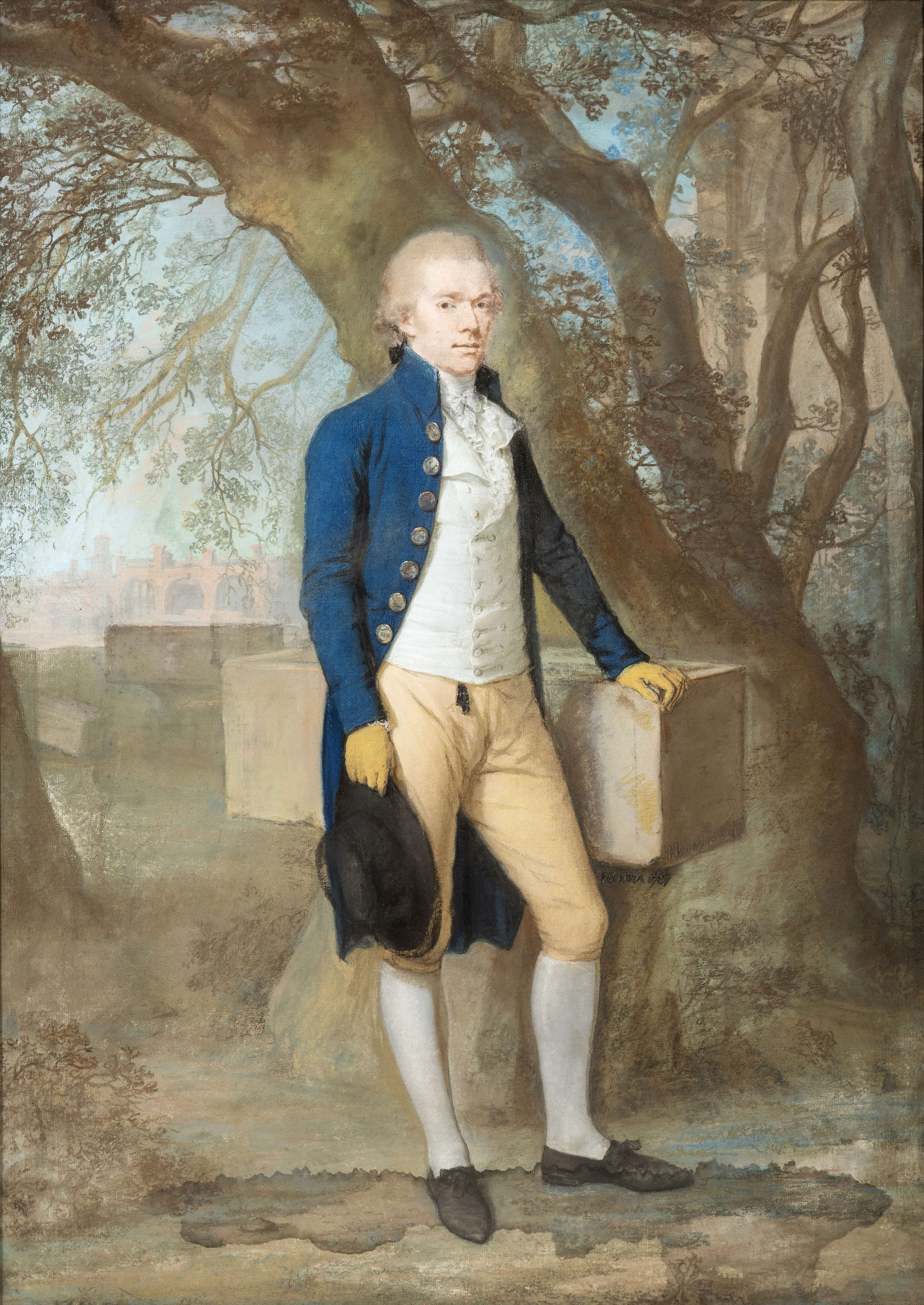
Full Length Portrait of a gentleman in a blue coat, with tan breeches, his left arm resting on a water trough, view of the Basilica Maxentius beyond, (1787)
HUGH DOUGLAS HAMILTON RHA (1740-1808)
Full Length Portrait of a gentleman in a blue coat, with tan breeches, his left arm resting on a water trough, view of the Basilica Maxentius beyond, (1787)
Pastel, 93.3 x 66.7cm
Signed, inscribed and dated 'Hamilton F/Roma 1787 (lower right on the water trough)
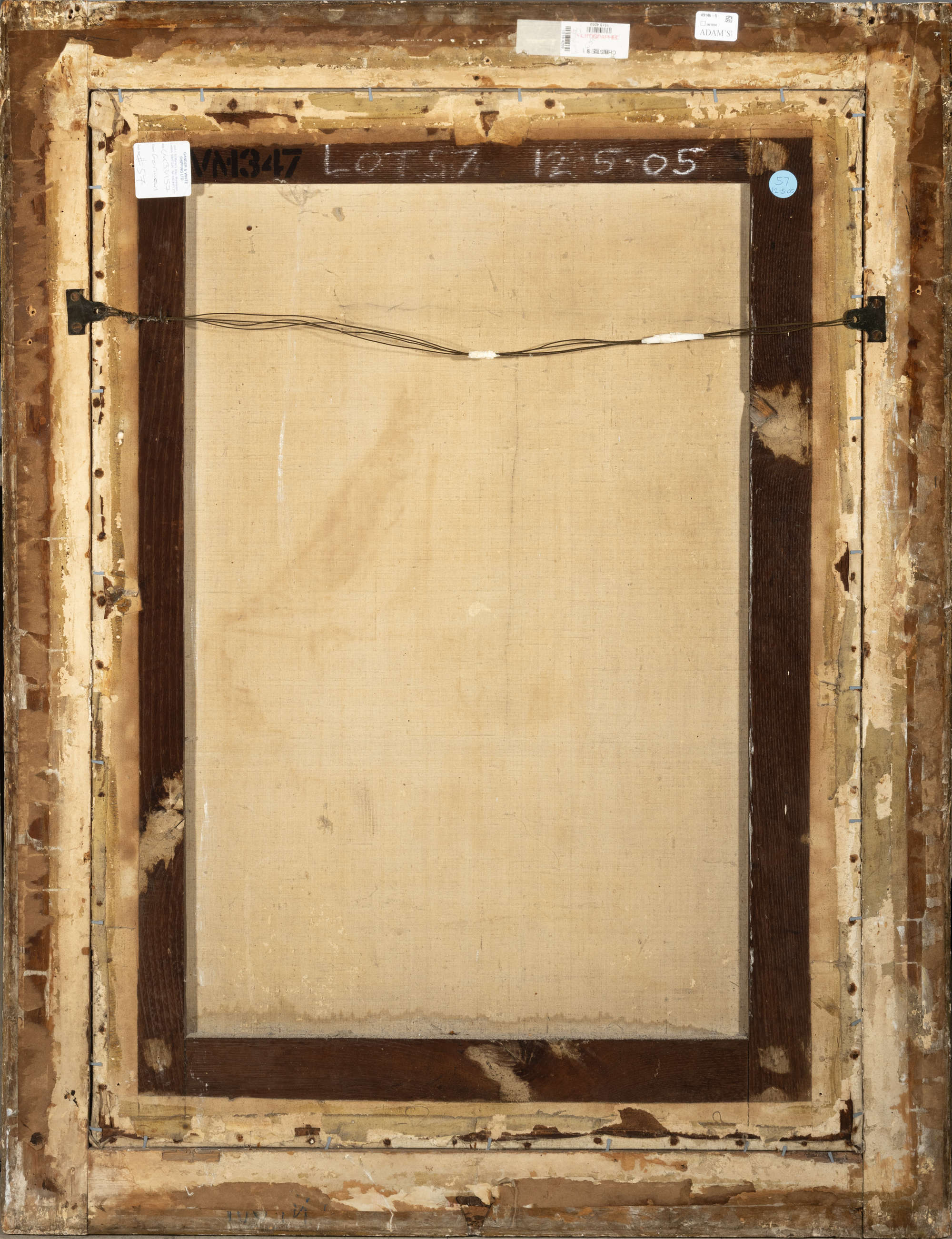
Provenance : The Irish Sale, Christie's, London, 12 May 2005, lot 57
The appearance of this fine example of Hugh Douglas Hamilton’s work is a rare opportunity to acquire one of the artist’s full-length pastel portraits, which seldom come to market.
While the sitter is unknown, he is evidently a man of some means, procuring a portrait from Hamilton while in Rome, as a fashionable souvenir to bring home from his Grand Tour. Leaning casually on a water trough, with a view of the Basilica Maxentius behind him, Hamilton suggests his subject’s easy confidence in his august surroundings; invoking with a single stance a whole culture of ease and privilege, scholarly discrimination and conviviality.
The portrait is signed and dated 1787. Hamilton had been in Italy for around five years at this point and was at the height of his powers. This pastel was completed not long before he embarked on his large-scale portrait Canova and Tresham – widely considered his chef d’oeuvre – probably completed in early 1788 and now in the V&A collection. By the late 1780s, Hamilton was at some remove from the popular, small-scale pastellist of his early London days. Through his friendship with artists such as Antonio Canova and John Flaxman, he was associating with the Roman avant-garde and was witness to their ongoing attempts to test the limits of their chosen media. This, combined with his relative lack of rivals in the pastel medium in Rome, gave Hamilton both the encouragement and the freedom he needed to try out new ideas and expand his repertoire. He was increasingly interested in pushing the limits of pastel’s possibilities and seemed keen to make it compete in impact with oil painting.
This experimentation is most evident in an expansion of scale in Hamilton’s pastel work during the 1780s. From small head-and-shoulders ovals, Hamilton steadily increased the size of his portraits, until at their largest they measured nearly a metre in height. His sitters were now depicted full-length and the plain blue and brown backgrounds of his early works were replaced by beautifully delineated Roman landscapes and carefully observed natural details.
A new-found grandeur and permanence replaced the more transient and fragile appeal of his youthful work. In particular, Hamilton’s ever-increasing skill in the rendition of textural and colouristic effects reached their zenith in these years. Although some abrasion is evident in this portrait and the pastel has been subject to a small area of water damage, most of the detailing is intact and exhibits many characteristic Hamilton flourishes. His technical assurance is abundantly evident; in the fine point work on the lace cravat, the mottled shine of the sitter’s coat buttons, and the luminous expanse of the summer sky beyond. The wonderfully observed colour accents - the rich indigo of the sitter’s jacket and the vibrant mustard yellow of his gloves - also give this work an undeniable vigour. No detail appears beneath notice, from the delicate delineation of the scrubby undergrowth at the sitter’s feet to the flashes of bright blue used to suggest sunlight through tree branches. Hamilton’s typical combination of blended and unblended pastels gives the work a remarkable three-dimensional effect.
In its conception, this portrait is strikingly similar to Hamilton’s portrait of Frederick North, later fifth Earl of Guilford, executed in 1790, now in the collection of the National Gallery of Art in Washington DC. Both are dressed in near identical attire and share the Basilica Maxentius backdrop. This repetition of setting was not unusual for Hamilton. He often worked from his own stock of sketches and studies, or took inspiration from those by other artists; adapting elements, with subtle variations, for each new commission. The inclusion of Piranesi’s The Amphitheatre of Verona, Pianta di Roma and Views of Rome in Hamilton’s posthumous sale of effects may indicate a source of background material for the portraits of North and the man in a blue coat; Piranesi etched the Basilica Maxentius many times.
While this artistic duplication can be read as the pictorial strategy of a sharp businessman, eager to turn out as many portraits as possible, the habitual deployment of the same recognisable settings also signified as an act of cultural requisition on the sitters’ part. Treating Italian cityscapes rather like painted theatrical scenery into which any figure could be inserted, Hamilton’s full-length pastels of English and Irish travellers transposed Northern European mores over an Italian backdrop. The Anglocentric mania for portraiture had not infiltrated Italian society to any significant extent and artists such as Hamilton (and his predecessors Mengs and Batoni) catered exclusively for tourists. Thus, the familiar landscapes of the Roman Forum, and the sheen of cosmopolitan sophistication and learning they offered, were ripe for visual appropriation, signalling the sitter’s unrivalled appreciation of their magnificence.
This portrait has been in the same private collection for several years. Its sale offers the prospect of acquiring a large-scale work by an artist in full command of his medium; a celebration of both Hamilton’s pastel prowess and the beauty of eighteenth-century Rome.
Ruth Kenny
All bids are placed in Euros (€)
Please note that by submitting a bid you are agreeing to our Terms & Conditions


 Have a similar item to sell?
Make Enquiry
Have a similar item to sell?
Make Enquiry