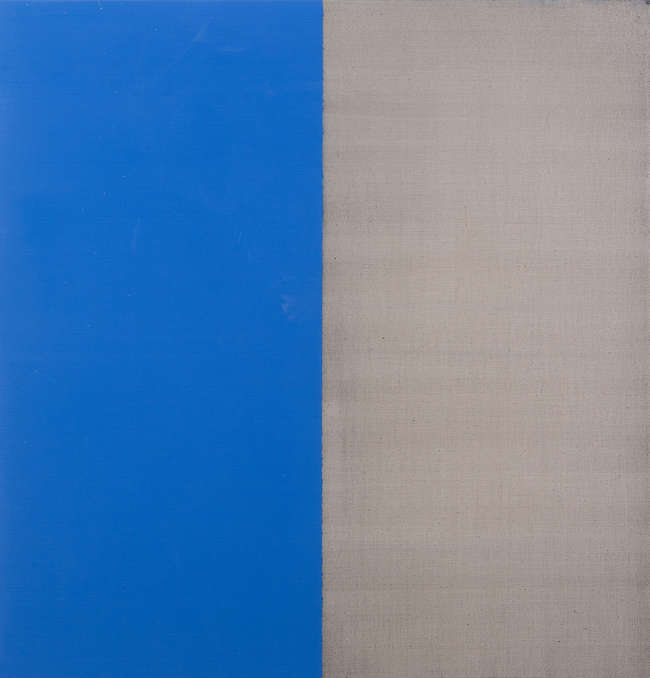
In his Edinburgh studio, Scottish abstract painter Callum Innes, winner of the NatWest Art Prize and the Jerwood Painting Prize, makes paintings that have been exhibited throughout the world, in Britain, Ireland, the US, New Zealand, Iceland, Asia. ‘I have to reinvent myself every morning. I have to approach it every morning in a different way’ says Innes.
Artists are always aware of how the vertical and horizontal feature in a work. Piet Mondrian’s early painting responded to the flat Du
tch landscape and an upright tree; later, in New York, the Manhattan grid influenced Mondrian’s work. Callum Innes turned from figurative to abstract but in Innes’s work the vertical and horizontal, the geometric shapes are never that. If Mondrian and Rothko play a part in Innes’s “abstract ancestry”, Innes, in his work, has found a unique voice and, in the act of painting, a unique process.
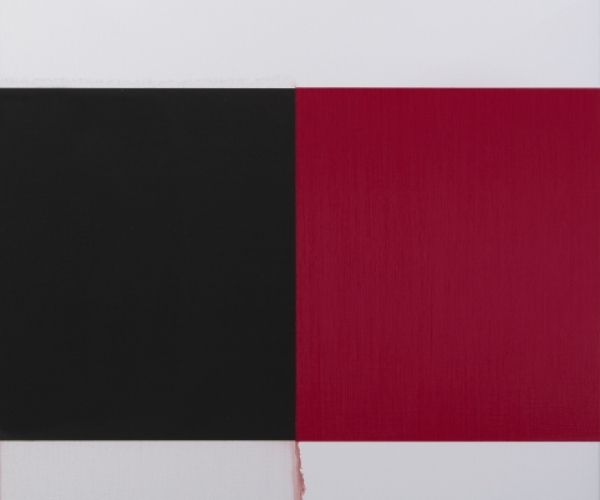
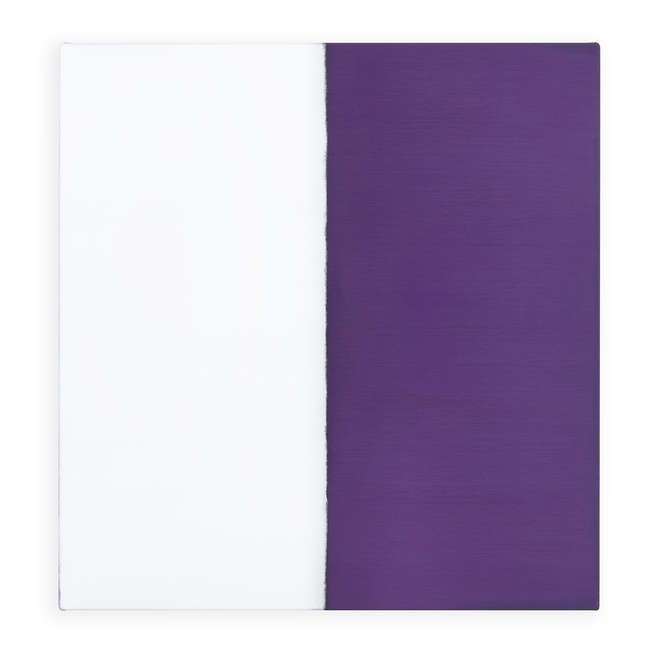
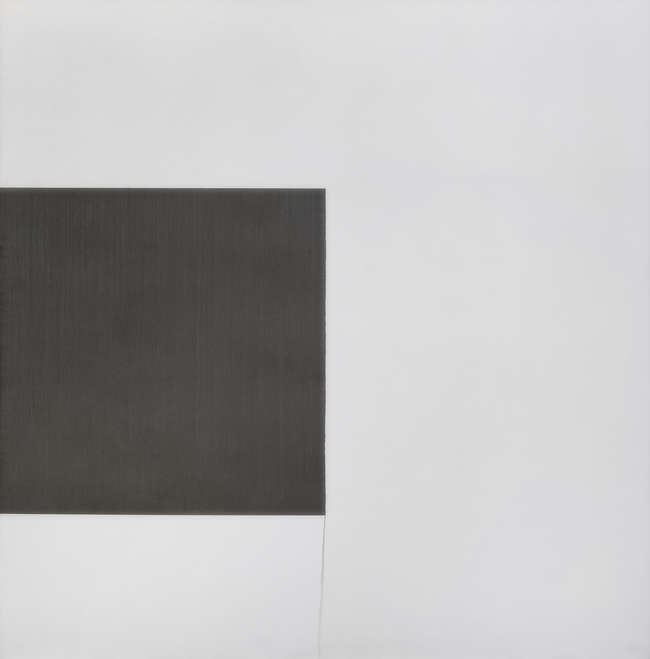
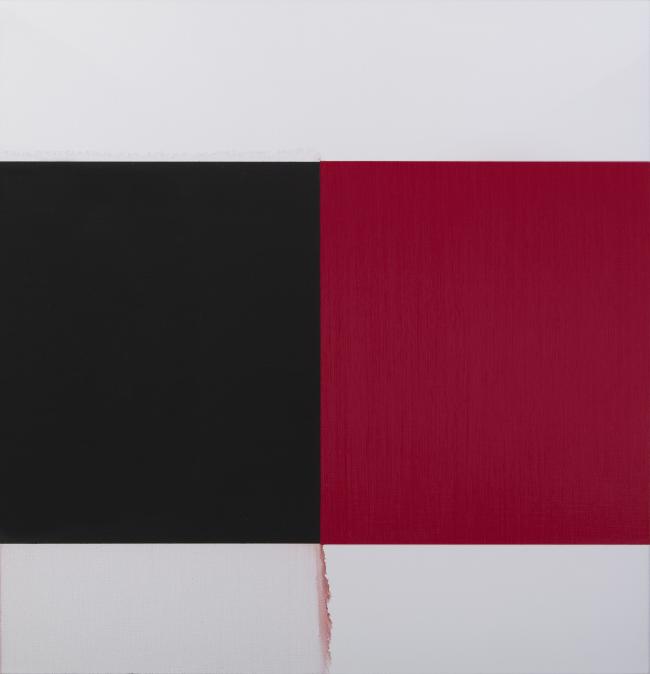
His Exposed Paintings, says Innes, ‘are all about physicality – about applying the paint and removing it’. This painting and unpainting, this making and unmaking is focused, careful work. ‘I work with time more than anything else’ and ‘How it feels, not how it looks’ is what’s important. ‘I can control the process of painting in the same way that I can control the shutter release on a camera. This brings the element of time into the equation as something continuous.’ Exposed Painting Cadmium Red Deep on Black, with its seemingly separate pitch black, pristine white, luxurious, cadmium red, celebrates difference but in its making those striking colours were all in this together. These Exposed Paintings ‘start off as solid black paintings and then essentially we take the black off and then, while they’re still wet, we run colour through them again and then take the colour off’. He takes a line, ‘I dissolve it off, put the colour on again, put the black on it again. The canvas is painted seven or eight times, the colour layer goes on the touch-wet black, wet on wet.’ The red picks up the black. Space is where the white comes and goes.
Turpentine is central to the work. ‘They pretend to be geometric and clean and tidy but are quite chaotic in the way that I make them.’ There is no pouring, no dripping, ‘the release of turpentine the only part I can’t control’.
The result is a work of resonance, depth, and though termed abstract and minimalist, Innes sees them as figurative, not geometric squares, containing fragility, the fragility that we have as humans. For Innes, ‘If it were just white, red, black it would be very mannered, very boring.’
Read more