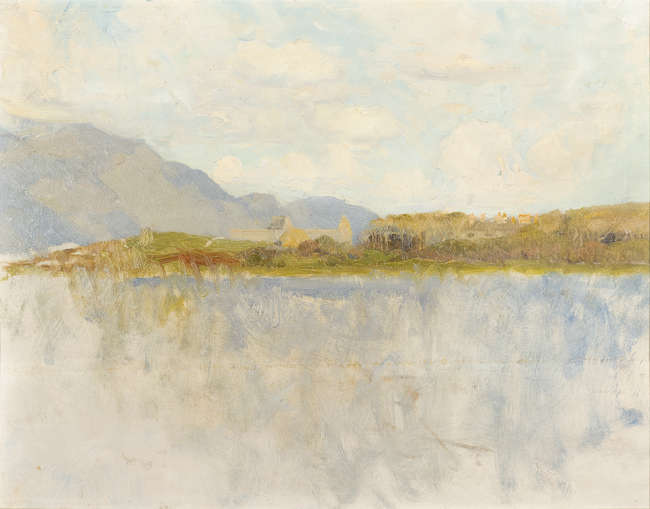
Walter Frederick Osborne was born in Dublin in 1859, the second son of an animal painter William Osborne. His family lived in Castlewood Avenue, Rathmines and he may have spent some time in his father’s studio before attending the Royal Hibernian Academy Schools in Dublin. He also seems to have attended classes in the Metropolitan School of Art. In 1881, he won the Taylor scholarship of £50 which enabled him to study abroad. He arrived in Antwerp in 1881 with fellow Irish painters, Kavanagh a
nd Hill and registered as a pupil in Verlat’s “Natuur” class at the Academie Royale des Beaux Arts. An influential teacher, Verlat was a genre and animal painter and perhaps it was because his father was an animal painter that Osborne felt drawn to Verlat’s class.
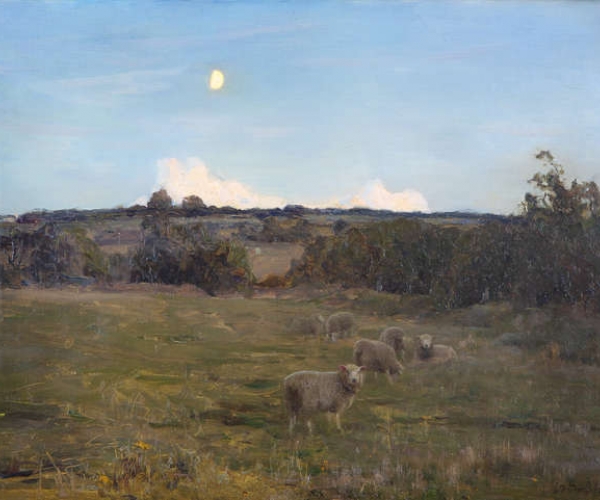
Two years later, Osborne travelled to Brittany where he worked at Pont-Aven, with Dinan and with Blandford Fletcher at Quimperlé. The plein-air style of painting associated with the French artist Jules Bastien-Lepage was pervasive among the younger painters at this time. Osborne left Brittany for England c.1884 and then worked in several small rural communities, painting landscapes and genre scenes: first at Walberswick, where Augustus Burke, his teacher at the RHA Schools, had painted and then at Evesham with Edward Stott and Nathaniel Hill where he developed a more lucid naturalism. During these years, Osborne wavered between precise naturalism and the looser sketch-like handling of Whistler. His subject matter also varied between scenes of rural life and coastal genre. Osborne remained in England until 1892 and associated himself with the painters of the New English Art Club, notably Stott, Fletcher, Brown and Steer.
While abroad he kept in contact with Dublin’s artistic community. He painted Dublin scenes, became a full member of the RHA in 1886 and, in the same year, was one of the founders of the Dublin Art Club. He taught in the Academy Schools, where one of his most important pupils was William J. Leech, from the early 1890s until his death. Osborne’s return to Dublin was prompted by the death of his sister Violet whose newly-born baby was given into the care of Osborne’s aged parents. From this time he cultivated a portrait practice and became very successful; he obtained international recognition when his “Mrs Noel Guinness and her Daughter Margaret” received a bronze medal at the Exposition Universelle in 1900.
Concurrently, Osborne continued to paint garden scenes and interiors with children but by this time the artist’s general manner of painting had begun to change. Influenced by the Impressionists, especially Manet and Degas, in his later work his palette is more adventurous, his brushwork looser, and his approach more painterly. In 1900 he was offered a Knighthood in recognition of his services to art and his distinction as a painter, but he refused. He died of pneumonia in 1903 at the age of forty-three.
Walter Osborne's work featured in Adam's loan exhibition 'The French Connection' (2010). Please click here for a link to the catalogue.
His work was also included in 'Ireland: Her People and Landscape' (2012). Please click here for a link to the catalogue.
Read more